Let me tell you something a little embarrassing. I'm Korean by background — born there, speak the language — and I still got completely stuck at Incheon Airport the last time I flew in from Australia.
I walked up to the airport bus counter, ready to hop on the limousine bus to the city like I'd done a dozen times before. Tapped my Australian credit card. Declined. Tried again. Declined. No cash, no local card, and the next bus leaving in four minutes.
My nephew had to book my ticket online from his phone while I stood there holding up the queue. Not my finest moment.
If this can happen to someone who's Korean, imagine how confusing it is for first-time visitors. This guide is everything I wish someone had told me before that trip — and before every trip, honestly.
Here's the thing about Incheon (인천국제공항): it is genuinely one of the best airports on the planet. It's been voted top of various "world's best airport" lists more times than I can count, and you'll see why the moment you walk through it — it's clean, it's calm, the staff are unfailingly polite, and there's an indoor garden that's nicer than most actual parks I've been to. None of that is the problem. The problem is the gap between landing and actually being on your way into the city, and that gap is where jet-lagged travellers come unstuck. Once you know the handful of things that trip people up, the whole thing becomes easy.
Foreign cards don't always work at Incheon kiosks. Always have a backup plan: pre-book transport online, carry some cash (Korean won), or get a T-money card at the airport. Details below!
What actually happens when you land — the arrival walk-through
Let me set your expectations before we get to the card stuff, because knowing the shape of the next 60 minutes takes a lot of the stress out of it. Incheon has two passenger terminals, Terminal 1 and Terminal 2. Terminal 2 is the newer one and a handful of airlines use it (Korean Air and its partners, mainly); most other carriers land at Terminal 1. Check your boarding pass or booking — it'll say which one. It matters because the two terminals are a free shuttle train ride apart, and you don't want to discover you're at the wrong one while looking for a friend.
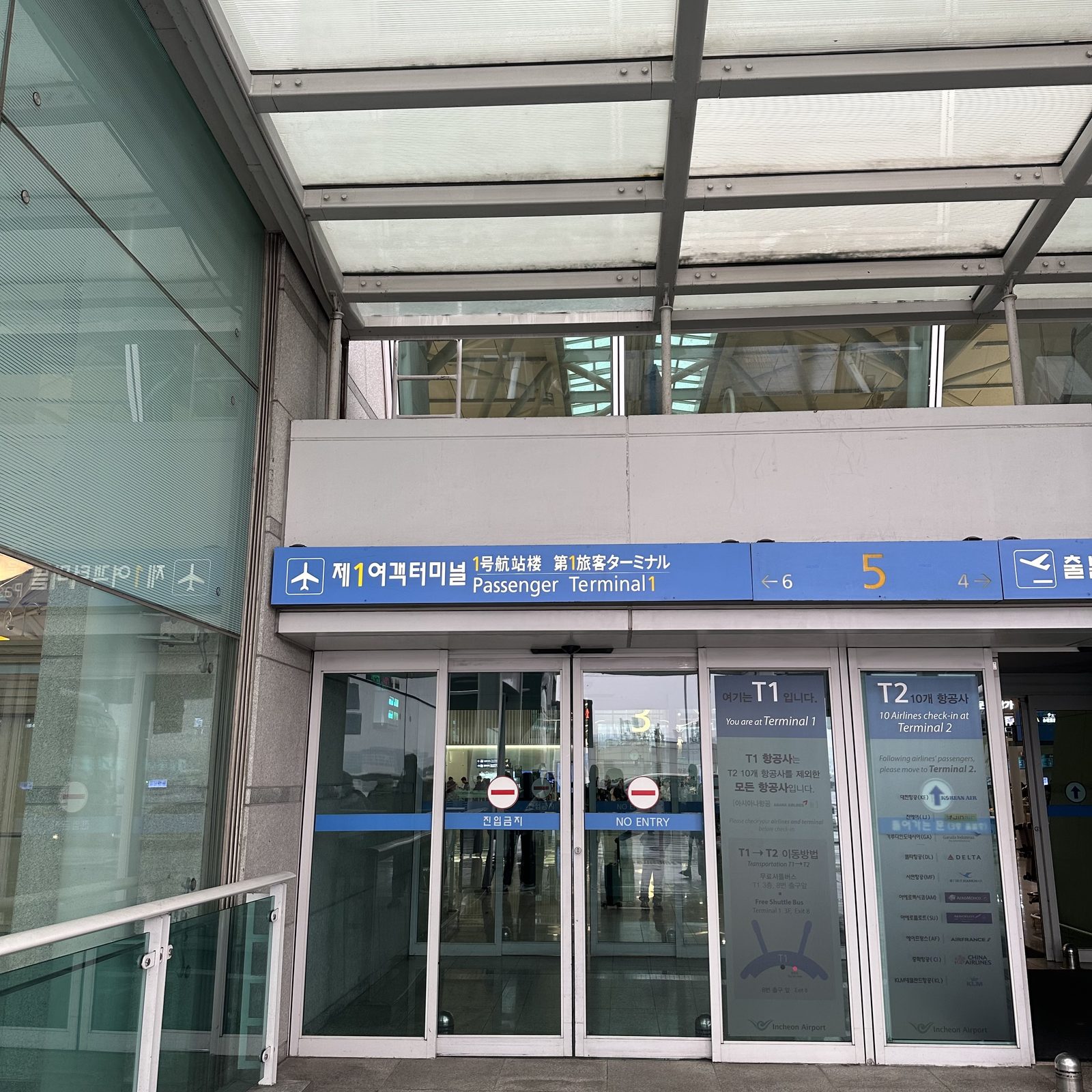
After you step off the plane, the order of events is roughly: follow the signs to immigration, clear immigration, collect your checked bags, pass through customs, and walk out into the arrivals hall. A few notes from doing this many times:
- Have your arrival paperwork ready. Depending on your nationality and the current rules, you may need an electronic travel authorisation (K-ETA) arranged before departure, plus a customs/health declaration. These requirements change, so check the official guidance for your passport before you fly rather than trusting a blog — including this one.
- Immigration queues vary wildly. If you land at the same time as three other long-haul flights, expect a wait. There's nothing to do but be patient. Have your passport and any paperwork in hand, not buried in your bag.
- Note your baggage carousel number on the screens before you wander off — the halls are big and it's easy to drift to the wrong belt.
- The arrivals hall is where everything useful lives — convenience stores, SIM/eSIM counters, currency exchange, ATMs, and the transport desks. This is your staging area. Don't rush out the front doors until you've sorted data, cash, and your ride.
When you reach the arrivals hall, resist the urge to bolt for the nearest taxi. Take five minutes: switch on your data, find an ATM or exchange counter for some won, grab a T-money card, and only then head for your train or bus. Five minutes of setup saves an hour of frustration later.
The card problem nobody warns you about
Korea is a highly cashless society — but paradoxically, foreign credit and debit cards are often rejected at transport kiosks, vending machines, and some smaller shops.
This is especially true for:
- Airport limousine bus ticket machines
- T-money card top-up machines
- Some convenience store self-checkouts
- Older subway ticket machines
It doesn't mean your card is broken. Korean payment systems sometimes just don't accept foreign-issued cards at unmanned terminals. The fix? Pre-book everything online before you land, or carry Korean won in cash.
I want to be fair here, because the situation has improved a lot. Staffed counters — the AREX ticket office, the airline desks, big department stores, most chain restaurants — generally take Visa and Mastercard without any drama. Where you run into trouble is the unmanned stuff: a bus ticket vending machine at 11pm, a self-service top-up kiosk, an old subway machine in a quiet suburb. There's no human there to swipe it the manual way, so if the terminal rejects your foreign card, you're stuck. That's exactly the situation I landed in. The lesson I took from it is simple and I'll repeat it a few times because it's the single most useful habit: never arrive in Korea with zero won and zero pre-booked transport. Carry a little cash as your safety net even if you plan to pay by card for everything.
A couple of practical money notes. ATMs that accept foreign cards exist at the airport — look for ones marked "Global ATM" or showing the Cirrus/Plus/Maestro logos, since not every Korean ATM works with overseas cards. Currency exchange counters are also in the arrivals hall; rates at the airport aren't the best you'll find, so I usually change just enough to cover transport and a first meal, then exchange the rest in the city or simply withdraw from an ATM as I go.
How to get from Incheon to Seoul
Incheon International Airport (ICN) is located about 60km west of central Seoul, out on Yeongjong Island (영종도). That distance is why you can't just stroll out and grab a quick cab to your hotel the way you might at a smaller city airport — you're committing to a proper journey into town, so it's worth picking the right option for your situation. There are four main ways to get to the city, and the best one depends on how much luggage you have, what time you land, and whether you're travelling solo or with a group:
My recommendation: Take the AREX to Seoul Station or book your limousine bus online before you fly. Both are reliable, affordable, and stress-free.
Here's how I actually choose between them. If my hotel is anywhere near a subway line — and in Seoul, almost everything is — I take the AREX, because trains don't sit in traffic and the schedule is predictable. If I'm hauling two big suitcases and the hotel happens to be a stop on a limousine bus route, the bus wins, because it drops me close to the door and I don't have to drag luggage through subway transfers. The express AREX and the all-stop AREX are different services on the same track: the express runs non-stop to Seoul Station and is quicker, while the all-stop makes intermediate stops, costs less, and — handy detail — accepts your T-money card, so you can just tap on like any other train. Both are perfectly comfortable. I've taken the all-stop with a full load of luggage many times and been fine.
The AREX and limousine buses don't run 24 hours — services wind down late at night and start again early morning. If your flight lands very late, your realistic options are a pre-booked private transfer or an official airport taxi. This is the one scenario where I happily pay more for a transfer: arriving exhausted at midnight is not the moment to be wrestling with a closed ticket office. Book it before you fly.
Book your transport before you land
This is the single most important tip in this guide. Book online, get a confirmation on your phone, and you'll never have to worry about card machines at the airport.
Get a T-money card immediately
T-money is Korea's rechargeable transit card — think Opal (Sydney), Myki (Melbourne), or Oyster (London). You tap it on buses, subways, and even taxis. It makes getting around Seoul effortless.
You can buy a T-money card at:
- Incheon Airport arrival hall — convenience stores (CU, GS25, 7-Eleven)
- Any subway station in Korea
- Most convenience stores across the country
Buy your T-money card at the airport arrival hall before you try to catch the AREX train. Top it up with ₩30,000–50,000 to start — that covers a few days of transport in Seoul. Cash works at top-up machines even when foreign cards don't.
One thing that confuses first-timers: there's the card itself, and then there's the credit you load onto it. When you buy a T-money card at a convenience store you pay a small one-off price for the blank card, and it arrives empty. You then "charge" it (that's the word the machines use) by feeding in cash at a top-up machine or by asking the convenience store clerk to add a balance — just point at the card and say a number, it's a transaction they do hundreds of times a day. From then on you tap it on the reader as you enter and, importantly, as you exit, and the fare comes off automatically. Keep an eye on the remaining balance shown on the gate; topping up takes ten seconds and you don't want to be caught short at a barrier.
Whatever's left on the card when you leave Korea doesn't expire, so if you're a repeat visitor like me you can just keep it in a drawer for next time. Worth knowing it works nationwide, not only in Seoul — buses in Busan, the subway, taxis, even some vending machines. It's the single most useful piece of plastic you'll carry.
Get a SIM card or eSIM before you go
Without data, you can't use Google Maps, translate menus, or call anyone. Korea has excellent mobile coverage, but roaming charges from your home carrier can be painful.
The cheapest option: buy a Korean SIM card or eSIM before you fly. You'll usually pay much less than at the airport, and you'll land with data ready to go.
Quick explainer if "eSIM" means nothing to you. A traditional SIM is the little physical chip you slot into your phone — with one of these you usually pick it up at a counter in the arrivals hall and someone helps you install it. An eSIM is the same idea with no physical card: you scan a QR code and a Korean data plan activates on your phone digitally. The catch is your phone has to support eSIM (most newer iPhones and flagship Android phones do; older or budget phones often don't), so check that before you buy. I lean eSIM these days because there's nothing to physically swap and lose, and I can have it ready to switch on the second the plane lands. Either way, do it before you fly — fumbling with a SIM counter while jet-lagged, in a queue, is exactly the kind of small misery this guide exists to spare you.
If you'd rather not deal with SIMs at all, two alternatives: a pocket WiFi device (a little hotspot you rent and carry, good if several people are sharing data) or international roaming from your home carrier (simplest, usually the most expensive). For a short trip, roaming for a day while you sort out a local option isn't the worst plan — just check what your carrier charges first so there's no nasty surprise on the bill.
Quick checklist before you land
| Task | When | Cost |
|---|---|---|
| 📱 Get eSIM or arrange SIM pickup | Before you fly | ~$15–25 |
| 🚌 Pre-book airport bus or transfer | Before you fly | ~$10–40 |
| 💱 Get some Korean won (cash) | Before or at airport | Varies |
| 💳 Buy T-money card at airport | On arrival | ~₩4,000 |
| 📍 Download Naver Maps or Kakao Maps | Before you fly | Free |
Google Maps notoriously underperforms in Korea due to government mapping restrictions. Download Naver Maps or Kakao Maps before you fly — they're far more accurate for Korean addresses, public transport, and walking directions.
A few more airport survival tips
Frequently asked questions
Can I just use my phone to pay for everything in Korea?
Mostly, yes — Korea is very card- and phone-friendly at staffed places. But "mostly" is the operative word. The gaps are unmanned machines and the occasional small shop, and those gaps tend to appear at the worst moments. Carry some won as backup and you'll never be stranded. I learned that one the hard way at a bus counter, remember.
Should I exchange money before I leave home or at the airport?
I bring a small amount of won from home so I'm never at zero on arrival, then top up with an ATM withdrawal or a city exchange once I'm settled. Airport exchange rates aren't the most generous, so I change only what I need at Incheon to cover transport and a meal. Do confirm your home bank's foreign-withdrawal fees before relying on ATMs.
Is it safe to travel from the airport to Seoul late at night?
Korea is generally a very safe country and the airport is well staffed at all hours. The issue late at night isn't safety, it's logistics — trains and buses scale back, so a pre-booked private transfer or an official airport taxi from the marked stand is the calm choice. Avoid anyone approaching you offering a "taxi" inside the hall; always use the official taxi rank.
You've got this
Korea is one of the most visitor-friendly countries in Asia once you know what to expect. The public transport is incredible, the food is amazing, and people are generally very helpful to tourists.
The airport experience can feel overwhelming when you're jet-lagged and everything is in Korean — but with a little preparation, you'll be sipping your first bowl of Korean ramyeon in Seoul before you know it. 🍜
If you found this guide helpful, check out our other Korea travel tips — and don't forget to try our AI Drama Recommender to find the perfect K-drama to watch on the plane!