If there's one thing you absolutely must do the moment you land in Korea, it's get a T-money card. Before you eat, before you find your hotel, before you take a selfie — get the card.
I'm only half joking. Korea's public transport is genuinely world-class, but navigating it without a T-money card is unnecessarily painful. With one? You'll tap your way around Seoul like you've lived there for years. I've watched first-time visitors stand frozen at a subscreen ticket machine, squinting at station names they can't read, holding up a queue of commuters who are far too polite to sigh out loud. The traveller next to them, the one who already has a little plastic card, just taps the gate and walks through. That's the whole difference, and it costs about the price of a coffee to be on the right side of it.
I grew up around this system, and even I still find it slightly magical that one card gets me onto a Seoul subway, a Busan bus, and a taxi in Daegu without me thinking about it once. The card doesn't care which city you're in or which transit company runs the line. You tap, the fare comes off, you go. For a visitor that simplicity is worth a lot, because it removes one of the few genuinely fiddly things about a Korea trip and lets you spend your attention on the actual fun parts.
T-money is Korea's rechargeable transit card — like Opal (Sydney), Oyster (London), or Suica (Tokyo). You tap it on buses, subways, taxis, and even some convenience stores. One card, the whole country.
How T-money actually works (and why it exists)
Here's the bit most guides skip, and it's the bit that makes everything else make sense. T-money is a stored-value card. You load money onto the chip inside it, and every time you tap a reader, it deducts the fare and stores the new balance back onto the card itself. There's no app login, no bank account, no signing up for anything. The card is the wallet. That's why it works the second you get it and why it works even if your phone is dead and your foreign bank app has decided, for no reason it will explain, to block your transactions.
The reason it feels so seamless is that almost every transit operator in the country agreed to accept it. Seoul's subway lines are run by a few different companies, the buses by others again, and yet your single card glides across all of them and even hands you transfer discounts for the privilege. That kind of cooperation is rare. In a lot of cities I've visited, you need a different ticket for the metro than the tram than the regional train. In Korea, the card is the universal language, and once you understand that it's just a little prepaid purse you keep topped up, the rest of this guide is really just logistics.
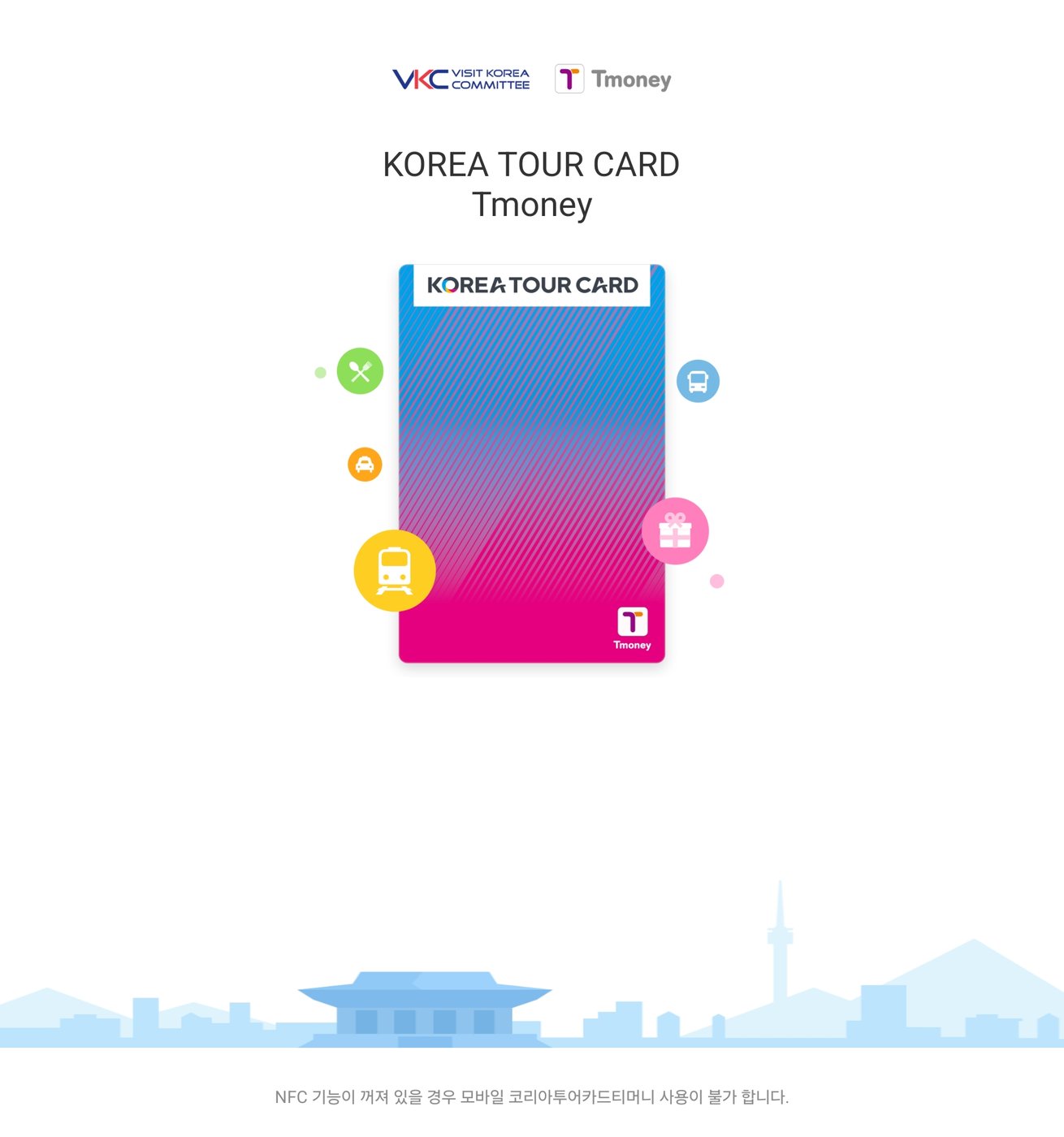
One honest framing before we dive in: T-money is not the only way to pay for transport in Korea, and there are newer options creeping in — some phones can carry a digital transit card, and there are tourist-branded cards that bundle in extras. But the plain physical T-money card remains the most foolproof, most universally accepted, least-likely-to-go-wrong option for a first-time visitor, which is exactly why I keep recommending it over the shinier alternatives.
Where to buy a T-money card
The good news: T-money cards are everywhere in Korea. You don't need to pre-book or plan ahead. They're sold in the kind of places you'll walk past twenty times a day, and the staff have handed one to so many bewildered tourists that you barely need to explain yourself.
If you want the smoothest possible arrival, buy it at the airport the moment you clear customs — that way you're holding the card before you even decide how you're getting into the city. But if you forget, don't stress for a second. There's almost certainly a convenience store within sight of wherever you're standing in Korea, and they all sell T-money. I've genuinely never been more than a few minutes' walk from a place that could sell me one.
Cost: The card itself costs a small fee — usually somewhere in the low single digits in dollars — and that's the price of the blank card, separate from the travel credit you load onto it. Prices nudge around over time and vary a little by where you buy, so treat any exact figure you read online as a ballpark rather than gospel. The important thing to understand is that you're paying a tiny one-off amount for the physical card, and then everything you load on top is your actual transit money.
A quick note on the cards themselves, because it surprises people: T-money comes in dozens of designs. The basic ones at the convenience store counter are plain, but there are character editions, keyring versions, and collaborations with whatever's popular at the time. Functionally they're all identical — a cute cartoon card and a boring grey one deduct the exact same fare — so don't agonise over it. That said, a fun T-money card makes a genuinely nice, cheap, useful souvenir, and I've given them as little gifts more than once.
One thing worth knowing before you tap in for the first time: when you enter and exit, you'll see your remaining balance flash up on the little screen at the gate or the reader on the bus. Get in the habit of glancing at it. It's the easiest way to know when you're running low, and it saves you the small indignity of a gate refusing to open because you're a few hundred won short during rush hour.
Affiliate link — if you book through it, KContentGuide may earn a small commission at no extra cost to you. We only point you to things we'd happily use ourselves.
How to top up (recharge) your T-money card
Topping up is easy — but here's the catch that trips up most foreigners: foreign credit and debit cards often don't work at top-up machines. Always carry some Korean won in cash as backup. This single fact derails more visitors than anything else about the card. They assume that because Korea is so modern and card-friendly everywhere else, the transit machines will obviously take their Visa from home. Many of them don't, and you find this out at the worst possible moment, with a balance of approximately nothing and a train you wanted to be on.
So I'll say it plainly: the reliable way to recharge as a tourist is cash. Keep a few crisp banknotes set aside specifically for this. The machines and convenience-store counters happily take cash every single time, and a single ₩10,000 note refills you for a good while of normal city travel. If you only remember one practical thing from this whole guide, make it this — feed your card cash and you will never get stuck.
Load ₩30,000–50,000 to start. That covers about 15–25 subway rides in Seoul, which is plenty for 2–3 days. You can always top up more at any convenience store.
Where can you use T-money?
| Where | T-money accepted? | Notes |
|---|---|---|
| 🚇 Seoul Metro (subway) | ✅ Yes | Tap on and off. Transfers within 30 min are discounted. |
| 🚌 City buses | ✅ Yes | Tap when boarding and alighting for transfer discounts. |
| 🚕 Taxis | ✅ Yes | Most taxis accept T-money. Look for the logo on the window. |
| 🚆 AREX (Airport Railroad) | ✅ Yes | Works on the All-Stop service. Not on the Express service. |
| 🏪 Convenience stores | ✅ Yes | CU, GS25, 7-Eleven, Emart24 all accept T-money. |
| 🚄 KTX (high-speed train) | ❌ No | KTX requires a separate ticket. Book via Korail or Trip.com. |
The one habit to build is tapping both when you get on and when you get off — especially on buses. Korea charges partly by distance and rewards transfers, so the system needs to see your exit tap to calculate the right fare and to know you're transferring rather than starting a fresh trip. Forget the exit tap and you can lose the transfer discount or get charged a penalty on your next ride. On the subway it's harder to forget, because the exit gate won't open without a tap, but on the bus it's genuinely easy to wander off the back doors without tapping. Make it muscle memory: tap in, tap out, every time.
The convenience-store thing deserves a mention too, because newcomers rarely believe me until they try it. The same card you use for the subway can pay for a bottle of water, a triangle kimbap, or a phone-charging cable at CU, GS25, 7-Eleven, or Emart24. You just tell the cashier you're paying with T-money and tap. It won't replace your real spending money — balances are small and you can't load a fortune onto it — but it's a handy way to burn through your last few thousand won before you fly home rather than carting the leftover balance back across the world.
T-money vs single-journey tickets
You might be tempted to just buy single-journey tickets at the subway machine. Here's why T-money is better:
- Cheaper per ride — T-money gives you a small discount on each journey vs single tickets
- Free transfers — Transfer between subway and bus within 30 minutes for free (or discounted)
- No queuing — Just tap and go. No fumbling for coins or tickets
- Works everywhere — Buses, taxis, convenience stores, subways all in one
If you have leftover balance, you can get a refund at subway station service centres or T-money vending machines. Small amounts (under ₩500) may not be refundable. Alternatively, just spend it at a convenience store before you fly home!
T-money outside Seoul
Great news — T-money works across most of Korea, not just Seoul. You can use it in Busan, Daegu, Incheon, Daejeon, and most other major cities. If you're planning a trip outside Seoul (highly recommended!), your T-money card will work just fine on local buses and subways.
This is the part I wish more visitors trusted, because it changes how you plan. You don't need a new card in each city. The card you bought at Incheon on day one will tap you onto a beachside bus in Busan on day six and a city bus in Gyeongju on day eight without a single extra step. I've handed my own card to nervous friends heading off on a regional trip and told them, honestly, to stop overthinking it — just keep some won on you to top up, and the card handles the rest of the country exactly the way it handled Seoul.
The main exception to keep in your head is the high-speed KTX train, which is a proper reserved-seat intercity service and needs its own ticket — T-money won't cover it. But the local buses and subways at either end of your KTX journey? Tap away. So a typical Korea trip looks like this: T-money for all your day-to-day city hopping everywhere you go, and a separately booked KTX ticket for the big jumps between cities. Two simple systems, and the card half is the one you never have to think about.
A few small tips I'd tell a friend
These are the little things that don't fit neatly into the sections above but genuinely make the card nicer to live with.
- Keep it somewhere quick. A front pocket or the outside slot of your phone case beats the bottom of a backpack. You'll tap dozens of times a day, often in a moving crowd, and fishing for the card while people pile up behind you is the one stress this card was meant to remove.
- Don't stack two transit cards together. If you carry more than one tappable card in the same wallet, the reader can get confused or charge the wrong one. When you tap, present just the T-money.
- Top up before you're empty, not when you're empty. I aim to recharge while I still have a bit of balance, usually whenever I'm already inside a convenience store buying something. It means I'm never the person holding up a gate at rush hour.
- One card can usually cover a small group's individual taps, but it's smoother to have one each. If you're travelling as a family, a card per person saves the awkward shuffle of passing one card back and forth through a gate.
- Hang on to it for next time. The card doesn't expire just because your trip ends. If you think you'll be back, keep it — the leftover balance and the card itself will still be good when you return.
Frequently asked questions
Can I use one T-money card for two people? You can technically tap one card for several people at a single gate or bus reader by tapping multiple times, but it's fiddly and easy to get wrong, and the transfer discounts get muddled. For a smooth trip, I'd just buy a card per traveller — they're cheap, and you each tap your own.
What happens if my balance runs out mid-journey? On the subway, the entry gate simply won't let you in until you top up, and there's almost always a recharge machine right there before the gates. On a bus, if you're short when tapping off, you'll usually be prompted to add cash. The fix is always nearby, but the real fix is to top up before you're scraping the bottom — keep a little buffer on the card.
Should I get a physical card or use a tourist transit pass instead? For most first-time visitors, the plain physical T-money card is the simplest, most reliable choice — it's accepted everywhere and there's nothing to activate or understand. Tourist-branded passes can bundle in extras that suit some itineraries, but they also add rules and expiry dates. Unless you've done the maths on a specific pass for your specific plan, the ordinary card is the safe default I recommend.
You're ready
Buy your T-money card at the airport, load it with ₩30,000–50,000, and you're set. Korea's public transport will take care of the rest — it's genuinely one of the best systems in the world, and with T-money in hand, you'll navigate it effortlessly.
Next up: check out our guide on surviving Incheon Airport and getting to Seoul — or let our AI Drama Recommender find you something to watch on the plane! 🎬