
I got tickets to BTS in Melbourne — and I'm still a little shaken. It was my first time buying concert tickets for a major K-pop act, and I fumbled it badly enough to end up near the very back. But I learned more in two hours than any guide ever taught me, so here's everything I wish a friend had told me first.
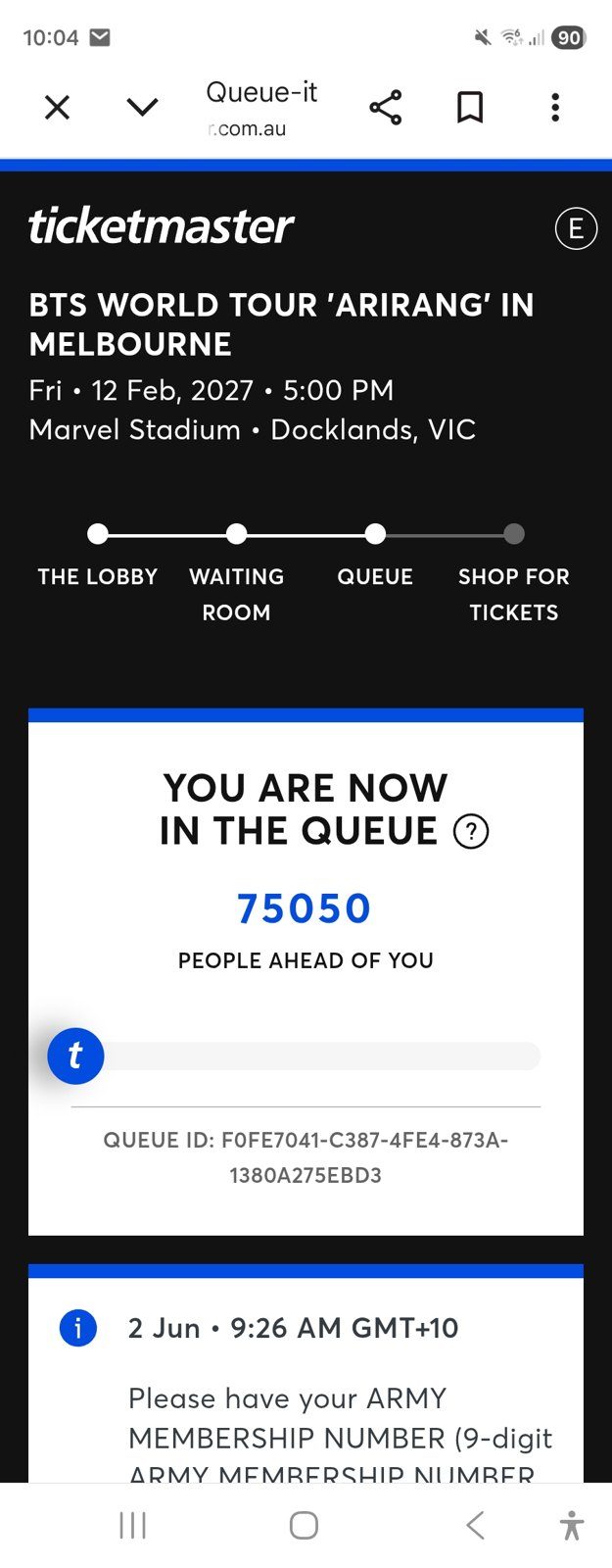
If you're an overseas fan hoping to see a Korean artist live — in your own country or in Korea — this is the guide I needed and didn't have. And I want to be upfront about something: this is not one of those calm, sanitised "step one, step two" pieces written by someone who's never actually sweated through a sale. I'm writing this with the memory still fresh of my heart hammering, two devices open, my niece on the phone, and 75,000 people somehow already ahead of me sixty seconds after the sale opened. The stress is real. But it's a beatable kind of stress, and almost all of beating it comes down to preparation you can do calmly, days ahead, in your pyjamas.
The biggest mistake isn't being slow on sale day. It's showing up without presale access at all — and getting pushed to general sale, where the good seats are already gone. Most of the battle is won before the clock even starts.
How K-pop ticketing actually works (the bit nobody explains)
Before the checklists, it helps to understand the shape of the thing, because once you see the structure, the individual tips stop feeling like random superstitions and start feeling like obvious moves. A major K-pop tour almost never just throws every ticket onto one website at one time and lets the fastest clicker win. Instead, sales happen in waves, and the earlier waves are gated.
The usual order goes something like this. First come the presales, which are reserved for people who've proven they're committed fans — typically through a paid fan-club or membership, sometimes through a separate registration tied to that specific tour. These fans get first crack at the best seats. Only after the presale waves are exhausted does the general sale open to everyone else, and by then a meaningful chunk of the prime inventory is already gone. That's the entire reason "just be fast on the day" is bad advice — if you're in the general-sale wave, speed barely helps, because the people ahead of you in the queue were never racing you in the first place. They had a head start measured in days.
The second thing to understand is the queue. Big sales funnel everyone into a virtual waiting room. When the sale opens, you're given a position — and that position is mostly luck, not reward for clicking early. I clicked one minute after opening and was 75,000-deep. That's normal. The queue then releases people in batches to buy, and your job, when your turn comes, is to not fumble the thirty seconds you're given. So the mental model is: get into an early wave (preparation), survive the queue (patience and luck), then convert when it's your turn (knowing the exact buttons). Everything below maps onto one of those three.
One more honest note: mechanics differ by region, by act, by ticketing company, and they change. The official seller in one country won't be the same as another, fan-club structures vary between agencies, and the rules for a stadium tour can differ from a smaller arena run. I'm deliberately not naming specific resale sites or quoting prices or inventing exact platform steps, because those are precisely the details that go stale or differ for you — and getting them wrong is worse than not having them. What doesn't change is the underlying shape, and that's what I want you to carry in.
Part 1 — Get eligible before sale day
Here's the prep nobody spells out. Sort these days in advance, not on the morning of the sale, because the people with the best seats are the ones who did this homework.
Part 2 — Sale day: the actual battle
You've done the prep. Now it's go time. Here's what actually happened to me, minute by minute — and what I'd do differently.
A seat you have beats a perfect seat you lost. I ended up near the very top — and I bought it instantly, no hesitation, because being in the room is the whole point. At a stadium show, even the back row sings every word. Grab, confirm, breathe.
Quick recap: the overseas fan's cheat sheet
| Step | Do it when? | Why it matters |
|---|---|---|
| Join fan membership | Weeks before | Unlocks presale — the only way to good seats |
| Register on tour site | In the set window | Membership alone won't unlock presale without this |
| Create + verify ticketing account | Days before | Logging in or verifying on the day wastes precious minutes |
| Pick your date & seat tier | Before sale | Multi-date shows split into separate queues; hesitation loses seats |
| Learn the "confirm" action | Before sale | Tap vs. drag vs. hold — getting this wrong cost me the good seats |
| Hand purchase to someone else | Avoid | Verification is tied to one person and adds a failure point |
Fan-club and presale realities nobody warns you about
Let me linger on the membership piece, because it's where the most heartbreak happens — and it's heartbreak that's completely preventable. The instinct of a casual fan is to wait. You tell yourself you'll grab a membership "if a tour gets announced near me." By then it's frequently too late: presale registration windows can close fast, and some fan-club tiers have their own sign-up cut-offs that predate the tour entirely. The fans who reliably get good seats treat membership as something they sort out early, almost as insurance, rather than something they scramble for once a date drops.
A membership also isn't a magic wand on its own, and this catches people every single tour. As I learned, you often need to complete a separate tour-specific registration — a distinct step, in a distinct window, on the official tour page — to actually unlock your presale code or eligibility. People assume "I'm a paid member, I'm in," skip the registration, and find themselves shut out of the wave they paid for. If you take nothing else from this section: when a tour is announced, hunt down the official registration requirements immediately and read them twice. The quiet steps are the ones that disqualify you.
And temper your expectations about what presale guarantees. It gets you into an earlier wave, not to the front of an empty room. There can still be tens of thousands of equally eligible fans in that wave with you. Presale dramatically improves your odds; it does not hand you a front-row seat. Going in understanding that keeps you calm when the queue number is still enormous — that's expected, not a sign you did something wrong.
Avoiding scams and resale heartbreak
This is the section I most want you to read, because the stakes are real money and real disappointment. When the official sale sells out, desperate fans go looking for tickets elsewhere, and that desperation is exactly what scammers feed on. I won't name specific sites or platforms — partly because they change, and partly because the safest mindset isn't "use site X," it's a set of habits that protect you wherever you are.
- Treat private sellers on social media with deep suspicion. The classic scam is a stranger in a fan group or comment section offering a "spare" ticket at a tempting price, asking you to pay by a method with no buyer protection, and then vanishing. If someone you don't know wants payment by an irreversible method for a ticket they swear is real, assume it isn't.
- Be wary of prices that are too good, and prices that are absurd. A scammer's bait is often a price that's just low enough to feel like a lucky break. On the flip side, wildly inflated resale prices are their own kind of trap — getting into a bidding panic is how people overspend on something that may not even be transferable.
- Understand that many modern tickets are tied to an identity or a specific account, which can make casual resale genuinely difficult or impossible, and is part of why "I have a spare, just pay me" offers are so often fake. If a ticket can't actually be transferred to you cleanly, the money you send is simply gone.
- If you must look at resale, stick to official, sanctioned channels only. Some tours run their own verified resale or face-value exchange when plans change. That's a different universe from a stranger's DM. If an artist or promoter offers an official way to resell, that's the only resale I'd personally trust.
- Never let urgency override your judgement. Scammers manufacture panic — "someone else is about to take it, send now." Real, legitimate transactions don't require you to abandon every safety instinct in thirty seconds. The pressure itself is a warning sign.
If you don't get a ticket through official channels, it is genuinely okay to let it go this time. I know that's not what you want to hear. But a chunk of fans lose money to scams precisely because missing the show feels unbearable in the moment. There will be other tours, other cities, livestreams, and cinema events. None of that is worth getting defrauded over.
Going to a Korean artist's show? Make it a trip
Here's the thing about being a fan — sooner or later you don't just want to watch from home, you want to be there. Maybe that's your local stadium. But more and more, overseas fans fly to Korea for concerts, festivals, and fan events — and then stay to walk the streets, eat the food, and stand where their favourite drama scenes were filmed. Fly in for the show, stay for the country.
If a Korea trip is even a maybe, two things make the whole experience smoother — sort them before you fly:
Some links above are affiliate links. If you book through them, KContentGuide may earn a small commission at no extra cost to you — we only point you to things we'd genuinely use ourselves.
💌 Get this kind of thing weekly
I send a free newsletter called Seoul Mate — a real Korean fan's weekly pick of what to watch, read, and actually go see, plus honest fan-travel tips like this one. No spam, and you can leave anytime. Drop your email below and come along:
Frequently asked questions
Do I really need a paid fan-club membership, or can I just try general sale? You can absolutely try general sale, and plenty of fans get in that way — but understand the trade-off. Without presale access you're entering after the earlier waves have already claimed a lot of the best inventory, so you're competing for what's left. If seeing a specific tour matters a lot to you, a membership and the tour registration that goes with it dramatically improve your odds. If you're relaxed about exactly which seat or even which show, general sale is a perfectly reasonable gamble.
Is it cheaper or easier to buy tickets in Korea than in my own country? Not necessarily, and don't assume so. Domestic Korean sales have their own platforms, their own verification quirks, and sometimes requirements that are awkward for overseas fans. For many international fans, catching the tour when it comes to a city near them is genuinely simpler than navigating a sale built for locals. If you do want to see a show in Korea, treat it as its own research project rather than assuming it'll be easier.
What do I do if I miss out completely? Breathe, and resist the panic-buying instinct that leads straight to scammers. Watch for officially sanctioned resale or exchange if the artist offers it, keep an eye out for additional dates being added to popular tours, and remember that livestreams and cinema screening events let you share the moment without a plane ticket or a ticket war. Missing one sale is not the end — it's an extremely common part of being a fan.
You've got this
Concert ticketing is genuinely stressful, and a chunk of it is luck. But the fans who land the good seats almost always did the boring prep — membership, registration, account, and a clear plan for the first 60 seconds of the sale. Do that, decide your "I'll take it" seat in advance, and you'll do far better than I did on my first try.
And if your fandom is turning into a full-blown Korea trip, we've got you: start with surviving Incheon Airport, sort your T-money transit card, and read up on the Hallyu wave that started it all. See you in the crowd. 🎤