I have a soft spot for Sokcho (속초). I first went on a high-school class trip — the kind where you're more interested in your friends than the scenery — and then kept coming back for weekends all through my twenties, when I actually started looking up at the mountains. It's that kind of place. Sitting on the East Sea coast in Gangwon province, right where the granite spires of Seoraksan tumble down toward the ocean, Sokcho is where Koreans go when they want peaks and a beach in the same trip, without choosing.
What I love about it is the strange, happy contradiction of the place. One minute you're craning your neck at a 1,700-metre mountain ridge; an hour later you're eating sweet-crispy fried chicken with sand between your toes. There's North-Korean-refugee comfort food you can't find anywhere else in the country, a hand-pulled ferry that's been quietly carrying people across the same little channel for generations, and sunrises over the East Sea that make the early alarm worth it. For a city this small, it punches absurdly above its weight.
It's also dotted with quiet K-content moments — the most famous being a certain ferry crossing from a classic early-2000s drama that older Korean fans will recognise instantly. I've put together everything below the way I'd actually explain it to a friend flying in: the headline sights, the food that matters, when to come, and how to string it all into a comfortable couple of days. Here's how to spend your time.
Why Sokcho is worth the trip
Most first-time visitors to Korea never leave the Seoul–Busan corridor, and I get it — the KTX makes those cities effortless, and Sokcho still has no train line of its own. But that's exactly why I keep sending people here. The mild inconvenience of a bus ride filters out the crowds, and what you get in exchange is one of the few places in Korea where serious mountains, an honest working harbour, and a proper beach all sit within twenty minutes of each other.
The other thing is the food culture, which is genuinely distinct. After the Korean War, refugees from the Hamgyong region of the north settled here and never made it home. They brought their cooking with them — heartier, more northern, built around sausage and squid — and it became Sokcho's signature. Eating abai sundae in Abai Village isn't a tourist gimmick; it's a living piece of twentieth-century Korean history you can taste. That layering of mountains, sea, and a slightly bittersweet local story is what gives Sokcho more soul than its size suggests.
Sokcho's headline act, and one of the most spectacular places in the whole country. Seoraksan National Park is famous for its jagged granite peaks, the towering Ulsanbawi (울산바위) rock ridge, the temple of Sinheungsa (신흥사) with its great bronze Buddha, and a cable car that lifts you toward the Gwongeumseong (권금성) fortress viewpoint without a full climb. In October the slopes catch fire with Korea's earliest and most famous autumn foliage — the country's foliage season actually begins up here in the northeast and rolls south over the following weeks.
You don't need to be a hiker to enjoy it. From the Seorak-dong entrance, a gentle paved path leads past Sinheungsa and the giant seated Buddha to the Biseondae and Ulsanbawi trailheads, so even a relaxed stroll rewards you. The Ulsanbawi climb is the famous one — a serious haul of metal staircases bolted to a sheer granite wall, and the views from the top are unforgettable, but it's genuinely tiring and not for everyone. If your legs (or your kids) aren't up for it, the cable car to Gwongeumseong gets you a big sweeping view of the ridgeline for a fraction of the effort. My honest advice: pick one — a proper hike or the cable car plus a wander — rather than trying to cram both into a rushed day.
Local buses run from Sokcho to the Seorak-dong entrance. Not a hiker? The cable car gives you big views for little effort. Autumn weekends are gorgeous but genuinely packed — arrive early, ideally before mid-morning, or the cable car queue and the trails both turn into slow-moving crowds. Bring layers; it's noticeably cooler up high than down in town.
A village with a moving history: it was settled by refugees from the Hamgyong region of North Korea who fled south during the war and never made it home. They brought their food with them, so this is the place to try abai sundae (아바이순대) and ojingeo sundae (squid stuffed with the same filling) — hearty northern sausages you won't find done quite like this anywhere else. You reach it on the gaetbae (갯배), a flat wooden ferry pulled across the narrow channel by hand. Passengers grab a long hook and haul the boat along a cable themselves, and it's genuinely half the fun.
For older Korean viewers, the gaetbae is pure nostalgia: it featured in the classic early-2000s drama Autumn in My Heart (가을동화), one of the dramas that helped kick off the whole Korean Wave abroad. Even if you've never seen it, crossing that little channel hand-over-hand, with the fishing boats bobbing around you, is a lovely few minutes. Once across, the village itself is small and a bit weathered — don't expect polish — but the sundae restaurants are the real reason to come. I'd sit down for a proper plate rather than grabbing it to go.
The gaetbae costs a small cash fare each way and runs frequently through the day. Eat abai sundae right in the village — it's the whole point. If sundae isn't your thing, the squid version and the seafood restaurants nearby give you easy alternatives.
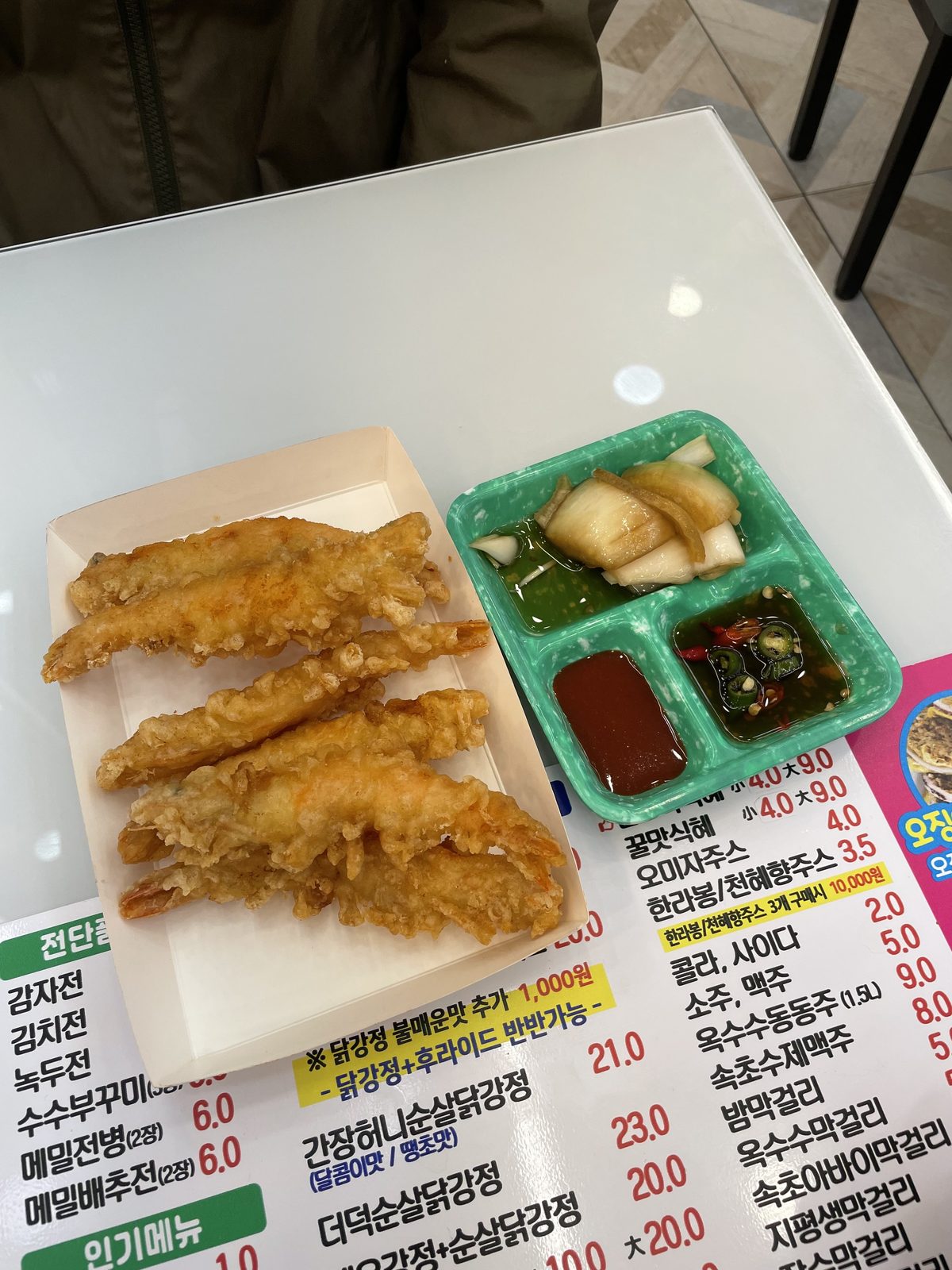
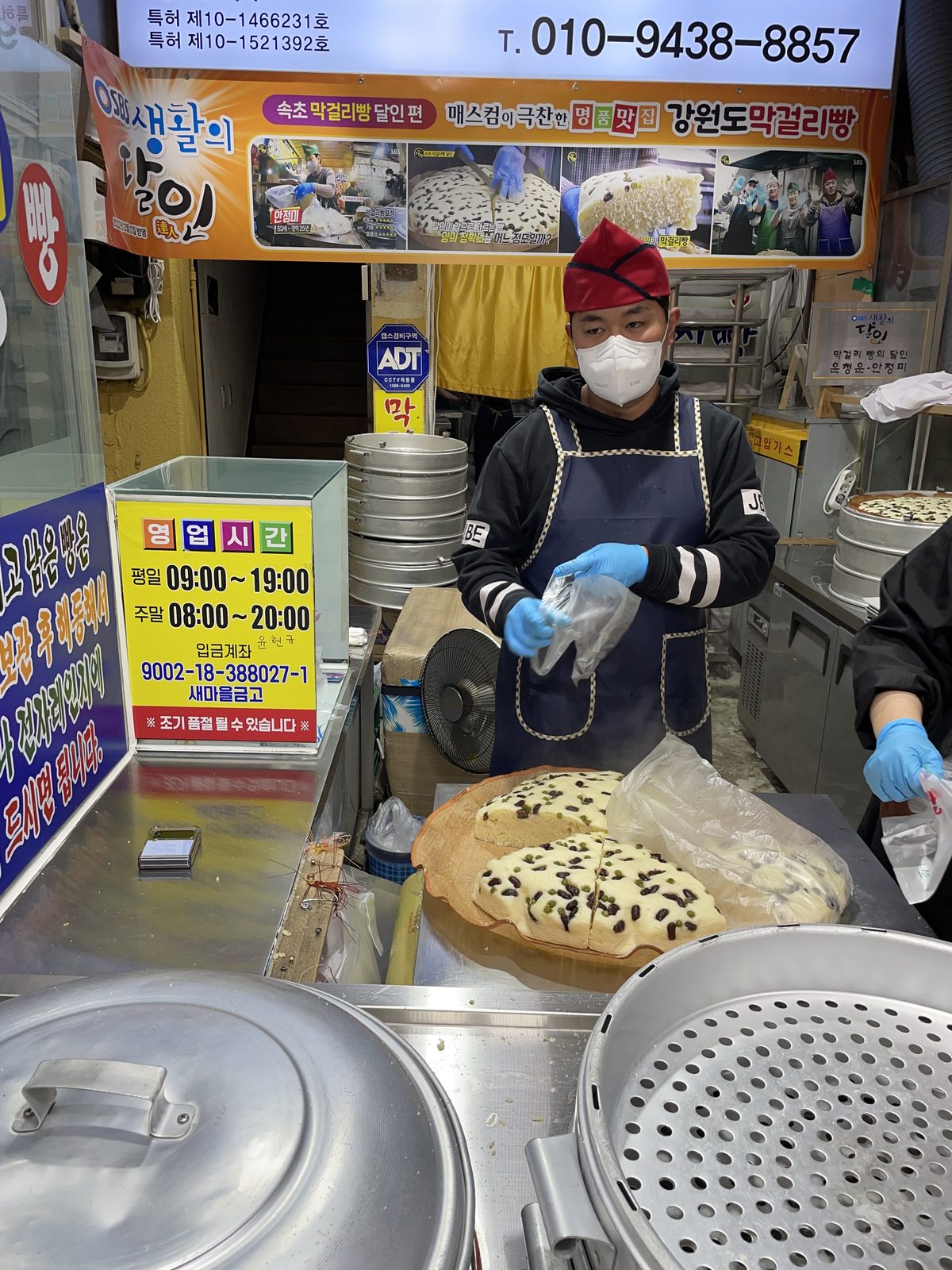
Sokcho's buzzing central market is a feast. Its signature is the city's own style of dakgangjeong (닭강정) — sweet, crunchy, double-fried chicken tossed in a sticky glaze — which draws genuinely long queues at the best-known stalls. Around it you'll find fresh seafood, hotteok, fishcakes (eomuk), stuffed squid, dried fish, and every kind of snack you could want. It's the easiest and happiest meal in town, and the kind of place where you should plan to graze rather than sit down for one big dish.
A small tip from experience: the famous dakgangjeong stalls sell it by the box, and a box is a lot. If there are two of you, one box plus a few other market snacks is plenty. The chicken travels well and stays crunchy for a surprisingly long time, so it's the perfect thing to carry down to the beach or onto the bus. The market is also covered and lively in any weather, which makes it a reliable plan B if the mountains are socked in with cloud.
Come hungry, and grab a box of dakgangjeong to take to the beach. Expect a wait at the most famous stall, especially on weekends — the queue moves, so don't be put off. Most stalls take cards now, but a little cash never hurts at a Korean market.
Join Seoul Mate free and I'll send you "Where to Start" — the 10 K-dramas I recommend to every beginner — plus a weekly pick. No spam, leave anytime.
For the sea side of Sokcho, head to Yeonggeumjeong (영금정), a little pavilion set on rocky outcrops where the waves crash right below — a long-time favourite sunrise spot for locals. There's a short walkway out over the rocks, and on a windy morning the spray and the sound of the sea are the whole experience. Nearby, Sokcho Beach gives you a wide sandy stretch, and the Expo waterfront has its tall observation tower and a breezy promenade. It's the perfect calm counterpoint to a day spent climbing.
Because Sokcho faces east, sunrise here is the main event rather than sunset — something to plan around if you're the type who loves a good dawn. Even outside sunrise hours, the stretch of coast from Yeonggeumjeong down to the beach is a pleasant, flat walk, with the lighthouse, cafés, and that big East-Sea horizon. I like doing the mountains in the morning when the air is clearest and saving the coast for a slower late afternoon.
Come at dawn for sunrise over the East Sea, then walk the waterfront promenade. The rocks at Yeonggeumjeong can be slippery with sea spray, so wear something with grip.
Just south of Sokcho, Naksansa (낙산사) is a serene seaside temple with a great white Gwaneum (관음, Goddess of Mercy) statue gazing out over the East Sea — one of the loveliest temple-and-ocean views in Korea. The temple was badly damaged by a wildfire some years back and has been carefully rebuilt, so much of what you see is restored, but the setting on the bluff above the water is timeless. The Uisangdae pavilion perched right on the cliff edge is the spot everyone photographs. Pair it with Daepohang (대포항), a working fishing port near Sokcho where you pick fresh raw fish (hoe) or grab a paper cone of crispy fried seafood to eat by the water.
Short bus or taxi from Sokcho. A sea-view temple plus a seafood lunch makes an easy, satisfying half-day. Naksansa technically sits in neighbouring Yangyang county, but it's close and well worth the short hop.
Sokcho actually has two lovely lagoons right in town — Yeongnangho (영랑호) and Cheongchoho (청초호) — calm sheets of water ringed by walking and cycling paths, with the jagged Seoraksan ridge reflected behind them on a clear day. Yeongnangho is the prettier of the two for a stroll: flat, quiet, and a complete change of pace from the mountains and the market. It's the kind of place locals walk in the evening, and a recently added lakeside skywalk lets you stroll out over the water.
Great for a gentle morning or after-dinner walk, and an easy add-on if you have a spare hour. No entry fuss — just the lakeside path.
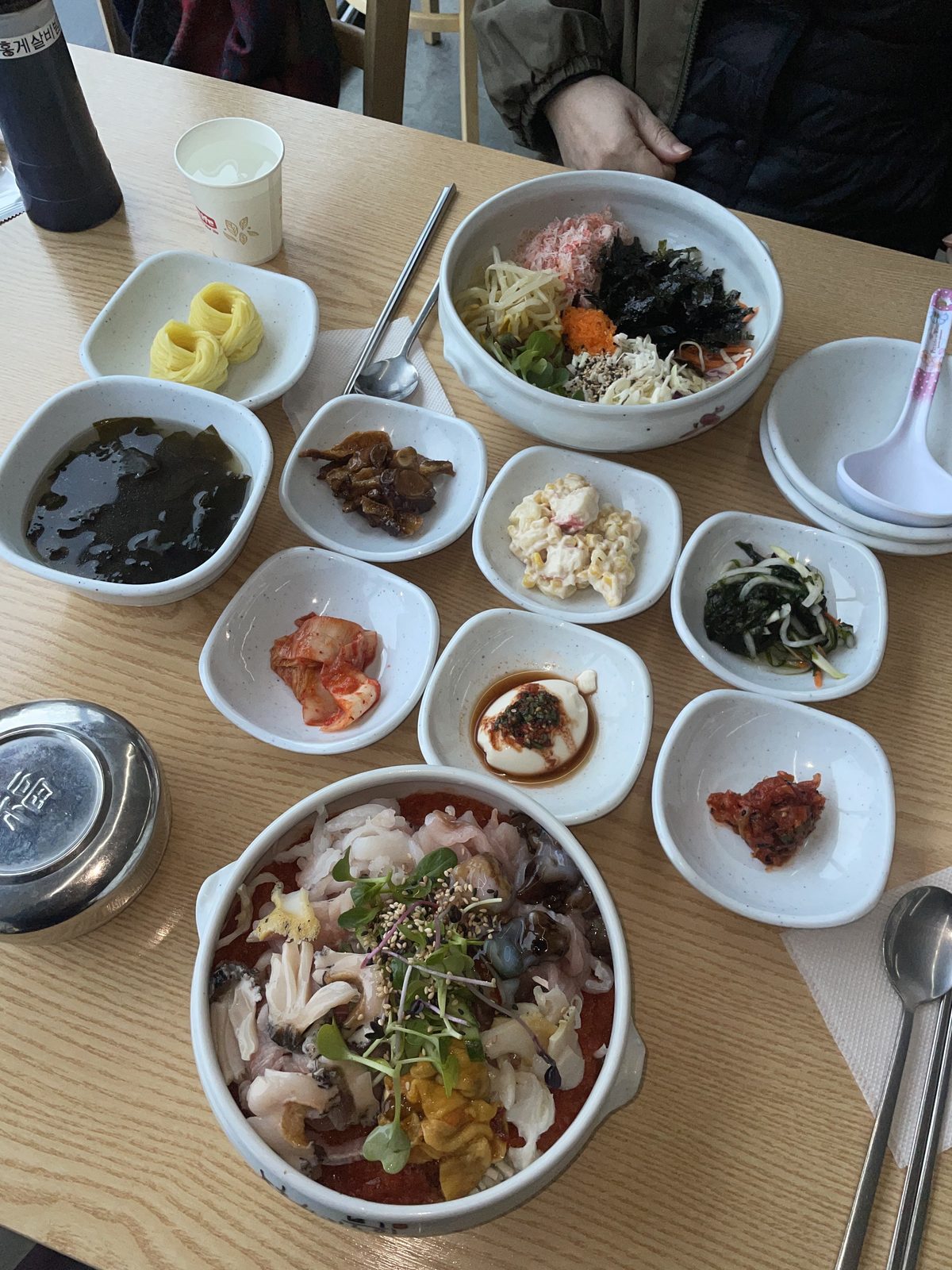
Beyond the famous fried chicken, Sokcho is a serious seafood town, and it's worth building one real seafood meal into your trip. The East-Sea specialties to look for are mulhoe (물회), a cold, tangy raw-fish soup that's incredibly refreshing on a hot day, and straightforward hoe (회, sliced raw fish) eaten at the harbour while it's about as fresh as it gets. Daepohang and the area around the Tourist & Fishery Market are the obvious places to find it.
Prices for raw fish vary with the day's catch and season, so it's normal to ask before you commit. If raw seafood isn't your thing, grilled fish and seafood stews are everywhere too.
Best time to visit
If you can choose your dates, come in autumn — late October is the classic window, when Seoraksan turns and the foliage here is the earliest and arguably the finest in the country. The trade-off is that everyone else knows this too, so weekends in peak foliage season are busy on the trails, on the cable car, and on the buses from Seoul. If you can swing a weekday, do.
Spring (April–May) is gentler and very pretty, with mild hiking weather and far fewer people. Summer is beach season: the East-Sea water is bracingly cool, the town fills with Korean holidaymakers, and accommodation prices climb — book ahead if you come in late July or August. Winter is quiet and can be genuinely cold and snowy up in the mountains, which makes for dramatic scenery but trickier hiking; it's also when the rare cranes and migratory birds are around the wider region. There's no truly bad time, but each season is a different trip.
How many days you need
Sokcho works as anything from a long day trip to a relaxed three-day base, and the right answer depends on how much you want to hike.
- One day: doable but rushed. Realistically you'd pick the cable car or a short Seoraksan walk, then squeeze in the market and a quick look at the coast. Fine if Sokcho is a stop on a bigger loop.
- Two days: my sweet spot. Day one for Seoraksan (hike or cable car), day two for Abai Village, the market, the coast, and the lakes. Comfortable without feeling lazy.
- Three days: ideal if you want a real mountain hike and a slow beach-and-temple day, with a half-day out to Naksansa or down the coast toward Gangneung.
Getting around
You don't need a car in Sokcho, though one makes the coast easier to roam. Local buses connect the express bus terminal, the Tourist & Fishery Market, Abai Village, the beaches and the Seorak-dong park entrance — the buses out to Seoraksan are the ones you'll use most, and they run regularly. Taxis are easy to flag and cheap for short hops in town, which is the simplest way to reach the gaetbae or the lakes if you don't want to wait for a bus.
For the buses, make sure you're carrying a T-money card — it works on Sokcho's local buses just like it does in Seoul, and saves you fumbling for cash. If you're planning to visit Naksansa or hop down to Gangneung, a rental car turns a fiddly bus connection into an easy half-hour drive, but it's by no means essential.
What to eat here
Sokcho is one of those places where the food is half the reason to go. Here's what I'd make sure to try:
- Dakgangjeong (닭강정) — the city's famous sweet-crispy fried chicken, sold by the box at the central market. Non-negotiable.
- Abai sundae (아바이순대) — the hearty northern blood sausage that came south with refugees, best eaten in Abai Village. The squid-stuffed version (ojingeo sundae) is milder if you're unsure.
- Mulhoe (물회) — a cold, tangy raw-fish soup that's a perfect summer lunch on the coast.
- Fresh hoe and grilled fish at Daepohang or near the market, straight off the East-Sea boats.
- Saewu-twigim and seafood snacks — cones of crispy fried shrimp and squid by the harbour are an easy, happy street snack.
A sample two-day plan
This is roughly how I'd lay out a relaxed weekend, weather permitting:
- Day 1 — Mountains. Catch an early bus to the Seorak-dong entrance. Walk in past Sinheungsa and the great Buddha, then either tackle Ulsanbawi if you're feeling strong or take the cable car up to Gwongeumseong for the views. Bus back to town, late lunch at the Tourist & Fishery Market (and a box of dakgangjeong for later). Evening stroll around Yeongnangho lake.
- Day 2 — Sea & the village. Up early for sunrise at Yeonggeumjeong, then breakfast on the coast. Mid-morning, ride the gaetbae across to Abai Village and have abai sundae for an early lunch. Afternoon down at Daepohang for fresh seafood, or a half-day out to Naksansa for the cliff-top temple view before you head off.
How to get there & get around
Sokcho doesn't have a train line yet, so the easiest way from Seoul is the express or intercity bus — about 2 to 2.5 hours from the Seoul Express Bus Terminal or Dong Seoul Bus Terminal, running very frequently. Once you arrive, local buses and taxis link the market, Abai Village, the beaches and the Seoraksan entrance, so you won't need a car (though one makes the coast easy to roam).
Planning a wider Korea trip around it? Here's a handy starting point for tours and tickets:
Affiliate link — if you book through it, KContentGuide may earn a small commission at no extra cost to you. We only point you to things we'd happily use ourselves.
Frequently asked questions
Is Sokcho worth visiting if I'm not a hiker?
Absolutely. The hiking gets the headlines, but plenty of Sokcho's best bits need no climbing at all — the Seoraksan cable car does the heavy lifting for the big view, and the market, the gaetbae to Abai Village, the beaches, Yeonggeumjeong and the lakes are all easy and flat. I'd happily send someone here who never planned to lace up a boot.
How do I get to Sokcho from Seoul without a train?
By bus, and it's simpler than it sounds. Frequent express and intercity buses run from the Seoul Express Bus Terminal and Dong Seoul Bus Terminal straight to Sokcho in roughly 2 to 2.5 hours. There's no KTX line to Sokcho, so the bus is the standard way Koreans get there — comfortable, cheap, and direct.
When is Seoraksan's autumn foliage at its peak?
Usually around mid-to-late October — Seoraksan is one of the first places in Korea to turn each year, so the colour starts up here in the northeast before rolling south. Exact peak shifts a little year to year with the weather, so check current foliage forecasts close to your dates, and expect weekends in season to be busy.
The bottom line
Sokcho is mountains, sea and comfort food in one easy package — climb (or cable-car) Seoraksan, ride the hand-pulled ferry to Abai Village, queue for dakgangjeong, and catch a sunrise on the rocks. It's at its absolute best in October for the foliage, but it's a lovely escape any time of year.
Heading down the coast too? See our Gangneung travel guide — Sokcho's laid-back neighbour to the south.
Planning more? See my guide to Korea's best small cities and grab a T-money card for the buses.