Korean BBQ is one of the greatest dining experiences on earth. Sizzling meat, warm side dishes, good company, cold drinks — it's not just a meal, it's an event. Done right, it's unforgettable.
Done wrong, you end up with sesame oil on your chin and a table of Korean people trying very hard not to stare.
I've watched countless foreigners navigate a Korean BBQ restaurant and make the same mistakes. This guide is so you don't have to. Consider it a gift from your Korean friend.
Here's the thing I most want you to understand before we start: Korean BBQ is not really about the meat. I know, I know — the meat is wonderful. But if it were only about grilling protein, you could do it anywhere. What makes it Korean BBQ is everything around the meat — the dozen little dishes, the leaves and pastes, the cutting and wrapping, the pouring of drinks for each other, the slow back-and-forth of a meal that goes on for two hours. It's a system. Once you understand the system, you stop being a tourist poking at unfamiliar plates and start eating the way the meal was designed to be eaten. That's the whole goal of this guide.
A little context before you sit down
Grilling meat at the table isn't some ancient ceremony — the version most people picture, with the round tabletop grill and endless banchan, is mostly a postwar, twentieth-century thing, and samgyeopsal (삼겹살) in particular only became the national obsession it is now in the last few decades. That surprises people. It feels timeless because it's so woven into how Koreans socialise, but it's really comfort food and a social ritual rolled together, not a museum piece. I find that helps foreigners relax: you are not going to offend anyone's ancestors by holding the scissors wrong. You'll just look like you've never done this before, which is fine, because you haven't.
The other bit of context worth having: in Korea, going for BBQ is rarely a solo, eat-and-leave affair. It's what you do after work with colleagues, with friends on a Friday, with family on a Sunday. The meal carries a social weight. People pour drinks for each other, share from the same grill, and talk. So if you go with Korean friends, follow their lead and don't be in a hurry — the leisureliness is the experience. If you go as a couple or a pair, that's completely normal too; you'll just order a little less. One honest warning, though: many of the cheaper, classic samgyeopsal places have a two-portion minimum per person and don't love single diners, so eating Korean BBQ properly really is a thing best done with at least one other person.
Korean BBQ (고기구이, gogi-gui) means grilling meat — usually pork or beef — at a built-in grill at your table. The most popular cut is samgyeopsal (삼겹살) — thick slices of pork belly. You grill it yourself, cut it into pieces, and eat it wrapped in lettuce or perilla leaves with various accompaniments. It's interactive, communal, and absolutely delicious.
Step 1: Understand what's on the table
Before the meat even arrives, your table will already be covered in small dishes. These are banchan (반찬) — Korean side dishes that come free with your meal and are refilled as many times as you want.
Don't ignore them. They're not decoration. They're integral to how the meal works.
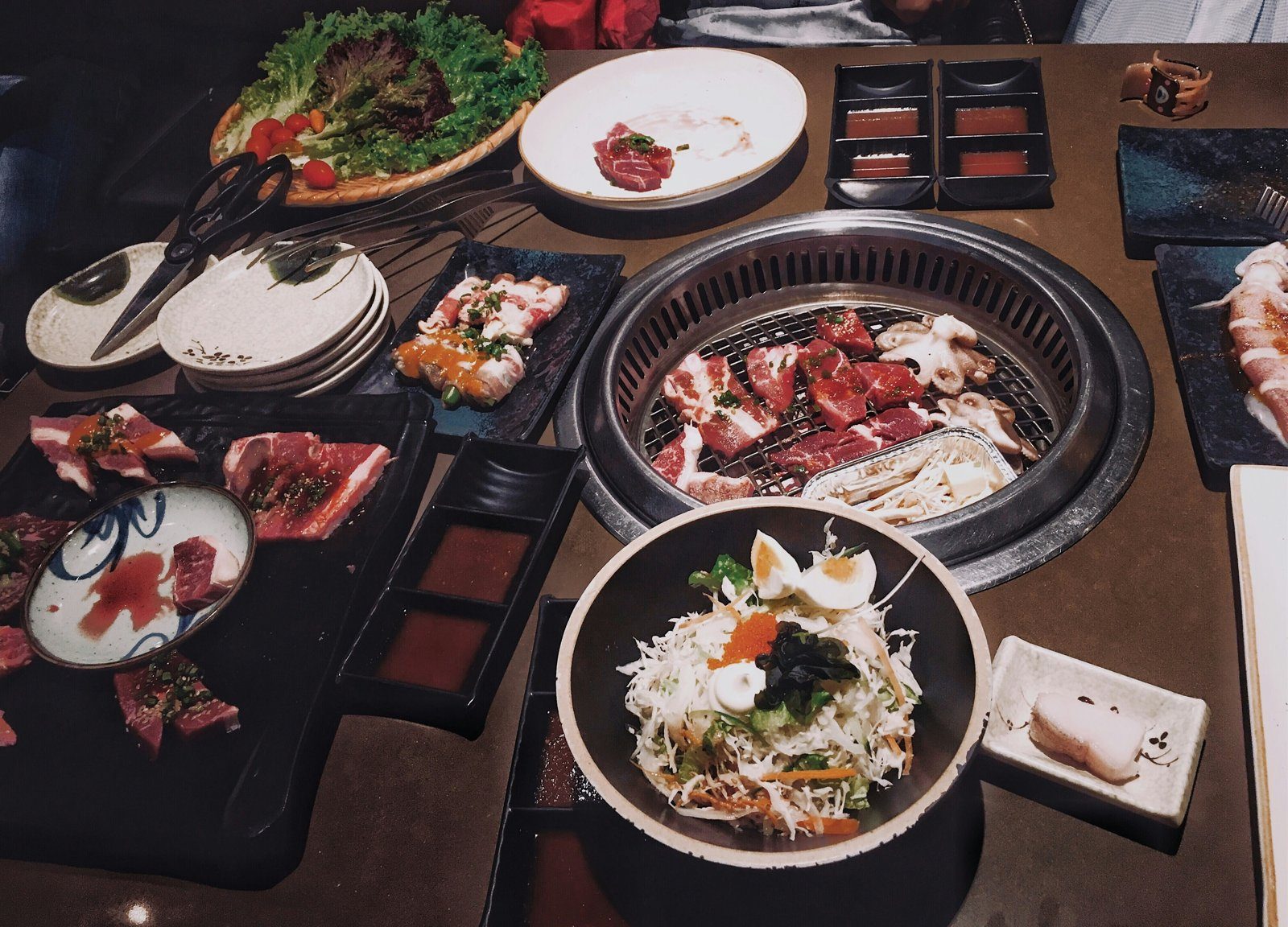
Two small things about banchan that nobody tells foreigners. First, it really is bottomless — if you love the kimchi or the pickled radish, you can ask for more and it's free. Just catch a staff member or press the call button. Second, you don't have to finish it. Banchan is meant to be grazed, not cleared like a plate of food. Take what you want, leave what you don't, and don't feel guilty about it.
Step 2: The grill
The raw meat arrives on a plate. Now it goes on the grill. Most restaurants will have a staff member grill and cut the meat for you — let them. If not, here's how:
- Lay the pork belly slices flat on the grill — don't overlap
- Let it cook without touching it for 2-3 minutes
- Flip once the underside is golden and slightly crispy
- Use scissors (가위, gawi) to cut the cooked meat into bite-sized pieces — this is standard Korean BBQ practice
- Move cooked pieces to the edge of the grill to keep warm without burning
The slightly charred, crispy edges of the pork belly are the best part. Don't rescue them from the heat too early. Let them caramelise. The fat renders down and becomes nutty and sweet. Worth the wait.
Join Seoul Mate free and I'll send you "Where to Start" — the 10 K-dramas I recommend to every beginner — plus a weekly pick. No spam, leave anytime.
Ssam (쌈) means "wrap" — you wrap the meat in a leaf with various fillings and eat it in one bite. This is the heart of Korean BBQ and also the thing most foreigners get completely wrong.
Here's how to make a proper ssam:
- 1Take a lettuce leaf or perilla leaf and hold it flat in your palm. Not a romaine spear — a loose, cupped leaf.
- 2Add a small dab of ssamjang (the dark savoury paste) to the centre. A small dab — not a spoonful.
- 3Add 1-2 small pieces of cooked pork. Cut pieces. Not a whole slab.
- 4Add a tiny bit of kimchi, garlic, or rice if you want. Keep it small. The leaf needs to close.
- 5Fold the leaf over the filling to form a small parcel — like closing an envelope. Then pop the whole thing in your mouth in one bite.
I say this with love. I have watched foreigners pile an entire plate of pork, three spoonfuls of ssamjang, a heap of kimchi, and a fistful of rice into a leaf the size of their hand — fold it into something the size of a softball — and then try to bite into it like a sandwich.
This is not how ssam works. The leaf tears. The filling falls everywhere. The ssamjang ends up on your nose. The entire table watches in silent Korean horror.
Ssam is a one-bite food. The whole point is that everything combines in your mouth at once — the fatty pork, the savoury paste, the fresh leaf, the garlic. If you need to bite it twice, you put too much in. Start over with a smaller amount. I promise it tastes better this way.
Step 4: The rest of the meal
Eat rice between bites
A small bowl of rice (공기밥, gonggi-bap) is your palate cleanser and filler. Korean BBQ is rich and fatty — rice balances it out. Take a spoonful of rice between bites of meat or dip the meat in the sesame oil and salt mixture that usually comes on the side.
The sesame oil and salt dip (참기름 소금)
A small dish of sesame oil with a pinch of salt and sometimes black pepper. Dip a piece of freshly grilled pork into this before eating it — no ssam, no wrapping, just pure pork and sesame. This is one of the purest, most perfect flavour combinations in Korean cuisine. Don't skip it.
Drink cold beer or soju
Korean BBQ and cold drinks are inseparable. Beer (맥주) cuts through the fat perfectly. Soju is the classic Korean spirit — small glasses, shared with everyone at the table. Or make somaek (소맥) — a beer-soju mix that's criminally easy to drink.
Don't leave the table to order
Most Korean BBQ restaurants have a call button on the table (호출 버튼). Press it when you need more banchan, more meat, or a fresh grill. Don't wander around looking for staff — the button is there specifically so you don't have to.
Ordering tips
Eating with an allergy, halal, gluten-free or another restriction? We took the whole barbecue table apart piece by piece — marinades, dips, the free side dishes, the shared grill — in our Korean BBQ for every diet guide. This page covers the fun; that one covers the safety.
Grill etiquette: the small stuff that matters
None of this is required and nobody will throw you out for getting it wrong. But these are the little habits that make a Korean person at the next table think, "oh, this foreigner knows what they're doing." They cost nothing and they're genuinely nice things to do.
- Pour for other people, not yourself. This is the single biggest one, and it carries over from Korean drinking culture. Keep an eye on your companions' glasses and top them up; they'll do the same for you. Pouring your own drink is a tiny faux pas — not offensive, just slightly lonely-looking.
- Use two hands with elders. If someone older or more senior pours for you, receive the glass with both hands, and pour for them the same way. With friends your own age, one hand is fine.
- Let the youngest tend the grill — but offer anyway. Traditionally the most junior person at the table handles the flipping and cutting. If you're a guest, offering to help (even clumsily) reads as polite and warm.
- Don't double-dip the communal ssamjang with a chewed piece. Use the spoon, or dab onto your own leaf.
- Grill in batches. Don't pile the whole plate of raw meat on at once. Cook a few pieces, eat them while they're hot and the fat is still rendering, then grill the next round. Cold, sat-around BBQ is a sad thing.
- Ask for a grill change. Once the grill plate gets blackened and smoky, the food starts tasting burnt. Press the button and ask to swap it — "판 갈아주세요" (pan garajuseyo). Staff do this constantly; it's expected, not a bother.
Frequently asked questions
Is Korean BBQ expensive? It depends entirely on what you order and where. A plain samgyeopsal place in a regular neighbourhood is genuinely affordable and is where most Koreans actually eat. Beef — especially marbled, named cuts of Korean beef (hanu) — is a different league and can get expensive fast. My honest advice for a first visit: stick to pork, order a couple of cuts, and you'll eat very well without spending much. Prices vary too widely for me to quote real numbers, so I won't pretend to.
Do I cook the meat myself, or do they do it? Both happen. At many mid-range and nicer places, a staff member comes over and grills and cuts everything for you, which is honestly lovely — let them. At cheaper or more casual spots you do it yourself. If you're unsure, just start grilling; if they want to take over, they will, with a smile and a gentle nudge of your hand off the tongs.
I don't eat pork — can I still do Korean BBQ? Yes. Order beef BBQ instead, or look for a place that does both. Beef-focused restaurants are everywhere. If you're keeping halal or have other restrictions, plan a little — see our guide to halal Korean food for how to navigate it.
Korean BBQ is meant to be eaten slowly, over conversation, with lots of refills. It's not a fast food experience. Sit down, pour drinks for each other, let the grill do its work, and enjoy the whole ritual. The meal is the occasion. That's the point. Keeping halal, or eating with someone who avoids meat? See our guide to halal Korean food.