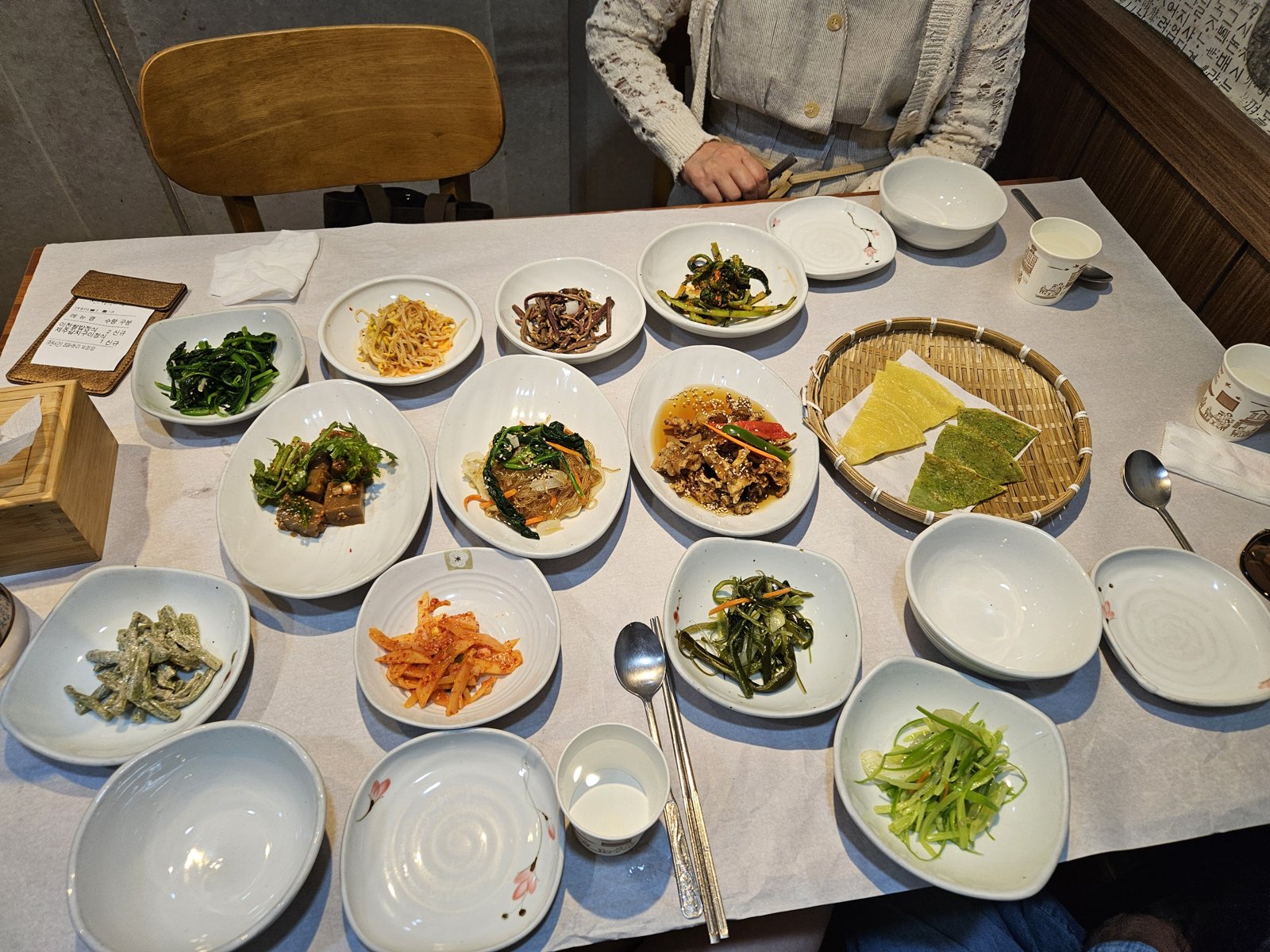
If there's one image that makes people gasp the first time they eat in Korea, it's this: you sit down, and the table slowly fills until it's a mosaic of little dishes — a dozen, two dozen, sometimes more. This is hanjeongsik (한정식), the traditional Korean full-course meal, and it's one of my favourite things to introduce to friends visiting Korea.
The photo above is from one of my own hanjeongsik meals — and yes, every one of those dishes is part of a single set. The first time I took a friend from abroad to a proper hanjeongsik house, she actually laughed out loud when the dishes kept arriving — she thought the staff had mixed up our table with a party of ten. They hadn't. That was just dinner for two.
What I love about hanjeongsik is that it isn't really about any single show-stopping dish. It's about balance — a whole table composed so that nothing dominates and everything has a counterpart. There's a logic to it that goes back centuries, and once you understand that logic, the wall of little bowls stops looking like chaos and starts looking like a quiet kind of art. Here's what it actually is, what's on the table, and how to eat it like you belong there.
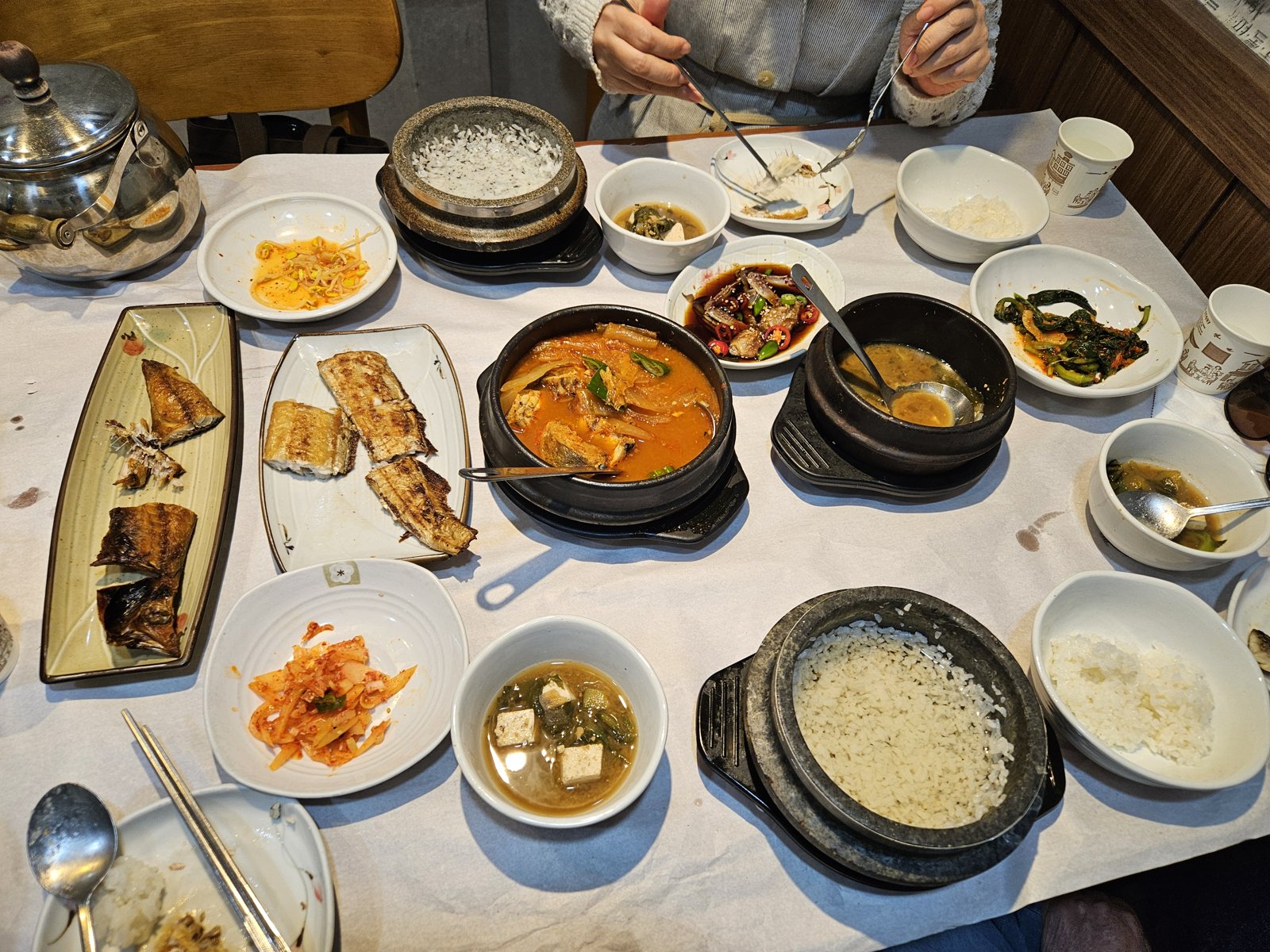
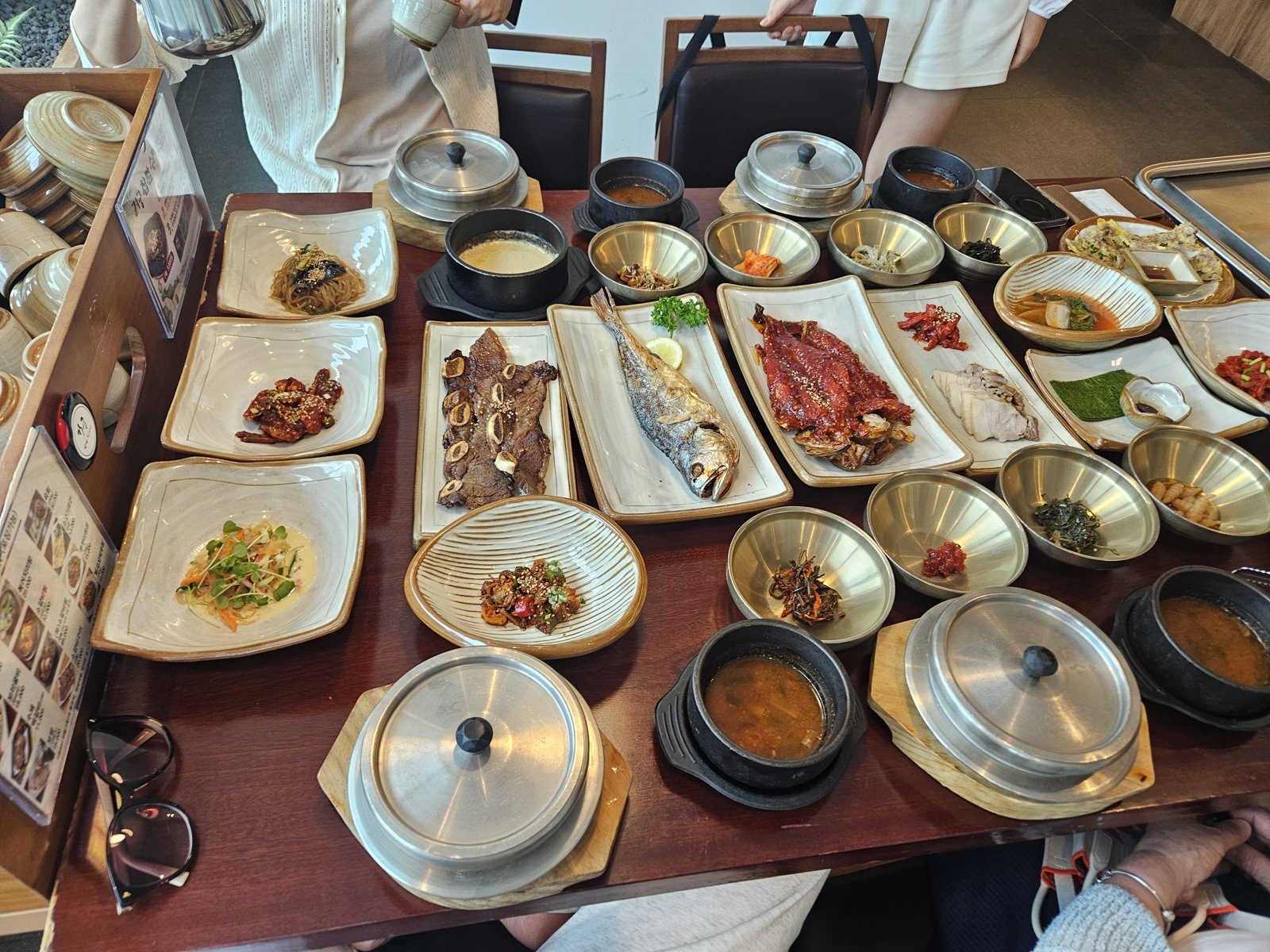
Hanjeongsik is a set meal of rice and soup served with a large spread of banchan (side dishes) — often grilled fish or meat, vegetables, jeon, kimchi and more — all brought out at once. It grew out of Korean court and aristocratic dining, and it's still the most lavish everyday way to eat traditionally.
What hanjeongsik actually is
Korean meals aren't served in courses one after another the way Western meals are. Instead, everything arrives together and you graze across the whole table — and hanjeongsik is that idea taken to its most generous extreme. Its roots are in court cuisine and the dining of the yangban (the old scholar-aristocracy), where a proper meal meant balance: a harmony of colours, of the five flavours, of warm and cool, meat and vegetable, rich and clean.
A modern hanjeongsik restaurant carries that spirit forward. You order by the set — often priced per person — and the kitchen sends out a carefully composed spread that's meant to be admired as much as eaten. It's the meal Koreans choose for special occasions, visiting elders, or simply when they want to eat properly.
The idea behind the table
If you remember one concept, make it this: a traditional Korean table is built around the principle that a meal should be balanced across the senses. Older Korean cooking talks about harmonising the five flavours — salty, sweet, sour, bitter and spicy — and the five colours, red, green, yellow, white and black. You'll notice it once you start looking: a hanjeongsik spread almost always has something fresh and crunchy next to something braised and soft, something cool beside something hot, a sharp pickled note to cut through a rich grilled one.
The traditional way of naming a set meal even counts the dishes. The old bansang (반상) system described a table by the number of banchan beyond the basics — a "3-cheop" table, a "5-cheop," and so on, with a "9-cheop" reserved for the highest households and a fuller spread historically the preserve of the royal court. Modern hanjeongsik doesn't follow these rules strictly, but it inherited the instinct: more dishes, more care, more honour to the guest. That's why hanjeongsik still feels celebratory. Handing someone a table this full is, in a very Korean way, a way of saying you matter.
What you'll find on the table
No two hanjeongsik are identical, but most include some version of these:
- Bap & guk/jjigae — your own bowl of rice and a soup or stew (doenjang stew, a clear soup, sometimes a small hot pot). These are personal; the rest of the table is shared.
- Banchan — the heart of it: seasoned vegetables (namul), kimchi in several kinds, braised and pickled things, tofu, and small savoury bites. They're refillable, so don't be shy.
- Grilled fish or meat (gui) — a grilled fish, bulgogi, or galbi often anchors the spread.
- Jeon — savoury pan-fried fritters of vegetable, fish or meat.
- Special touches — depending on the house and region, you might get japchae, bossam, raw fish, steamed egg, or a little dessert of fruit or sikhye to finish.
Join Seoul Mate free and I'll send you "Where to Start" — the 10 K-dramas I recommend to every beginner — plus a weekly pick. No spam, leave anytime.
Regional & specialty hanjeongsik
Hanjeongsik takes on a local accent wherever you go:
- Jeonju — Korea's food capital is the most famous place for a classic, lavish hanjeongsik; it's reason enough to make the trip. See our Jeonju guide.
- Coastal & Jeju versions — by the sea, the spread leans into seafood; a Jeju hanjeongsik built around grilled galchi (cutlassfish) is a thing of beauty.
- Temple cuisine — a quieter, all-vegetarian cousin served at some Buddhist temples, focused on seasonal mountain vegetables.
If you want to choose a hanjeongsik experience deliberately rather than just walking into the first place you see, here are the styles I'd point a friend toward, and what each one is really like.
Jeonju is Korea's official food capital, and its hanjeongsik is the benchmark — a long, generous parade of banchan, jeon, grilled fish or meat, and seasonal specialities, often served in a hanok dining room. If you only do hanjeongsik once, this is the version I'd send you to.
Go with at least two or three people so you can taste across the whole table, and come properly hungry. See our Jeonju guide to build a day around it.
By the sea, the spread tilts toward whatever the boats brought in. A Jeju hanjeongsik built around grilled galchi (갈치, cutlassfish) is a genuine highlight — silvery, rich and tender — surrounded by raw fish, shellfish banchan and island vegetables. Coastal versions elsewhere swap in local catch.
Ask what's in season; the best coastal houses build the set around the day's catch rather than a fixed menu.
Not strictly hanjeongsik, but its calm relative: a fully vegetarian table of seasonal mountain vegetables, prepared without the pungent "five aromatics" (garlic, onion and the like) that Buddhist tradition avoids. It's gentle, clean-tasting food meant to settle rather than excite — and a revelation if you think Korean food is all chilli and meat.
Some temples offer it as part of a temple-stay; a few specialist restaurants serve it too. Go in expecting subtlety, not spectacle.
How to eat it like a local
- Rice and soup are yours; everything else is shared. Reach across the table for the banchan — that's how it's meant to be.
- Ask for refills. Side dishes are almost always free to top up; a quick "리필 돼요?" (refill?) works.
- Pace yourself. It looks like a lot because it is a lot. Try a little of everything before going back for favourites.
- Use both hands for elders. If you're dining with older Koreans, pour their drinks and receive with two hands — small gestures that mean a lot.
If you want to understand how Koreans really eat — not just one dish but a whole balanced table — hanjeongsik is the single best meal to book. It's a little more expensive than a casual bite and best shared with at least two people, but it's worth doing once on any Korea trip. Come hungry, and don't try to finish everything; even Koreans can't.
Hanjeongsik vs baekban: don't confuse the queen with the workhorse
One distinction will make you sound like you know Korean food: hanjeongsik is not the same as baekban (백반), even though both put a crowd of little dishes on your table. Baekban — literally "white rice meal" — is the everyday workhorse: a humble set of rice, soup and whatever banchan the kitchen made that morning, served fast and cheap at neighbourhood diners, no ceremony involved. Hanjeongsik is the formal, composed version — courses considered, table arranged, occasion implied. Think of baekban as what Koreans eat on a random Tuesday and hanjeongsik as what they book for a parent's birthday. The delightful trap for travellers is that a great baekban house can casually hand you twelve banchan for the price of a sandwich — some of the best "hanjeongsik experiences" foreigners rave about were technically baekban all along. Order both on your trip and you'll understand Korean home cooking from both ends.
Frequently asked questions
Can I eat hanjeongsik alone? You can, but it's not really built for it. The whole point is a shared table you graze across, and many of the fuller sets are priced and portioned for two or more — some houses won't serve their grandest sets to a single diner at all. If you're travelling solo, a smaller set or a hanjeongsik-style lunch is more realistic; otherwise, save the big spread for when you have company.
Is hanjeongsik vegetarian-friendly? A standard hanjeongsik usually includes grilled fish or meat and seafood-based banchan, so it isn't vegetarian by default. The vegetable dishes (namul) are lovely, but cross-contamination with fish sauce and anchovy stock is common. If you don't eat meat or fish, temple cuisine (sachal eumsik) is the far better fit — see our guide to Korean food for halal, vegan & allergy eaters for how to navigate it.
Do I need to book ahead, and how much does it cost? The fancier multi-set houses often take reservations and price per person, so it's worth checking ahead, especially on weekends. It costs more than a casual meal — you're paying for a whole composed table — but it's still reasonable for what arrives. Prices and hours vary a lot between cities and houses, so confirm on the day rather than trusting an old listing.
Where to try it & what to know
Look for restaurants advertising 한정식 — Jeonju has the most famous houses, but you'll find good ones in Seoul, Gyeongju, and most cities. The fancier, multi-set places often take reservations and price per person, so it's worth checking ahead and going with a small group. Prices and hours vary a lot, so confirm on the day.
🍜 Hungry for more? See our 10 Korean foods every fan must try, the Jeonju food guide, and our Korean street food guide for the casual end of the spectrum. And if you don't eat meat, don't miss our guide to Korean food for halal, vegan & allergy eaters.