It looks like the most plant-based food imaginable: napa cabbage, chilli, garlic, salt. So surely kimchi — Korea's national side dish, on every table, in every drama — is vegan? It's the question I get asked more than almost any other about Korean food.
Here's the honest answer: most kimchi is not vegan, and not vegetarian either. The cabbage isn't the problem. It's the savoury, funky depth — and where that comes from might surprise you.
Vegan? Usually no — traditional kimchi is made with jeotgal (salted fermented seafood) such as fish sauce or salted shrimp. Vegetarian? Also usually no, for the same reason. Halal? Generally yes — kimchi normally has no pork or alcohol — but check. Vegan kimchi exists and is easy to find if you look for it.
What's actually in kimchi
Napa cabbage, Korean chilli flakes (gochugaru), garlic, ginger, spring onion, radish. So far, completely plant-based — this is the part everyone pictures.
This is the catch. Traditional kimchi gets its deep savoury funk from jeotgal — salted, fermented seafood. Most commonly that's myeolchi-aekjeot (anchovy fish sauce) and/or saeu-jeot (salted fermented shrimp). Some regional kimchis even add raw oysters or other seafood. None of that is vegetarian or vegan.
Join Seoul Mate free and I'll send you "Where to Start" — the 10 K-dramas I recommend to every beginner — plus a weekly pick. No spam, leave anytime.
The safe-for guide
How kimchi lines up, depending on how it was made and who's asking.
| Type of kimchi | Vegan 🌱 | Halal 🕌 | Red-meat allergy 🩺 |
|---|---|---|---|
| Standard kimchi (with fish sauce / shrimp) | 🔴 | 🟢 | 🟢* |
| Kimchi with raw oysters/seafood | 🔴 | 🟢 | 🟢* |
| Vegan / temple kimchi | 🟢 | 🟢 | 🟢 |
🟢 generally fine · 🔴 avoid. *Red-meat (alpha-gal) allergy: kimchi contains no mammalian meat, so it's generally not an alpha-gal trigger — but the salted shrimp/seafood matters a lot if you have a separate shellfish allergy, so read the ingredients — our full shellfish allergy guide to Korean food covers where else it hides. As always, confirm rather than assume.
Not all kimchi is the same
Here's something most "is kimchi vegan" answers skip: kimchi isn't one thing. There are hundreds of varieties, and the seafood rule shifts from one to the next. Knowing which type is in front of you is half the battle.
- Baechu-kimchi (배추김치) — the classic napa cabbage kimchi, the one on every table. It almost always contains fish sauce or salted shrimp.
- Kkakdugi (깍두기) — cubed radish kimchi, crunchy and punchy, but usually made with jeotgal too.
- Pa-kimchi & gat-kimchi (파김치 · 갓김치) — green-onion and mustard-leaf kimchi, common in the Jeolla region and typically heavy on fish sauce.
- Water kimchis — dongchimi & nabak (동치미 · 나박김치) — the hopeful ones. These mild, brothy radish kimchis are brined in salt water, often with a little fruit, and many versions are made without any seafood. They're your best chance at a naturally vegan kimchi — though some cooks still add a splash of aekjeot, so confirm.
There's a regional pattern, too. Southern styles (especially Jeolla) are famously rich and lean hard on fermented seafood, while some northern and Buddhist temple styles are lighter or skip it entirely. So "does this kimchi have fish in it?" honestly depends on who made it and where they learned to.
If you're hunting for a vegan-friendly kimchi and don't want to read every label, start with a water kimchi (dongchimi or nabak) or anything labelled temple-style — they're the most likely to be seafood-free. Still worth a quick check, but the odds are far better.
So, is kimchi vegetarian?
Same answer as vegan: usually no. Fish sauce and salted shrimp are animal products, so standard kimchi isn't vegetarian either — even though it looks like pure vegetables. The egg-and-dairy allowance that helps vegetarians with other dishes doesn't help here, because the hidden ingredient is seafood.
Is kimchi halal?
Generally yes. Standard kimchi contains no pork and no alcohol, and fish and shrimp are permissible — so most kimchi is fine for halal diners. The things worth a quick check: a few commercial or fusion kimchis add other flavourings, and anything labelled but uncertified is always a "confirm if it matters to you." When in doubt, look for a halal-certified or clearly vegetarian product.
How to get vegan kimchi
Good news: vegan kimchi is real, traditional, and increasingly easy to find. Korean Buddhist temple kimchi has always been made without seafood, using kelp (dashima), mushrooms, and fermented soy for that umami instead. To get it:
- Ask for "vegan kimchi" — 비건 김치 (bigeon kimchi) — or temple-style kimchi.
- Read the label on commercial jars: avoid 멸치액젓 (anchovy sauce), 새우젓 (salted shrimp), 젓갈 (jeotgal). Many brands now make a vegan version.
- Make it at home — swap the fish sauce for extra salt, kelp broth, soy sauce or a little miso. It's genuinely delicious.
On a jar of kimchi, the deal-breaker words for vegans are 젓 / 액젓 / 멸치 / 새우 (jeot / aekjeot / anchovy / shrimp). See those, and it isn't vegan. A vegan jar will say so, or list only vegetables and seasonings.
Making vegan kimchi at home
If you want kimchi you can trust completely, making it yourself is easier than it sounds — and replacing the seafood is the whole trick. To rebuild that savoury depth from plants, simmer a quick broth of dried kelp (dashima) and dried shiitake, then stir in a spoonful of soy sauce or doenjang (soybean paste) and a little grated apple or Korean pear for sweetness and to feed the fermentation. A thin cooked sticky-rice porridge (chapssal-pul) helps everything cling and ferment, and salt does the heavy lifting.
The honest result? It ferments just as happily and tastes genuinely like kimchi — most people can't tell the difference. After years of making it without fish sauce, I'd never call the vegan version a compromise.
Buying kimchi: what to look for
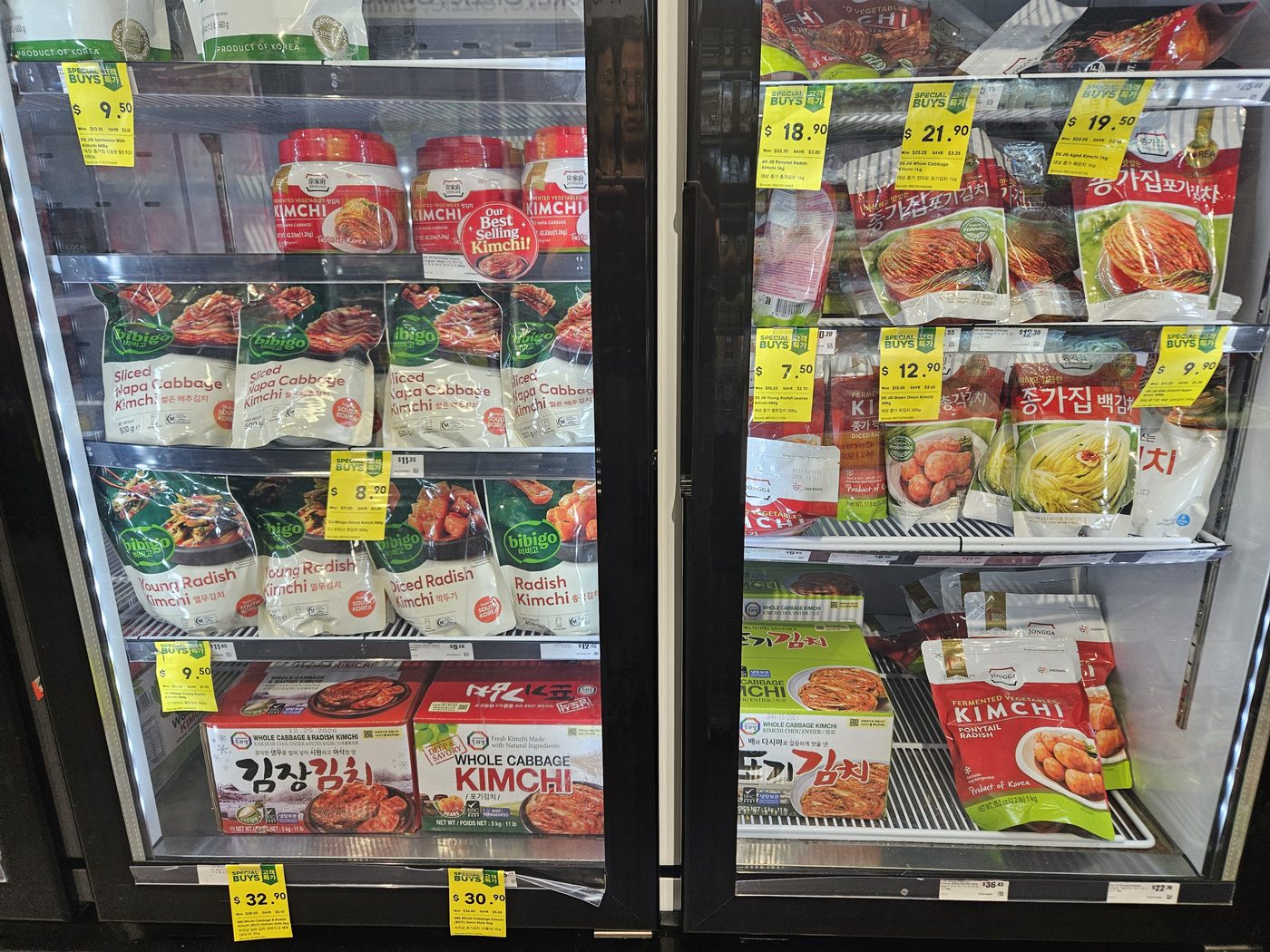
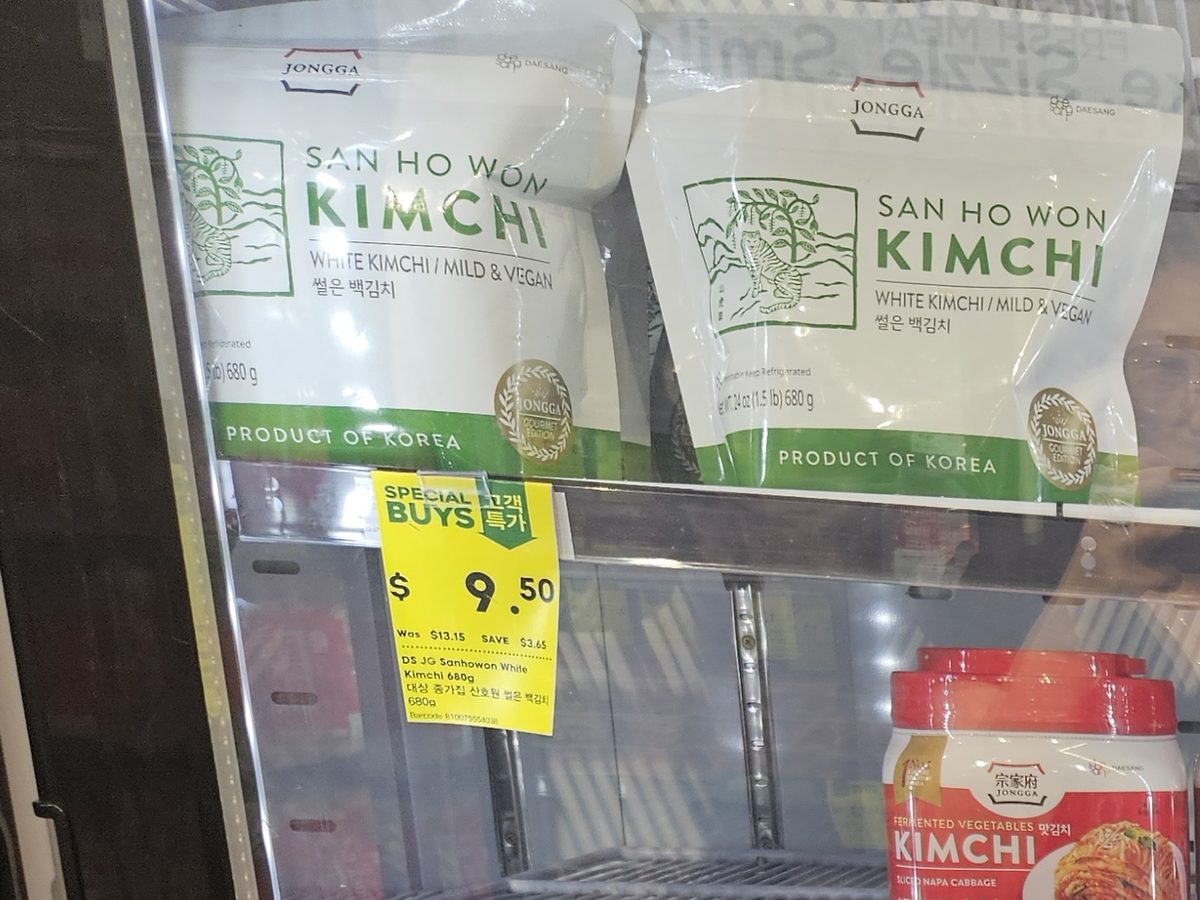
If you'd rather buy it, vegan kimchi has become much easier to find. Korean grocers like H-Mart and most Asian supermarkets now stock at least one vegan or temple-style option, and there are specialist brands online. Two habits make it foolproof:
- Scan the ingredient list for the seafood words — 젓갈, 멸치액젓, 새우젓, or "anchovy" / "shrimp" / "fish sauce" in English. If they're there, it isn't vegan.
- Don't trust the free side dish. The complimentary kimchi at a restaurant is almost always made the traditional way with jeotgal — assume it has seafood unless the restaurant tells you otherwise.
Is kimchi gluten-free?
Usually, yes — cabbage, chilli flakes, garlic and salt are naturally gluten-free. But it's worth a glance at the label: a few commercial seasonings and fusion-style kimchis add soy sauce (which normally contains wheat) or other thickeners. For coeliac-level care, choose a product that states it's gluten-free, or see our gluten-free Korean food guide.
One more trap: dishes made from kimchi
Even when your kimchi itself is vegan, the popular dishes built around it often aren't — and this is where people get caught. A few to watch:
- Kimchi-jjigae (김치찌개) — the beloved kimchi stew is usually simmered with pork belly or tuna, and even the "plain" versions often start from an anchovy or beef broth.
- Kimchi-bokkeumbap (김치볶음밥) — kimchi fried rice frequently hides ham, bacon or Spam, and is classically topped with a fried egg.
- Kimchi-jeon (김치전) — the savoury pancake is bound with egg and flour, so it suits ovo-vegetarians more than vegans — and only if the kimchi in it was seafood-free to begin with.
The lesson: clearing the kimchi is step one, but always ask what else went into the pan. It's the same hidden-broth puzzle as our doenjang jjigae guide — the headline ingredient looks plant-based, and the supporting cast isn't.
A kimchi's life: from fresh to stew-worthy
Here's something I wish more guides explained, because it changes how you read a menu. Kimchi isn't a fixed food — it's a living thing on a timeline, and Koreans eat it differently at every stage. Geotjeori (겉절이) is the day-one version: fresh-dressed cabbage, barely fermented, closer to a salad — often made in small batches, which means if you've found a seafood-free kitchen, this is the easiest version for them to make vegan on request. A few weeks in, kimchi hits its bright, fizzy prime — that gentle carbonation isn't spoilage, it's fermentation doing its job. And months later it becomes mugeunji (묵은지): deeply sour, soft, too intense to eat plain — which is exactly why it's the star of kimchi-jjigae and braises. So when a menu says "mugeunji" anything, you're getting old, sour kimchi cooked into a dish — with all the usual questions about what else went into that pot. One vegetable, three different foods, depending on the calendar.
Frequently asked questions
Does fermentation "cancel out" the fish sauce? No — this is a common hopeful theory, but the fish sauce and salted shrimp are ingredients, not contaminants. Fermentation transforms flavours; it doesn't remove what was put in. For vegans and vegetarians the question is simply whether seafood went in at the start, and for that only the recipe or the label can answer.
Is the kimchi at Korean restaurants overseas any different? The rule travels with the recipe, not the geography. A Korean restaurant in Sydney or London most likely makes or imports standard kimchi — fish sauce and all. The encouraging flip side: overseas Korean grocers increasingly stock labelled vegan kimchi precisely because customers ask, so your odds at the shop are often better than at the restaurant table.
My kimchi is fizzy and sour — has it gone bad? Almost certainly not: fizz and deepening sourness are normal fermentation, and Koreans prize different stages for different uses (see the timeline above — that sour jar is future jjigae). The actual warning signs are surface mould or off, non-sour smells. Store it cold, keep it submerged in its brine, use clean utensils, and a jar will happily evolve for months.
What about baek-kimchi (white kimchi)? The elegant, chilli-free white version looks like the safest bet, and it is milder — but "no chilli" doesn't mean "no seafood." Many baek-kimchi recipes still season the brine with saeujeot or aekjeot, so it gets the same one question as every other variety. The reliably seafood-free direction remains temple-style and clearly labelled vegan products.
Affiliate link — if you book through it, KContentGuide may earn a small commission at no extra cost to you. We only point you to things we'd happily use ourselves.
This is a food and lifestyle guide based on real experience, not medical or religious advice. Recipes vary by household, brand and restaurant. If you have a diagnosed food allergy, follow the plan your doctor gave you and check labels and ingredients every time. For halal, rely on the product's or restaurant's own certification. When in doubt, ask.
Bottom line
Kimchi looks vegan but usually isn't — the secret is salted seafood, not the cabbage. It's typically halal, rarely vegetarian, and there's a genuine vegan version worth seeking out. For the bigger picture, see our vegan Korean food guide and the rest of the Eat guides.