If you have a shellfish or seafood allergy, Korean food deserves your respect — not your fear, but your genuine attention. Korea is a peninsula, and its cuisine reflects that: seafood isn't just a category of dishes, it's woven into the seasonings and broths underneath dishes that look completely seafood-free. A bowl of vegetable stew, a plate of seasoned spinach, the kimchi that arrives free with every meal — any of them can carry shrimp, anchovy or shellfish that you'd never spot by looking.
I've spent my working life around food, including years running food businesses where allergen questions are part of every single day — so I want to give you the honest map, not false comfort. This guide covers where seafood hides in Korean cooking, how the risk differs depending on which seafood allergy you have, what to ask, and how to read Korean labels. It's a food guide from experience, not medical advice — your allergist's plan always comes first.
The three biggest hidden carriers are saeujeot (fermented salted shrimp — in most kimchi and some stews), aekjeot (fish sauce — in kimchi, seasoned vegetables and soups), and myeolchi yuksu (anchovy broth — the default base for countless stews and noodle soups). None of them are visible in the finished dish. Always ask, never assume — and carry your allergy written in Korean.
First: which seafood allergy do you have?
This distinction matters more in Korea than almost anywhere, because Korean kitchens use crustaceans, molluscs and fish in different places. "Shellfish allergy" usually means crustaceans (shrimp, crab, lobster), sometimes also molluscs (clams, oysters, mussels, squid, abalone) — and fish allergy is a separate thing again. Someone who reacts to shrimp but not fish faces a different map than someone who reacts to anchovies. Only your allergist can tell you which applies to you and how cautious to be about traces and cross-contact — this guide just shows you where each type tends to appear.
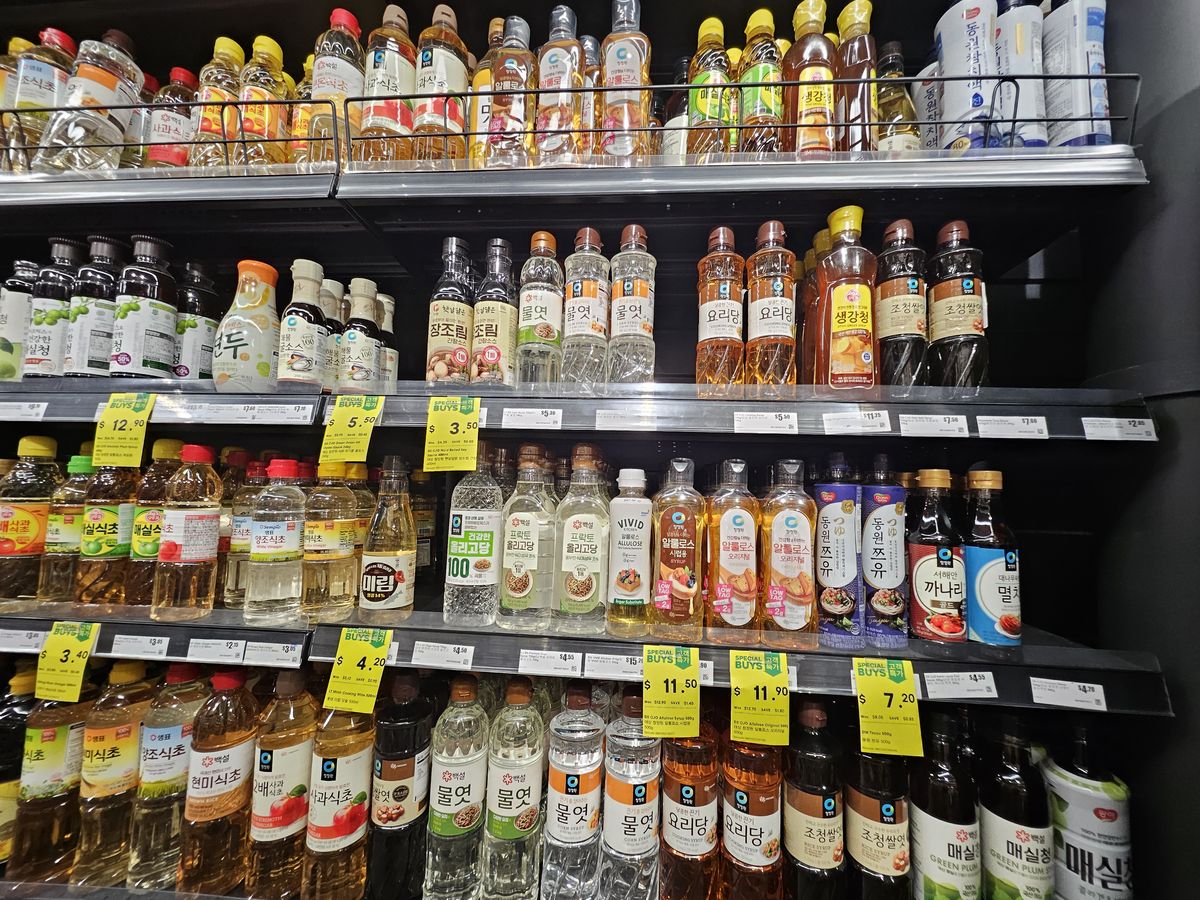
The three hidden carriers
Tiny fermented shrimp, ground into a seasoning paste. It's a signature flavour of most traditional kimchi, and it also shows up as a table condiment and seasoning for some soups and steamed dishes (sundubu jjigae and bossam are common examples). By the time it's in the dish, there is nothing visible — no shrimp to spot, just flavour. For a crustacean allergy, this is the single most important word to know in Korean food. Our kimchi deep-dive covers exactly how it's used.
Fermented fish sauce, usually anchovy or sand lance, used generously in kimchi and frequently in namul (seasoned vegetable side dishes), soups and dipping sauces. Like saeujeot, it disappears completely into the finished dish. If your allergy is to fish rather than crustaceans, this is your headline ingredient — and note that many kimchi recipes use both fish sauce and shrimp paste together.
Dried anchovies (usually with kelp) simmered into the default broth of Korean home cooking — under doenjang jjigae, kimchi jjigae, tteokbokki sauce, kalguksu and countless other soups and stews. The anchovies are strained out before serving, so the bowl in front of you looks purely vegetable. Some kitchens use beef or kelp-only broth instead, which is why the answer is always "ask this restaurant," never "that dish is fine." We wrote about this same trap from the vegetarian angle in our doenjang jjigae guide — for a fish allergy it matters even more.
Join Seoul Mate free and I'll send you "Where to Start" — the 10 K-dramas I recommend to every beginner — plus a weekly pick. No spam, leave anytime.
The other places seafood turns up
- Kimchi variations — beyond shrimp paste and fish sauce, some regional and winter kimchi includes raw oysters (gul) or other seafood mixed in. Fresh kimchi in season is the most likely to carry oyster.
- Eomuk (fish cake) — ground fish formed into sheets and sticks; it's in tteokbokki, street-food skewers, soups and banchan. Some fish cakes also contain shrimp or squid, so crustacean-allergic eaters shouldn't treat it as "just fish."
- Crab sticks (surimi) — the "crab" in gimbap and salads is processed fish, but products vary — some contain real crab extract, and they're made in seafood facilities either way. With a crustacean allergy, treat crab sticks as a check-the-label item, not a safe swap.
- Sundubu jjigae & "vegetable" stews — soft tofu stew very often includes clams or shrimp as standard, even when you ordered it for the tofu. Haemul (해물) in a dish name means seafood is the point — but its absence from the name doesn't mean absence from the pot.
- Banchan (free side dishes) — the rotating little plates often include dried shrimp stir-fries, anchovy stir-fry (myeolchi bokkeum), pickled seafood, and namul seasoned with fish sauce. They arrive unannounced, which is exactly why they deserve a question.
- Jjajangmyeon & Korean-Chinese food — the black-bean sauce frequently includes shrimp or squid alongside pork, and jjamppong is built on seafood. Don't assume the "pork noodle dish" is crustacean-free.
- Dipping sauces & ssamjang — some sauces blend in fish sauce or seafood elements; recipes vary by kitchen, so ask rather than assume.
The safe-for matrix: same table, three allergies
This is the heart of it. The same dish can be a different colour depending on which seafood allergy you have — which is why generic "is Korean food safe?" answers fail. 🦐 = crustacean (shrimp/crab), 🦪 = mollusc (clam/oyster/squid), 🐟 = fish (incl. anchovy).
| Dish | 🦐 Crustacean | 🦪 Mollusc | 🐟 Fish | Why |
|---|---|---|---|---|
| Traditional kimchi | 🔴 | 🟡 | 🔴 | Usually shrimp paste + fish sauce; some regional kimchi adds oyster |
| Doenjang / kimchi jjigae | 🟡 | 🟡 | 🔴 | Anchovy broth is the default base; some kitchens add clams or shrimp |
| Tteokbokki | 🟡 | 🟡 | 🔴 | Broth often anchovy; fish cake is standard, and it may contain shrimp/squid |
| Sundubu jjigae | 🔴 | 🔴 | 🔴 | Clams and shrimp are common by default, plus broth and saeujeot seasoning |
| Samgyetang | 🟢 | 🟢 | 🟢 | Traditionally chicken, rice, ginseng — still confirm the kitchen's recipe |
| Unmarinated BBQ (samgyeopsal) | 🟡 | 🟡 | 🟡 | The meat itself is fine; the risk is banchan, ssamjang and saeujeot dips on the table |
| Bibimbap | 🟡 | 🟢 | 🟡 | Depends how the namul were seasoned — fish sauce and dried-shrimp garnishes vary |
| Jjajangmyeon / jjamppong | 🔴 | 🔴 | 🟡 | Shrimp/squid common in jjajang; jjamppong is a seafood soup by design |
🟢 traditionally made without this allergen — but recipes vary, so confirm every time · 🟡 sometimes contains it / depends on the kitchen — ask before ordering · 🔴 commonly contains it — high risk. This table describes typical recipes, not a guarantee about any particular kitchen, and it doesn't account for shared pots, fryers and utensils.
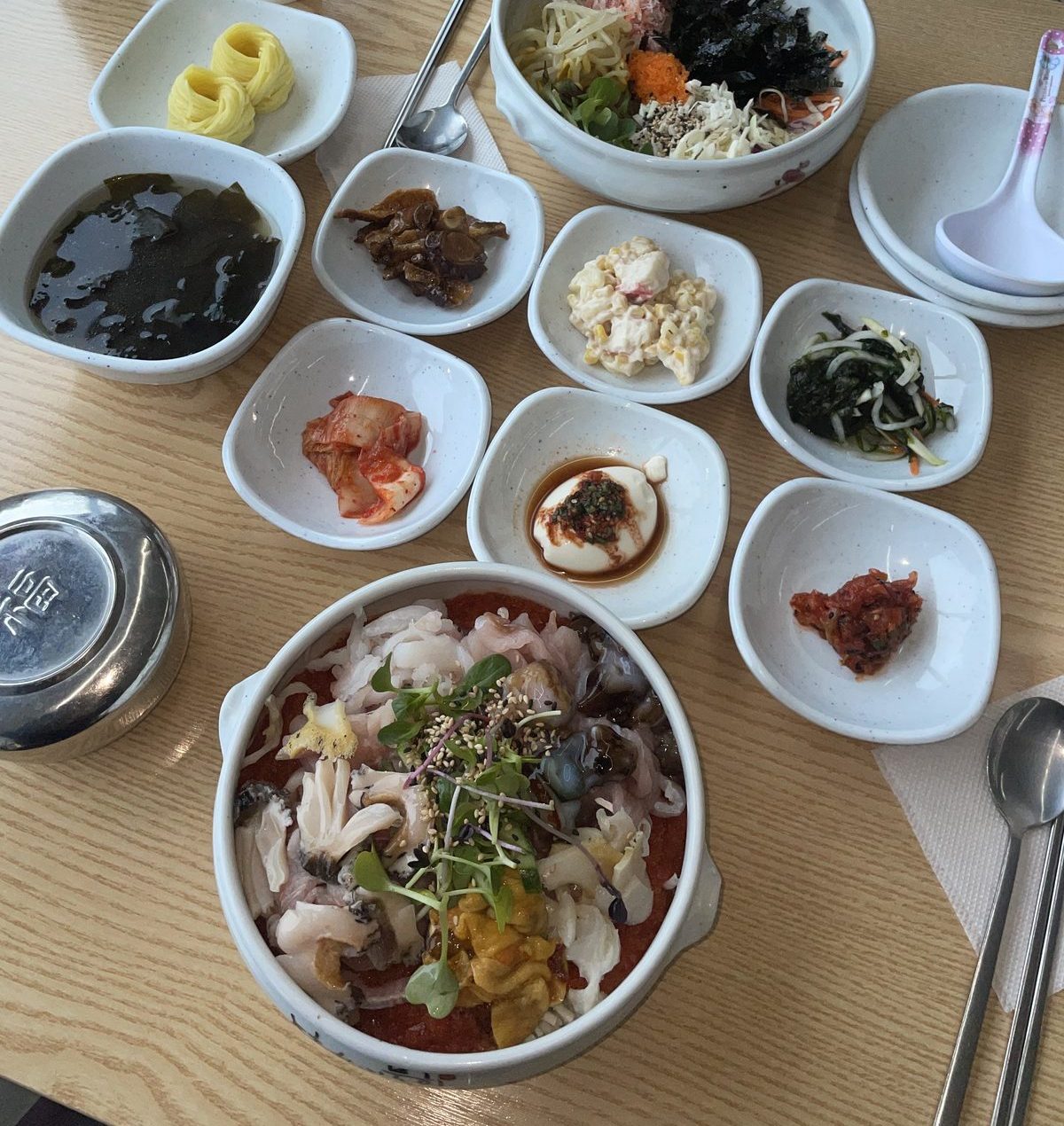
The communal-table reality
Korean dining is gloriously communal, and that's the part allergy travellers need to plan around. Banchan plates are shared and refilled, stews often arrive in one pot for the table, and the same tongs and scissors move between dishes. In markets and street-food stalls, shrimp skewers and fish cakes share fryers and grills with everything else. None of this makes eating out impossible — but it means the question isn't only "what's in my dish?" but "what's it cooked in, and what's it next to?" If your allergy is severe, a quieter restaurant that can answer questions calmly beats a packed market stall every time — and when a kitchen can't give you a clear answer, the kindest thing you can do for yourself is choose somewhere that can.
What to ask (and how to say it)
"I have a shellfish allergy." — "Jeoneun gapgangnyu allereugi-ga isseoyo" (저는 갑각류 알러지가 있어요) · "I have a seafood allergy." — "Jeoneun haemul allereugi-ga isseoyo" (저는 해물 알러지가 있어요) · "Does this have salted shrimp in it?" — "Yeogi saeujeot deureoga-yo?" (여기 새우젓 들어가요?) · "Is this anchovy broth?" — "Myeolchi yuksu-yeyo?" (멸치육수예요?). Better still: keep these written on your phone or a printed allergy card in Korean, and show it — it removes any language-barrier risk. Our restaurant phrase guide has more.
One practical note on the word itself: Korean distinguishes 갑각류 (gapgangnyu, crustaceans) from 조개류 (jogae-ryu, shellfish/molluscs) and 해물 (haemul, seafood in general). If your allergy is specific, using the specific word — or showing a card that lists exactly what you react to — gets you a much more useful answer than a general "seafood" question.
Reading Korean labels
For packaged food, the Korean words to scan for are: 새우 (shrimp), 게 (crab), 오징어 (squid), 조개 (clam/shellfish), 굴 (oyster), 홍합 (mussel), 전복 (abalone), 멸치 (anchovy), 액젓 (fish sauce), 새우젓 (salted shrimp) and 어육 (fish meat — the base of fish cakes). Korean packaged foods carry allergen declarations, typically in a highlighted box near the ingredients list — a translation app like Papago pointed at the label fills the gaps. Instant ramyeon deserves special mention: many soup powders contain shrimp, shellfish or anchovy even in "beef" flavours, so the label check is worth the thirty seconds.
Lower-risk starting points
With the caveat repeated — confirm every time, at every kitchen — some corners of Korean food are traditionally built without seafood: samgyetang (ginseng chicken soup), plain grilled meats ordered unmarinated with untouched-by-seafood dips, gomtang and seolleongtang (beef-bone soups seasoned with salt), juk (rice porridge — the plain and chicken versions), and Korean temple cuisine, which traditionally uses no animal products at all, seafood included. Temple food restaurants are arguably the most relaxing meal in Korea for a severe seafood allergy — the entire tradition is built without fish sauce, shrimp paste or broth.
And if you're cooking for yourself or staying somewhere with a kitchen, Korean food opens right up: kelp-and-mushroom broth replaces anchovy broth beautifully, vegan kimchi (made without shrimp paste or fish sauce) is increasingly easy to find, and soy sauce, doenjang and gochujang are seafood-free staples — see our vegan Korean food guide for the full seafood-free toolkit, which doubles nicely as an allergy resource.
Convenience stores: your low-stress backup
Korea's convenience stores (CU, GS25, 7-Eleven, Emart24) are a quietly useful ally, because everything is packaged and labelled. Plain rice (heatable rice packs), fruit, boiled eggs, plain yoghurt, nuts and unflavoured rice cakes make easy low-risk snacks. The items that deserve a label check are the ones built on fish paste or seafood seasoning: triangle gimbap (many fillings involve crab stick, tuna or seafood-based sauces), fish-cake bars by the register, and — as mentioned — instant ramyeon, where even non-seafood flavours can carry shrimp or anchovy in the soup powder. Thirty seconds with the allergen box and a translation app is all it takes, and unlike a busy kitchen, the label never gets your question wrong. We've since written a full aisle-by-aisle convenience store guide — worth a read if the 편의점 is going to carry many of your meals.
A sample lower-risk day
To show the shape of it in practice — confirming at every step, as always. Breakfast: juk (plain or chicken rice porridge) from a porridge chain, where ingredients are listed per menu item, or fruit and yoghurt from a convenience store. Lunch: seolleongtang or gomtang — beef-bone soups seasoned with salt at the table — after confirming no seafood seasoning; skip the kimchi side or ask about it separately. Snack: labelled convenience-store items. Dinner: unmarinated Korean BBQ with a salt-and-sesame-oil dip, asking the kitchen to hold the saeujeot dip and seafood banchan, or a temple-food restaurant where the entire menu is built without seafood by tradition. It's a genuinely good day of eating — the planning happens before you sit down, not while you're hungry.
Frequently asked questions
Is Korean fried chicken safe with a shellfish allergy? The recipe itself is usually chicken, flour and sauce — but the practical question is the fryer. Some kitchens, especially in markets and snack bars, fry shrimp, squid and fish cake in the same oil as everything else. Dedicated chicken franchises are more likely to have single-purpose fryers, but that's a question to ask, not an assumption to make. If shared oil is a trigger risk for you, treat fried food as a confirm-first category everywhere in Korea.
Are soy sauce, doenjang and gochujang okay? The three core Korean seasonings are made from soybeans, grains, salt and chilli — no seafood in the traditional recipes, which is one reason home cooking is so much easier to control than eating out. As with everything packaged, a quick scan of the allergen box covers you against brand-level surprises (a small number of flavoured or blended sauces add seafood extracts).
Is gim (roasted seaweed) a problem? Seaweed is a plant, not shellfish, so it isn't itself a crustacean or mollusc allergen — plain roasted gim is one of Korea's most popular snacks for good reason. Two caveats: flavoured varieties can carry seafood-derived seasonings, and seaweed is often processed in facilities that also handle seafood, so the label and your allergist's guidance on trace exposure are what count.
Affiliate link — if you book through it, KContentGuide may earn a small commission at no extra cost to you. We only point you to things we'd happily use ourselves.
Shellfish and seafood allergies can cause anaphylaxis, which is life-threatening. This is a food guide based on experience — not medical advice, and nothing here should override the plan you've made with your allergist. Recipes vary between regions, restaurants and even batches; cross-contact through shared broths, fryers, grills and utensils is a genuine risk in Korean kitchens. Carry any prescribed emergency medication exactly as your doctor directs, keep your allergy written in Korean, confirm ingredients in person every single time, and when you can't get a clear answer — walk away. No dish is worth the risk.
Bottom line
Korean food and a seafood allergy can coexist — thousands of people manage it — but it takes more homework here than in cuisines where seafood stays visible on the plate. Learn the three hidden carriers (saeujeot, aekjeot, anchovy broth), know which Korean word matches your allergy, lean on the traditionally seafood-free corners of the menu, and ask every time. For the wider toolkit, browse the Eat guides — especially what's really in kimchi, the doenjang jjigae broth trap, and what to ask in a Korean restaurant. And if nuts are also on your list, there's genuinely good news in our peanut & tree nut guide to Korean food.