Every allergy guide in this series has had a shape. Nuts were a garnish problem. Shellfish was a hidden-broth problem. Soy was a seasoning-system problem, but at least the label told you. Sesame is different again, and I want to be straight with you about why: sesame is in an enormous amount of Korean food, and it is not on Korea's mandatory allergen labelling list. The tool that carried you through the other guides — read the box, look for the highlighted allergen line — is the one tool that partly stops working here.
That's not a reason to stay home. It's a reason to change method. For sesame you lean less on packaging and much more on the question you ask before the food is made, and on knowing which dishes get the drizzle at the end. I've spent years running food businesses where allergen questions come across the counter every week, and the pattern I've watched is always the same: the ingredient that hurts people isn't the one on the menu, it's the one the kitchen doesn't think of as an ingredient. In Korea, that ingredient is toasted sesame oil. So let me map it properly — where sesame lives, what to say, and which dishes are genuinely lighter on it. As always: recipes vary kitchen to kitchen, so confirm every single time.
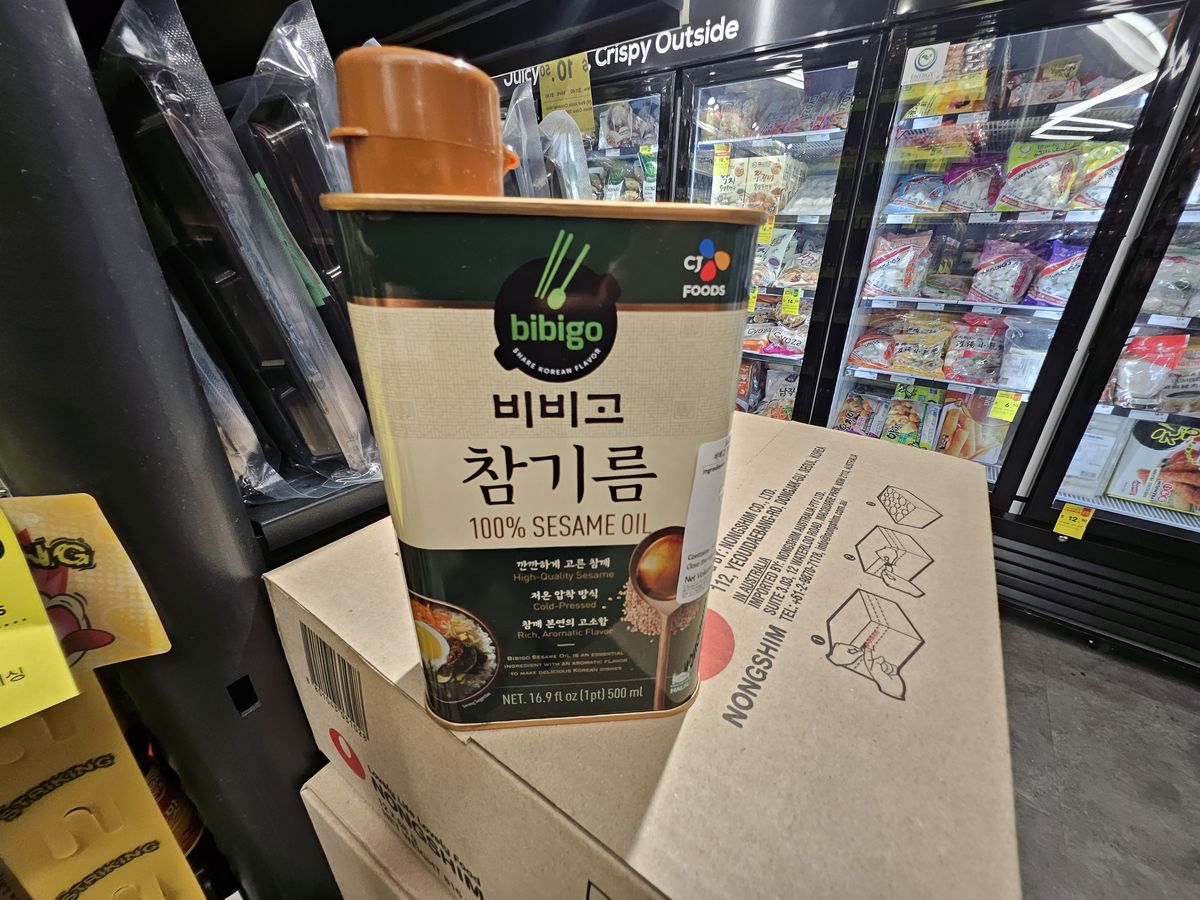
Sesame is a finishing ingredient in Korean cooking — 참기름 (chamgireum, toasted sesame oil) drizzled at the end and 깨 / 깨소금 (kkae, sesame seeds or sesame salt) sprinkled on top. That puts it on most namul banchan, bibimbap, gimbap, japchae, seaweed soup and the barbecue dip. Crucially, sesame is not one of Korea's legally required allergen declarations, so packaged labels may or may not mention it. Your strongest tools here are asking about 참기름 specifically before cooking starts, sticking to broth-and-salt dishes, and carrying a Korean allergy card. And note: 들기름 (deulgireum, perilla oil) is a different plant, not sesame — though it's used the same way, so still ask.
Why sesame is the one allergen where labels let you down
Korea's food labelling rules require manufacturers to declare a fixed list of allergens in a separate, highlighted box near the ingredients — a genuinely good system, described by the Ministry of Food and Drug Safety. In our soy guide I called that box the strongest tool a soy-allergic traveller has, because 대두 (soybean) sits on the list. So do peanuts, walnuts and — unusually, and helpfully — pine nuts.
Sesame does not. The mandatory list covers eggs, milk, buckwheat, peanuts, soybeans, wheat, mackerel, crab, shrimp, pork, peach, tomato, sulphites, walnuts, chicken, beef, squid, shellfish (oyster, abalone, mussel) and pine nuts. Sesame is absent — which is striking, because sesame has been added to the mandatory allergen lists in the United States, the EU, the UK, Australia and New Zealand in recent years. Many Korean manufacturers do list 참깨 voluntarily, and you will often see it in the ingredient list even when it's not in the allergen box. But "often" is not "always", and a voluntary declaration means the absence of the word proves nothing.
So the mental model changes. For soy: read the box, trust the box. For sesame: read the ingredient list and the allergen box, treat a silent label as unknown rather than safe, and lean much harder on the two things you can control — what you order, and what you say before it's cooked.
The five places sesame lives in Korean food
This is the one that matters most, because it goes in last and nobody counts it. Korean cooks finish an enormous range of dishes with a few drops of dark, toasted sesame oil for aroma: spinach and bean-sprout namul, bibimbap, gimbap rice, japchae, miyeok-guk (seaweed soup), yukhoe, many jeon batters and dipping sauces, and the rice in a hot stone bowl. Because it's added off the heat as a perfume rather than cooked in as a component, a busy kitchen genuinely may not think of it when you ask "what's in this?" — you have to name it. The single most useful sentence in this entire guide is "참기름 들어가요?" (does this have sesame oil in it?), asked before the dish is assembled.
Whole toasted sesame seeds (통깨) and ground sesame-and-salt (깨소금) are the default garnish across Korean cooking. They land on namul, on braised dishes, on japchae, on fried chicken, on cold noodles, on tofu, on the free banchan that arrives before you've ordered anything. The good news is that this form is visible — you can often see the seeds. The bad news is twofold: 깨소금 is ground fine enough to disappear into a dressing, and the banchan on a Korean table is communal, arriving unannounced and shared with the same chopsticks. Give the small plates a proper look before anyone starts reaching, and if sesame is on them, ask for the plate to be taken away rather than politely working around it.
There's an irony here I have to flag. In the soy guide, gireum-jang — the little saucer of sesame oil with salt and pepper — was the hero: it's what lets a soy-allergic traveller eat Korean barbecue. For sesame allergy it's the opposite, and if you carry both allergies your barbecue dip is plain salt and pepper alone ("소금만 주세요"). Beyond the dip, watch the wrap itself: ssamjang is soy-based but many versions include sesame oil or ground sesame, and the sesame leaf (깻잎, kkaennip) served with barbecue is a common source of confusion — despite the English name, perilla leaf comes from a different plant and is not sesame. If in doubt, ask; a leaf is not worth a guess.
Korean bakeries are wonderful and, for this allergy, high-risk — not only because 참깨빵 (sesame bread), 깨찰빵 (chewy sesame rice-bread) and seed-topped rolls exist, but because unpackaged bakery items sit in open trays with shared tongs. ASCIA's sesame dietary guide flags bakery items and Asian restaurant food as the two highest cross-contamination categories, and a Korean bakery is both at once. Sealed, labelled packaged bread is a much calmer choice than the tray-and-tongs counter, and burger buns in Korea are frequently sesame-topped, exactly as they are at home.
Black sesame (흑임자, heugimja, or 검은깨) is sesame — worth saying plainly, because it appears under a name that shares no letters with 참깨 and it has become fashionable. Black-sesame lattes, ice cream, rice cakes, porridge (heugimja-juk) and bakery fillings are all common now. Add the traditional confections — 깨강정 (sesame brittle), 깨엿, sesame-coated tteok — and Busan's famous 씨앗호떡, the pancake stuffed with a scoop of mixed seeds and nuts. Street-food stalls and dessert cafés are where sesame stops being a garnish and becomes the point of the dish.
Join Seoul Mate free and I'll send you "Where to Start" — the 10 K-dramas I recommend to every beginner — plus a weekly pick. No spam, leave anytime.
Perilla is not sesame — the one distinction worth learning
If you look up Korean ingredients in English you will keep hitting the words "sesame leaf" and "wild sesame", and both are misleading. 들깨 (deulkkae) and its oil 들기름 (deulgireum) come from perilla, a plant in the mint family, and 깻잎 (kkaennip) is the perilla leaf you wrap barbecue in. Botanically these have nothing to do with Sesamum indicum, the sesame plant that gives you 참깨 and 참기름.
Why does that matter? Because it widens your map. Perilla oil finishes many of the same dishes sesame oil does — deulkkae-guksu (perilla noodle soup), perilla-seed stews, some namul — and a perilla-finished dish is not a sesame exposure. But two cautions before you relax: the seeds look alike and sit side by side in the same kitchen, ground perilla powder and ground sesame live in similar tubs, and plenty of cooks and translation apps use "sesame" loosely for both. Treat perilla as good news for your options and still ask which oil went in. If you have a diagnosed seed allergy more broadly, that's a separate conversation with your allergist — some people react to both, and cross-contact between the two is realistic in Korean kitchens.
The safe-for matrix: as served vs. with one request
Sesame's saving grace is that it usually goes in at the end. That makes it one of the few allergens where a request genuinely changes the answer — "no sesame oil, no seeds, please", said before cooking, moves a lot of dishes. So this matrix has two columns again: how the dish typically arrives, and what happens when you ask.
| Dish / situation | 🌾 As served | 🙋 With a request | Why / what to ask |
|---|---|---|---|
| Seolleongtang / gomtang | 🟢 | 🟢 | Bone broth, salt and spring onion at the table — one of the cleanest choices; check the banchan separately |
| Samgyetang | 🟢 | 🟢 | Ginseng chicken soup, salt-and-pepper seasoned; confirm nothing is drizzled at the end |
| Bibimbap | 🔴 | 🟡 | Sesame oil is drizzled and seeds sprinkled almost by default; ask before it's mixed — some namul are pre-dressed, so ask about each |
| Namul banchan (spinach, bean sprout) | 🔴 | 🔴 | Sesame oil and 깨소금 are the seasoning; already dressed when it reaches the table |
| Gimbap | 🔴 | 🟡 | Rice is usually seasoned with sesame oil and the roll brushed and sprinkled; some shops can make it plain if you ask first |
| Japchae | 🔴 | 🟡 | Sesame oil and seeds are standard; only worth asking where it's cooked to order |
| Korean BBQ (unmarinated cuts) | 🟡 | 🟢 | The meat is fine; the gireum-jang dip is sesame oil — ask for salt and pepper only ("소금만 주세요") |
| Miyeok-guk (seaweed soup) | 🔴 | 🟡 | The seaweed is traditionally fried in sesame oil at the start — a request only helps if it's made fresh |
| Kimchi (plain) | 🟡 | 🟡 | Classic napa kimchi has no sesame, but seeds are added to some kinds and to kimchi-based side dishes; check |
| Tteokbokki | 🟡 | 🟡 | The gochujang sauce itself usually has none, but sesame seeds are a common finishing sprinkle |
| Naengmyeon | 🟡 | 🟡 | Broth is usually sesame-free; the garnish and bibim sauce often are not — ask for it without 깨 |
| Korean fried chicken | 🟡 | 🟡 | Sesame seeds are a common topping and some glazes include sesame oil; frying oil is usually soybean or canola — ask |
| Bakery items / burger buns | 🔴 | 🔴 | Sesame breads plus open trays and shared tongs — high cross-contact; choose sealed packaged bread instead |
| Black-sesame drinks & desserts | 🔴 | 🔴 | 흑임자 is sesame — lattes, ice cream, tteok, porridge |
| Salt-grilled fish (saengseon-gui) | 🟢 | 🟢 | Salted and grilled; skip any dipping sauce and check the sides |
| Convenience-store meals | 🟡 | 🟡 | Read the full ingredient list, not just the allergen box — sesame isn't legally required to appear there |
🟢 traditionally made without sesame — but recipes vary, so confirm every time · 🟡 sometimes contains it / depends on the kitchen or your request — ask before eating · 🔴 commonly contains it — high risk. This describes typical recipes, not a guarantee about any particular kitchen, and it doesn't account for shared utensils, grills, fryers, tongs or facilities.
The sesame-lighter lane: what to actually order
Look at the green rows above and a pattern appears — the same one as in the soy guide, for a different reason. The dishes that escape sesame are the broth-and-salt dishes, the ones whose whole tradition is that they arrive unadorned and you season them yourself.
Seolleongtang and gomtang: milky ox-bone soups, salt and spring onion on the table, nothing drizzled. Samgyetang: a small whole chicken stuffed with rice, ginseng, jujube and garlic. Dak-baeksuk, its boiled cousin. Salt-grilled fish at a saengseon-gui place. Unmarinated Korean barbecue with salt and pepper instead of gireum-jang — meat, garlic, lettuce, rice. Plain white rice and plain juk (rice porridge), asking that nothing is drizzled on top. Fresh fruit, which Korea does beautifully. And hot pot-style dishes cooked at your table such as dak-hanmari, where you watch everything that goes in.
The thing to manage in every one of those meals is not the main dish — it's the free banchan that arrives beside it. That is where the sesame is. Deciding in advance that the small plates are not for you, and saying so warmly when they land, removes most of the daily risk of eating in Korea with this allergy.
Reading labels when the label isn't required to help
You still read labels — you just read them differently. Scan the full ingredient list, not only the allergen box, and look for: 참깨 (sesame), 참기름 (sesame oil), 깨 and 통깨 (sesame seed), 깨소금 (sesame salt), 검은깨 / 흑임자 (black sesame), 참깨분말 (sesame powder) and 참깨드레싱 (sesame dressing). Separately note 들깨 / 들기름 (perilla — a different plant, per the section above) so you don't rule out food you can actually eat.
Two practical habits make this workable. First, use a translation app's camera on the ingredient panel rather than trying to match characters yourself — Papago and Google Translate both handle Korean packaging text well, and 참깨 is a short, distinctive word that comes through cleanly. Second, when a product is silent on sesame, treat that as unknown, not clear — because there is no legal duty to declare it, silence carries much less information here than it would at home. Sealed products from large manufacturers that do voluntarily list allergens are the easiest wins; unpackaged food, bakery counters and market stalls are the hardest.
What to ask (and how to say it)
"I have a sesame allergy." — "Jeoneun chamkkae allereugi-ga isseoyo" (저는 참깨 알러지가 있어요) · "Does this have sesame oil in it?" — "Chamgireum deureoga-yo?" (참기름 들어가요?) — ask this one before cooking starts · "Without sesame seeds, please." — "Kkae ppaejuseyo" (깨 빼주세요) · "Please don't sprinkle sesame on it." — "Kkae an ppuryeojuseyo" (깨 안 뿌려주세요) · "Just salt, no sesame-oil dip." — "Gireum-jang malgo sogeum-man juseyo" (기름장 말고 소금만 주세요) · "Is this perilla oil or sesame oil?" — "Deulgireum-ieyo, chamgireum-ieyo?" (들기름이에요, 참기름이에요?). Because sesame is legally invisible on labels, a written Korean allergy card naming 참깨 · 참기름 · 깨 · 흑임자 does more work here than almost anywhere else — show it, let the kitchen read it properly, and if the answer is a vague "probably fine", order something else. Our restaurant phrase guide has the fuller toolkit.
One more thing from the working side of a counter: the single most useful framing is not "does this contain sesame?" but "can you make this without sesame oil and without sesame seeds?" The first question asks someone to audit a recipe from memory under time pressure. The second asks them to do something — and a kitchen that can't will usually tell you so straight away, which is exactly the answer you need.
A realistic day of eating
To show it's doable, with confirmation at every step. Breakfast: plain juk with a "nothing on top, please", or fruit and a packaged item whose full ingredient list you've read. Lunch: seolleongtang — salt, pepper and spring onion added by you — with the banchan politely declined or moved aside. Afternoon: a café. Korean coffee shops are everywhere and a black coffee, a fruit juice or a plain tea asks nothing of you; skip the black-sesame latte and the bakery counter. Dinner: unmarinated pork belly or fresh short rib on the grill, lettuce, garlic, rice, and salt-and-pepper instead of gireum-jang. Late night: salt-grilled mackerel with rice, or cut fruit from a stall. That is a full, genuinely good Korean day — the compromise isn't flavour, it's the garnish.
Two honest caveats: temple food and the market
If you've read the shellfish guide you'll remember I love sending seafood-allergic readers to temple cuisine. For sesame, that recommendation reverses: temple food leans on sesame and perilla oil for richness precisely because it uses no meat or strong seasoning, so it's one of the least suitable cuisines for this allergy. Similarly, traditional markets — Gwangjang, Namdaemun, Jagalchi — are among the great food experiences in Korea and among the hardest environments here: everything is cooked in shared pans, garnished by hand, and served without a label in sight. That doesn't mean don't go. It means go to look, and eat somewhere you can ask properly.
A small practical note for peace of mind: Korea's emergency number is 119, pharmacies are marked 약국 (yakguk) and sit on nearly every block, and large hospitals in major cities have international clinics. Carry your prescribed emergency medication exactly as your doctor directs, keep it on your person, and have your Korean allergy card ready to show medical staff.
Frequently asked questions
Is sesame really not on Korea's allergen label list? Correct — the mandatory declaration list covers items such as eggs, milk, buckwheat, peanuts, soybeans, wheat, mackerel, crab, shrimp, pork, peach, tomato, sulphites, walnuts, chicken, beef, squid, shellfish and pine nuts, and sesame is not among them. Many manufacturers list 참깨 voluntarily, and you'll frequently see it in the ingredient list — but its absence from a label is not evidence of its absence from the food.
Is 깻잎 (perilla leaf) sesame? It's sold as "sesame leaf". No. Perilla is a separate plant from the mint family, and 깻잎 is its leaf; the English name on menus and packaging is simply a long-standing mistranslation. The same goes for 들기름 (perilla oil), often sold as "wild sesame oil". If you react to sesame only, perilla widens your options — but ask which oil a dish was finished with, because the two live side by side in every Korean kitchen.
Can I eat Korean barbecue? Usually yes, and it's one of the better options — the risk isn't the meat, it's the gireum-jang dip and the sesame that may be in ssamjang. Ask for salt and pepper only, keep the sauce dishes on the far side of the table, and be aware that the grill itself is shared with whatever was cooked on it before.
What about sesame oil in tiny amounts — is refined sesame oil safer? The toasted sesame oil used in Korean cooking is unrefined and strongly aromatic, which is exactly the kind that retains protein. ASCIA's dietary guidance lists sesame oil alongside sesame seed as something to avoid and makes no refined/unrefined exception. How your own threshold works is a question for your allergist, not for a food blog — and in a Korean kitchen you have no way to know how much went in.
I have both soy and sesame allergies. Is Korea possible? It's the hardest combination in this series, because the soy-free lane runs through gireum-jang and the sesame-free lane runs through soy-seasoned dishes. What's left is the salt-seasoned centre: seolleongtang, gomtang, samgyetang, dak-baeksuk, salt-grilled fish, plain rice, unmarinated grilled meat with plain salt. It's narrow, but it's real food and it's enough to travel on. Read the soy guide alongside this one and build your list from the overlap.
Are Korean restaurants abroad the same? Broadly yes for the recipes — sesame oil finishes the same dishes in Sydney or London as it does in Seoul — but with one important difference: in most Western countries sesame is a legally declared allergen, so packaged products and many restaurant menus will tell you. Use that at home, and don't assume the same information will be waiting for you in Korea.
Affiliate link — if you book through it, KContentGuide may earn a small commission at no extra cost to you. We only point you to things we'd happily use ourselves.
Sesame allergy can cause severe reactions, including anaphylaxis, which is life-threatening. This is a food guide based on experience — not medical advice — and nothing here should override the plan you've made with your allergist, including how to treat sesame oil, trace exposure and cross-contact, which are individual medical questions. Because sesame is not a mandatory label declaration in Korea, an unlabelled product may still contain it; recipes vary between regions, restaurants, brands and batches, and shared grills, fryers, tongs, pans and communal banchan are genuine cross-contact risks. Carry any prescribed emergency medication exactly as your doctor directs, keep your allergy written in Korean, confirm ingredients in person every time, and when you can't get a clear answer — choose something else. No meal is worth the risk.
Bottom line
Sesame is the quiet one. It rarely appears on a menu, it goes into the pan last, it isn't required on a Korean label, and it lands on the free side dishes you never ordered. That combination makes it feel harder than it is — because once you know that 참기름 and 깨 are finishing ingredients, you also know that asking early changes the answer. Order from the broth-and-salt side of the menu, ask "참기름 들어가요?" before anything is assembled, decline the banchan, carry a card that names 참깨 · 참기름 · 깨 · 흑임자, and remember that perilla is a different plant. For the rest of the toolkit, browse the Eat guides — especially what to ask in a Korean restaurant, the nut allergy map, the soy guide if you carry both, and the egg & dairy guide for the two allergens Korean labels do declare.