I'll be honest with you before anything else, because this series has always been honest: soy is the hardest allergy to carry into Korean food. Not one of the harder ones — the hardest. Where peanuts are a garnish and shellfish is a hidden broth, soy is the foundation. Soy sauce, doenjang, gochujang and ssamjang are the four pillars of Korean seasoning, and every one of them is soybeans. Tofu floats in the stews, soybean sprouts sit in the banchan, soy milk fills the summer noodle bowls, and the oil in the fryer is very often soybean oil.
So why write a guide at all? Because "hard" is not "impossible," and because the people who need this most — parents travelling with a soy-allergic child, K-drama fans who've dreamed of Seoul for years — deserve better than a shrug. There is a soy-free Korea. It lives in the salt-seasoned corner of the cuisine: the milky bone soups, the ginseng chicken, the plain grilled meat with a salt-and-sesame dip, the salt-grilled fish. I've spent years managing allergen questions in my own food businesses, so let me map that corner properly — where soy hides, where it doesn't, which questions actually get you a useful answer, and how to make one request that flips a dish from red to green. As always in this series: recipes vary kitchen to kitchen, so confirm every single time.
Soy is in most Korean seasoning — soy sauce, doenjang, gochujang and ssamjang all start with soybeans — plus tofu, soy milk and soybean sprouts. But a real soy-free lane exists: salt-seasoned soups (seolleongtang, gomtang, samgyetang), unmarinated grilled meat with a salt-and-sesame-oil dip instead of ssamjang, salt-grilled fish, and plain rice. Learn the word 대두 (daedu) for labels, ask about the sauce on everything, and settle the soybean-oil question with your allergist before you fly.
First, why soy is different from every other allergy in this series
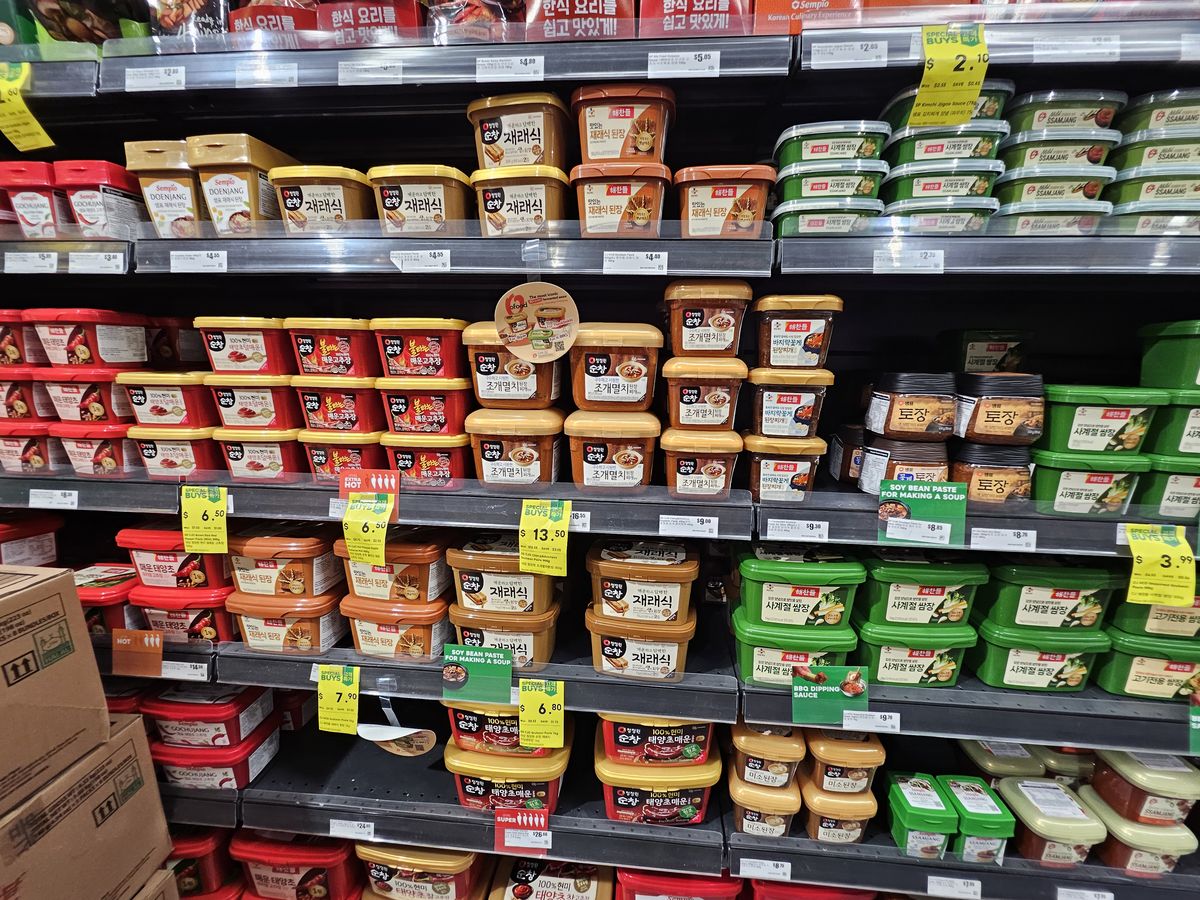
In our nut allergy guide I could tell you that Korean main dishes are mostly clear and the danger sits in the snacks. In the shellfish guide, the risk was a handful of hidden carriers — shrimp paste, fish sauce, anchovy stock. Soy has no such tidy shape. It's structural. Korean cooks don't reach for salt the way Western cooks do; they reach for ganjang (soy sauce) to season, doenjang (fermented soybean paste) for depth, and gochujang for heat and sweetness — and gochujang, which many people picture as a pure chilli paste, is traditionally made with fermented soybean powder (meju garu) as one of its base ingredients. Ssamjang, the dip that arrives with every barbecue lettuce wrap, is simply doenjang and gochujang blended together. If a Korean dish tastes seasoned, soy is the first suspect.
Then there's the whole-bean layer: dubu (tofu) in stews and as a side, kongnamul (soybean sprouts) in soups and banchan, duyu (soy milk) in kongguksu, yubu (fried tofu skin) wrapping rice, and cheonggukjang, the pungent quick-fermented bean stew. And underneath everything, the frying oil, which brings us to the one question you must ask your allergist before anything else.
The soybean oil question — settle it before you fly
Much of Korean frying — fried chicken, pancakes, tempura-style twigim, the fried tofu itself — is done in vegetable oil, and in Korea "vegetable oil" is very often 콩기름 (kong-gireum) or 대두유 (daedu-yu), refined soybean oil. Allergy bodies such as Australia's ASCIA note in their soy allergy dietary guide that highly refined soybean oil and soy lecithin can be eaten by most people with soy allergy, because refining removes most of the protein — but "most people" is a population statement, not a promise about you or your child. Whether refined soybean oil is on your avoid list is a decision for your allergist, and it changes the size of your Korean map enormously. If refined oil is fine for you, fried chicken and pajeon come back into play (with sauce and batter still to check). If it isn't, treat every fried thing in Korea as a question, and lean on grilled, boiled and steamed dishes instead.
The four places soy hides (beyond the obvious)
This is the trap I most want you to know about, because it looks nothing like a soybean product. Gochujang is red, sweet, spicy — and traditionally built on fermented soybean powder alongside the chilli and glutinous rice. That means tteokbokki, bibimbap sauce, yangnyeom fried chicken glaze, bibim-naengmyeon, spicy pork (jeyuk-bokkeum) and most "spicy" anything carry soy through the gochujang. Ssamjang at the barbecue table is doenjang plus gochujang: soy twice over. Recipes and brands vary — some modern gochujang uses different fermentation bases — but the traditional recipe contains soybeans, so treat any red paste as soy until a label or a cook tells you otherwise.
Bulgogi, galbi, dak-galbi, jangjorim, and any menu item with the word 양념 (yangnyeom, seasoned) in front of it is almost certainly marinated in a soy-sauce base. The trick that flips Korean barbecue from red to green: order the unmarinated cuts — samgyeopsal (pork belly), moksal (pork neck), saeng-galbi (fresh, unmarinated short rib), chadol (thin beef brisket) — and swap the ssamjang for gireum-jang, the little dish of sesame oil with salt and pepper that most barbecue restaurants offer alongside. Meat, salt, sesame, garlic, lettuce: no soy anywhere in that wrap. Confirm the meat really is unmarinated, and keep the ssamjang bowl on the far side of the table.
Plenty of Korean soups that look clear are seasoned with guk-ganjang, a lighter soup soy sauce that doesn't colour the broth much. Miyeok-guk (seaweed soup), many vegetable soups, and some naengmyeon broths fall here. And nearly every dish that arrives with a small dipping sauce — pajeon, mandu, sashimi-style hoe, jeon of any kind — pairs it with a soy-based yangnyeomjang. The dish itself might be fine; the sauce beside it isn't. Ask about the broth's seasoning ("소금으로 간한 거예요?" — is it seasoned with salt?), and treat every little sauce dish as soy by default.
Gimbap looks like harmless rice-and-veg, but the classic fillings are quietly seasoned: the burdock (u-eong) is braised in soy sauce, the spinach is dressed with soy or sesame, and the imitation crab or ham can carry soy protein. On the banchan table, spinach namul, braised potatoes, jangjorim (soy-braised beef) and stir-fried anchovies are all soy-sauce dishes, while kongnamul-muchim is literally soybean sprouts. In packaged food, soy protein and soy sauce powder show up in fish cakes (eomuk), instant noodle soup packets, sausages, dressings and snacks. Read every label — which is easier than it sounds, and the next section shows you how.
Join Seoul Mate free and I'll send you "Where to Start" — the 10 K-dramas I recommend to every beginner — plus a weekly pick. No spam, leave anytime.
The safe-for matrix: as served vs. with one request
Because soy is so structural, a single "safe or not" column would paint most of the menu red and leave you nothing to eat. So this matrix has two columns: how the dish typically arrives, and what happens if you make one simple request (swap the dip, hold the sauce, hold the tofu). That second column is where soy-allergic travellers actually eat.
| Dish / situation | 🫘 As served | 🙋 With a request | Why / what to ask |
|---|---|---|---|
| Seolleongtang / gomtang | 🟢 | 🟢 | Milky bone broth, salt at the table by tradition — skip the kkakdugi if it was made with soy sauce; ask |
| Samgyetang | 🟢 | 🟢 | Ginseng chicken soup, traditionally salt-and-pepper seasoned; confirm no soy in the stuffing or side sauce |
| Korean BBQ (unmarinated cuts) | 🟡 | 🟢 | Meat itself is fine; ask for gireum-jang (sesame oil + salt) instead of ssamjang, keep sauces off your plate |
| Bulgogi / galbi / "yangnyeom" anything | 🔴 | 🔴 | Soy-sauce marinade is the dish — no request fixes it |
| Bibimbap | 🔴 | 🟡 | Gochujang is soy; ask for it on the side and skip it — but namul may be dressed with soy sauce, so ask about each |
| Kimchi jjigae | 🔴 | 🟡 | Tofu is standard and some cooks add soy sauce; "두부 빼고" (no tofu) plus a seasoning question gets you partway — confirm |
| Doenjang jjigae / sundubu / cheonggukjang | 🔴 | 🔴 | Soybean paste or tofu is the dish |
| Kimchi (plain) | 🟡 | 🟡 | Many recipes use fish sauce and salt, not soy — but some add soy sauce, and brands vary; check |
| Tteokbokki / spicy street food | 🔴 | 🔴 | Gochujang sauce; the rice cakes themselves are fine, but not as served |
| Naengmyeon (mul) | 🟡 | 🟡 | Broth recipes vary — some use guk-ganjang; bibim version is gochujang (🔴) |
| Salt-grilled fish (saengseon-gui) | 🟢 | 🟢 | Mackerel or croaker, salted and grilled; skip the soy dip if one arrives |
| Fried chicken (plain / huraideu) | 🟡 | 🟡 | Soybean-oil frying (allergist question) + batter may include soy; yangnyeom glaze is soy (🔴) |
| Pajeon / jeon | 🟡 | 🟡 | Batter is usually wheat and egg; oil and the soy dipping sauce are the questions |
| Gimbap | 🔴 | 🟡 | Soy-braised burdock and dressed spinach are standard; a stripped-down version is possible at some shops — ask |
| Kongguksu / kongnamul-guk / dubu-kimchi | 🔴 | 🔴 | Soy milk, soybean sprouts, tofu — the bean is the point |
| Convenience-store meals | 🟡 | 🟡 | Read the allergen box for 대두; triangle gimbap and instant noodles usually contain it |
🟢 traditionally made without soy — but recipes vary, so confirm every time · 🟡 sometimes contains it / depends on the kitchen or your request — ask before eating · 🔴 commonly contains it — high risk. This describes typical recipes, not a guarantee about any particular kitchen, and it doesn't account for shared oil, utensils, grills or facilities.
The soy-free lane: what to actually order
Rather than leaving you with a wall of red, here's the lane I'd walk a soy-allergic friend down. Seolleongtang (ox-bone soup) and gomtang — long-simmered, milky, seasoned by you at the table with salt, pepper and spring onion; the whole tradition of these soups is that they arrive unseasoned. Samgyetang — a whole small chicken stuffed with rice, ginseng, jujube and garlic, seasoned with salt. Unmarinated barbecue with gireum-jang, as above. Salt-grilled fish at a saengseon-gui restaurant, where mackerel or croaker comes with rice and simple sides. Plain white rice and juk — rice porridge is a soy-free base, though check that the porridge shop hasn't seasoned it with soy sauce, and skip any side dishes you can't identify. Fresh fruit and simple rice cakes like plain baekseolgi. And Korean-style dak-baeksuk (boiled chicken) is another salt-seasoned classic worth knowing.
Notice the pattern: the soy-free dishes are the salt-seasoned ones — the older, simpler layer of the cuisine that predates the modern reach for soy sauce in everything. Once you start seeing Korean menus as "salt-seasoned vs. soy-seasoned," the map gets a lot clearer.
Reading Korean labels (your strongest tool)
Packaged food is where you have the most control. Korean food labelling requires manufacturers to declare a set list of allergens, and 대두 (daedu, soybean) is on that list — so on most packaged products you'll find it called out in a highlighted allergen box near the ingredients, not just buried in the list. That's a real advantage. The words to scan for: 대두 (soybean — the legal term), 콩 (bean, the everyday word), 간장 (soy sauce), 된장 (soybean paste), 고추장 and 쌈장 (soy-based pastes), 두부 (tofu), 두유 (soy milk), 유부 (fried tofu skin), 콩나물 (soybean sprouts), 대두단백 (soy protein), 대두유 / 콩기름 (soybean oil) and 레시틴 (lecithin — the refined-derivative question for your allergist again). You'll also see the same-facility advisory phrase — "대두를 사용한 제품과 같은 제조시설에서 제조" — which is Korea's may-contain warning. Point Papago's camera at the allergen box and every one of these words comes through clearly. Sealed, labelled convenience-store food is, in all honesty, one of the more relaxing food environments in Korea for a soy allergy — as long as you actually read the box.
What to ask (and how to say it)
"I have a soy allergy." — "Jeoneun daedu allereugi-ga isseoyo" (저는 대두 알러지가 있어요) — using 대두 rather than 콩 tells the kitchen you mean the allergen, not just "I don't like beans." · "Does this have soy sauce or soybean paste in it?" — "Yeogi ganjang-ina doenjang deureoga-yo?" (여기 간장이나 된장 들어가요?) · "Is it seasoned with salt?" — "Sogeum-euro ganhan geoyeyo?" (소금으로 간한 거예요?) · "Sesame oil and salt instead of ssamjang, please." — "Ssamjang daesin gireum-jang juseyo" (쌈장 대신 기름장 주세요) · "No tofu, please." — "Dubu ppaejuseyo" (두부 빼주세요). Because soy hides in so many pastes and sauces, an allergy card written in Korean — listing 대두, 간장, 된장, 고추장, 두부 explicitly — does more work here than in any other allergy. Show it, let the kitchen read it, and if the answer is a hesitant "probably fine," choose something else. Our restaurant phrase guide has the fuller toolkit.
A realistic day of eating
To show it's doable — confirming at each step, as always. Breakfast: plain juk with a seasoning question, or fruit and a labelled convenience-store item you've checked for 대두. Lunch: a bowl of seolleongtang or gomtang, salt and spring onion added by you, kimchi checked. Afternoon: a café — coffee shops in Korea are everywhere, and a black coffee or a fruit juice asks nothing of you (skip soy-milk lattes, obviously). Dinner: unmarinated pork belly or fresh short rib on the grill, lettuce, garlic, gireum-jang, rice — one of the great meals of the country, and soy-free by request. Late night: salt-grilled mackerel with rice if you're still hungry, or fresh-cut fruit from a stall. That's a full, satisfying Korean day, and it didn't require a single compromise on flavour — just the right questions at the right moments.
Two honest caveats: temple food and Korean-Chinese
If you've read our other guides you know I love pointing seafood-allergic readers toward temple cuisine. For soy allergy the picture reverses: temple food is built on soybean seasonings — doenjang, guk-ganjang, tofu — because those are exactly the ingredients that make plant-based food taste deep. So a temple-food restaurant is one of the least suitable places for a soy-allergic traveller, which is a neat reminder that "safe cuisine" always depends on which allergy you carry. Korean-Chinese restaurants (jjajangmyeon, tangsuyuk territory) are the other caution zone: jjajang is a fermented soybean-based black bean paste, soy sauce runs through most of the menu, and woks are shared. Both are places to admire from outside.
And a small practical note for peace of mind: Korea's emergency number is 119, pharmacies are marked 약국 (yakguk) and are on nearly every block, and large hospitals in major cities have international clinics. Carry your prescribed emergency medication exactly as your doctor directs, keep it on your person, and have your Korean allergy card ready to show medical staff.
Frequently asked questions
Is gochujang really soy? It just says chilli. Traditionally, yes — the standard recipe includes fermented soybean powder along with chilli, glutinous rice and salt, and most commercial gochujang lists 대두 among its allergens. A few specialty producers make soybean-free versions, but you should assume gochujang contains soy unless a label proves otherwise.
Is Korean fried chicken safe if I tolerate refined soybean oil? Then the oil is not your problem, but the batter and the sauce still might be — some batters include soy flour or soy protein, and yangnyeom (the sweet-spicy glaze) is gochujang and soy sauce. Plain fried (후라이드, huraideu) with a batter check is the version to ask about.
Is kimchi soy-free? Often but not reliably. The classic napa kimchi recipe seasons with salted seafood and salt rather than soy sauce, but plenty of home and restaurant recipes add a splash of soy sauce or fish sauce products that contain soy, and some kimchi types (like certain white kimchi or "soy sauce kimchi" variants) use it deliberately. It's a 🟡: ask each time. Our kimchi guide covers what else hides in there.
What about sesame — isn't that in everything too? It is, and sesame is a completely separate allergen from soy with its own patterns; if sesame is also on your list, gireum-jang stops being your friend and you'll want salt alone. Our sesame allergy guide maps that one separately — including why Korean labels are less help there.
Can I trust "may contain" facility warnings in Korea? Korean manufacturers print same-facility advisories much like Western ones, and how much weight to give them depends on your reaction threshold — an allergist conversation. From the food-business side I'll say what I always say: those warnings exist because shared lines are real, so if your allergy is severe, treat them in Korea exactly as seriously as you do at home.
Affiliate link — if you book through it, KContentGuide may earn a small commission at no extra cost to you. We only point you to things we'd happily use ourselves.
Soy allergy can cause severe reactions, including anaphylaxis, which is life-threatening. This is a food guide based on experience — not medical advice — and nothing here should override the plan you've made with your allergist, including how to treat refined soybean oil, soy lecithin, trace exposure and facility warnings, which are individual medical questions. Recipes vary between regions, restaurants, brands and batches; shared grills, fryers, woks and communal banchan are genuine cross-contact risks. Carry any prescribed emergency medication exactly as your doctor directs, keep your allergy written in Korean, confirm ingredients in person every time, and when you can't get a clear answer — choose something else. No meal is worth the risk.
Bottom line
Soy allergy in Korea is the hard mode of this series — the seasoning system itself is soybean-based, and gochujang, ssamjang and marinades hide soy in dishes that don't look like soy at all. But the salt-seasoned lane is real and delicious: bone soups, ginseng chicken, unmarinated barbecue with a sesame-and-salt dip, salt-grilled fish, plain rice. Learn the words 대두, 간장, 된장 and 고추장, carry a Korean allergy card that names them, ask about the sauce on everything, and settle the soybean-oil question with your allergist before you fly. For the rest of the toolkit, browse the Eat guides — especially what to ask in a Korean restaurant and the gluten-free Korea guide, which walks the same soy-sauce path for a different reason.