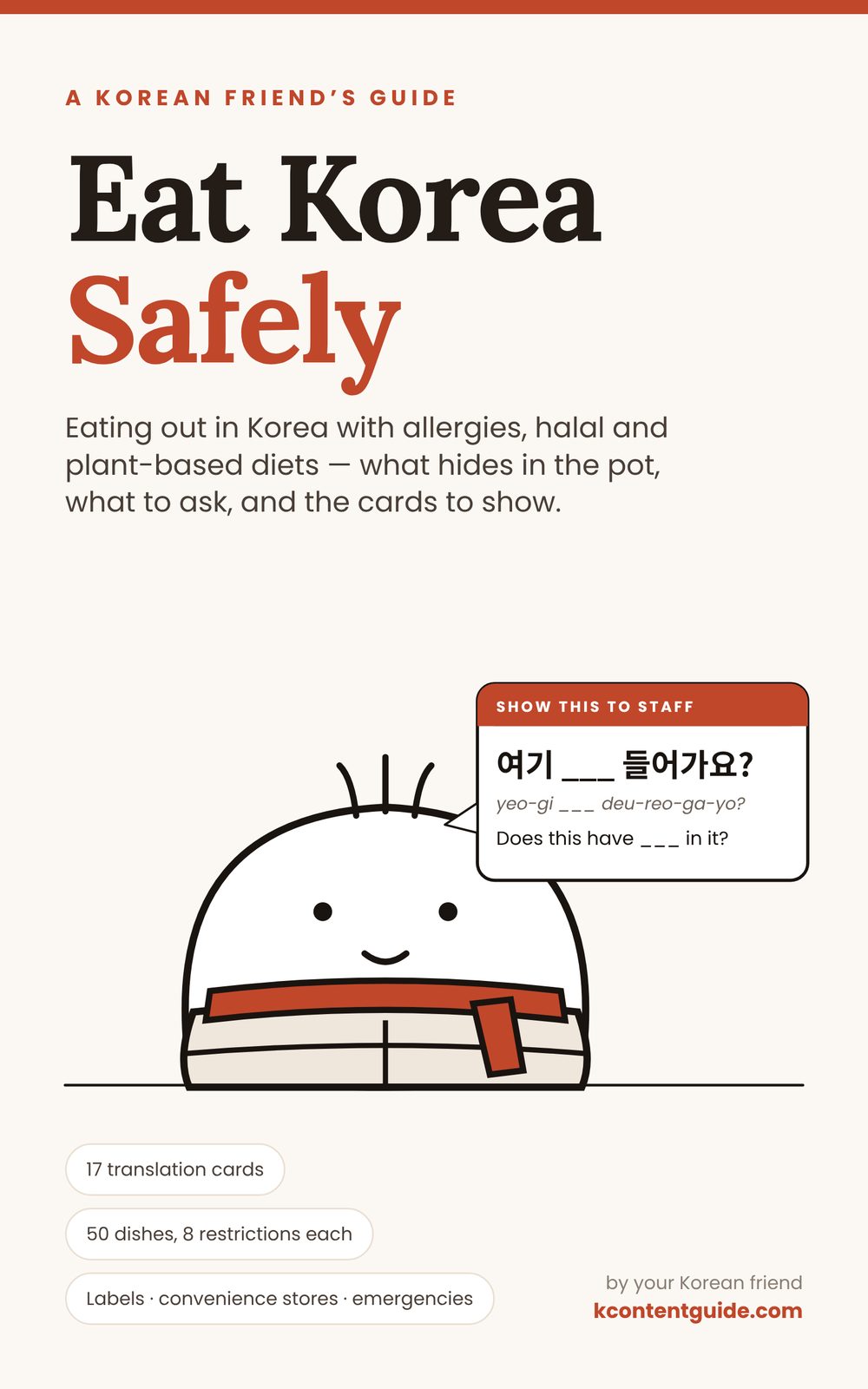
Korean food hides things — in the broth, the pastes, the seasoning powders, the sesame finish. A bowl of soybean stew can carry anchovy, beef and bouillon without any of them appearing on the menu. If you travel to Korea with a food allergy, a halal standard or a plant-based diet, "I'll just pick around it" doesn't work here, because the things that hurt restricted eaters are structural, not sprinkled. You can't pick the anchovy out of a broth.
Since June I've been writing that lesson out one guide at a time on this site — the stew that isn't vegetarian, how to read a Korean label, what to ask before you order. The book is what happens when you put all of it in one place, in order, and add the parts a website can't hold: fifty dishes each graded for eight restrictions, a chapter for every restriction, and the translation cards, one per page, sized for a phone screen.
The book's promise is not "this dish is safe." Every kitchen's recipe is its own. The promise is that you will always know what to ask, in Korean, before you eat — and when to walk away.
What's inside
The Ten-Minute Version
The whole method, small enough to hold in your head while standing outside a restaurant: the one rule above everything, the three colours, the eight lines, the one question that does most of the work, the five ways a "safe" dish goes wrong, the walk-away rule, and the thirty seconds you hope you never need. This chapter is the free preview.
The Tools — Chapters 1–5
Why Korean food hides things · the eleven big hiders (anchovy broth, jeotgal, the pastes, dashida, sesame, pine nuts, the topping egg, cooking alcohol, hidden wheat flour, soybean oil, the shared grill) · reading Korean labels with the master word table · the asking method that actually works · the convenience store as your safe harbour.
Your Restriction — Chapters 6–14
One chapter each: halal · vegan & vegetarian · gluten-free · fish & shellfish · peanut & tree nut · soy · egg & dairy · sesame · and one for people managing more than one restriction, or eating out with children.
The Food You Came For — 50 dishes
Bibimbap to bingsu. Every dish carries the same eight lines — vegan/veg, halal, gluten, fish & shellfish, soy, sesame, nuts, egg & dairy — graded 🟢🟡🔴, with Watch for and the exact Ask sentence in Korean, romanised so staff understand you when you read it aloud. One dish per page, with an A–Z index that jumps straight to it.
The Two Bookends — Chapters 22–23
Landing day, hour by hour — and if something goes wrong: pharmacies, hospitals, 119, 1330 and the emergency Korean to say or just show.
The Translation Cards
Seventeen cards in the words Korean kitchens actually use, one per page. They also come as a separate 18-page PDF in phone proportions so you're not hunting through 266 pages at a bus stop.
What one dish looks like
Here is entry 01 of Part 3, as it appears in the book — so you can judge whether the format is useful to you before paying for fifty of them.
- 🌱 Vegan/Veg: 🟡 — the vegetable version is one of Korea's most orderable meat-free meals, but the default often includes beef and always egg; order "고기 빼고, 계란 빼고". Namul may carry fish-sauce seasoning at some kitchens — ask.
- 🕌 Halal: 🟡 — beef is standard (not certified); the vegetable-and-egg version is the practical lane.
- 🌾 Gluten: 🟡 — rice and vegetables are clean; gochujang frequently contains wheat. Sauce on the side, or plain with sesame oil only.
- 🐟 Fish/Shellfish: 🟢 — typically none, but namul seasoning and some gochujang blends vary; one question covers it.
- 🫘 Soy: 🔴 — gochujang and soy-sauce-seasoned namul are structural. A plain version without sauce is possible but you're negotiating.
- 🌰 Sesame: 🔴 — sesame oil is the finishing signature, seeds scattered on top. Can be omitted if asked before assembly.
- 🥜 Nuts: 🟢 — not typical.
- 🥚🥛 Egg/Dairy: 🟡 egg (fried egg default, trivially omitted — say it early) · 🟢 dairy.
Fifty of those, grouped into rice bowls, soups and stews, barbecue, chicken, noodles, street food, sides and desserts — each section opening with the table it sits on (how a Korean barbecue table actually works for someone who can't eat soy, say), and a "by restriction" short list at the end for the days you only want to know what's 🟢 for you.
Join Seoul Mate free and I'll send you "Where to Start" — the 10 K-dramas I recommend to every beginner — plus a weekly pick. No spam, leave anytime.
The seventeen cards
Point-and-show Korean, checked against how real kitchens talk. Big Korean text, pronunciation underneath, English meaning, one card per page. At the restaurant you say 저기요 (jeo-gi-yo — excuse me), show the screen, and give them a second to read — Koreans read faster than they parse foreign-accented Korean. Every card ends with the same closing line so staff know a "no" is welcome: "I don't speak Korean — please read the card."
- C12 Emergency — with 119 in the biggest type on the page
- C1 The universal ask
- C2 Vegan
- C3 Vegetarian
- C4 Halal-minded
- C5 Gluten-free
- C6 Fish & shellfish allergy
- C7 Soy allergy
- C8 Sesame allergy
- C9 Nut & peanut allergy
- C10 Egg & dairy
- C11 The severe-allergy add-on (shared fryers, grills, tongs)
- C13 Not spicy
- C14 With a child
- C15 Pregnant
- C16 Religious diet — no beef
- C17 Low salt
Who it's for — and who it isn't
It's for travellers with food allergies (and parents of allergic kids), halal eaters, vegans and vegetarians, coeliac and gluten-free readers — anyone who has stood outside a Korean restaurant not knowing what to ask. It assumes no Korean at all.
It isn't a restaurant directory, a recipe book, or a list of "safe" places. Restaurant lists go stale in a season; the method in this book doesn't. And it isn't medical advice — see the fine print below, which I mean every word of.
Questions people ask me
- Is the free chapter really the first chapter, or a teaser?
- It's Part 0 complete — eleven pages: cover, the full table of contents and the whole Ten-Minute Version. If it turns out to be all you need, that's a fine outcome.
- What format is it?
- PDF, A5 pages, with bookmarks and internal links (tap a dish in the A–Z index and it jumps there). It's designed to be read on a phone or tablet; it prints fine too. The cards come as a second PDF in phone proportions.
- Does it work offline?
- Yes — it's a file, not an app. Download it before you fly and keep it in your phone's Files or Books app. I'd also screenshot your cards and C12.
- How do updates work?
- You buy once on Gumroad. When I revise the book, the new file replaces the old one in your Gumroad library at no charge.
- Why isn't there a halal restaurant list, or a list of allergy-friendly places?
- Because kitchens change hands, menus change, and a list that was right in spring can hurt someone in autumn. The book teaches the questions instead; the halal guide on this site covers how to read Korea's halal signage tiers.
- Is the website going away now that there's a book?
- No. The Eat guides stay free. The book is the same knowledge organised for the trip itself — plus the fifty-dish matrix and the cards, which only exist in the book.
266 pages + 17 translation cards · PDF for phone and tablet · $12.50 USD · free updates for life.
Sold through Gumroad. This is our own book, not an affiliate product.
I'm a Korean who has cooked and served food for years — not a doctor, an allergist, or a certification body. This book is a food guide based on experience, not medical or religious advice. Recipes vary by household, brand, restaurant and batch, and the same kitchen may cook restricted and unrestricted dishes side by side. The traffic lights describe typical recipes, never the specific plate in front of you. If you have a diagnosed food allergy, follow the plan your doctor gave you, carry your medication, and confirm ingredients in person every time; a food allergy can cause anaphylaxis, which is life-threatening. For halal, rely on the restaurant's own certification where that standard matters to you. When in doubt, ask — and if you can't get a clear answer, choose another dish. No meal is worth the risk.
Start here if you're not sure
Read the free Part 0. Then read your own chapter on this site — shellfish, nuts, soy, egg and dairy, sesame, gluten, vegan, halal. If those were useful, the book is the same voice with the fifty dishes and the cards added, and you'll know exactly what you're buying.