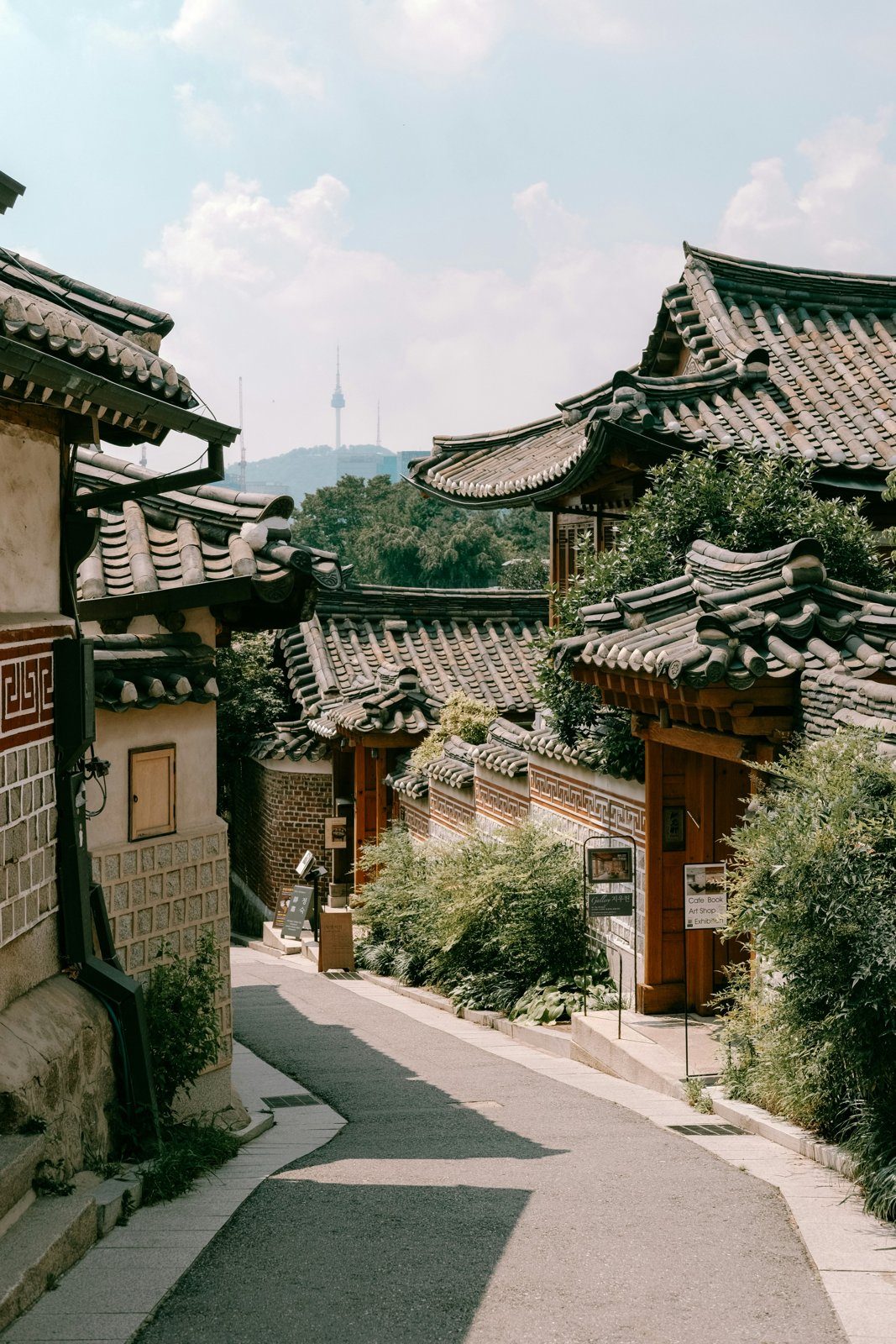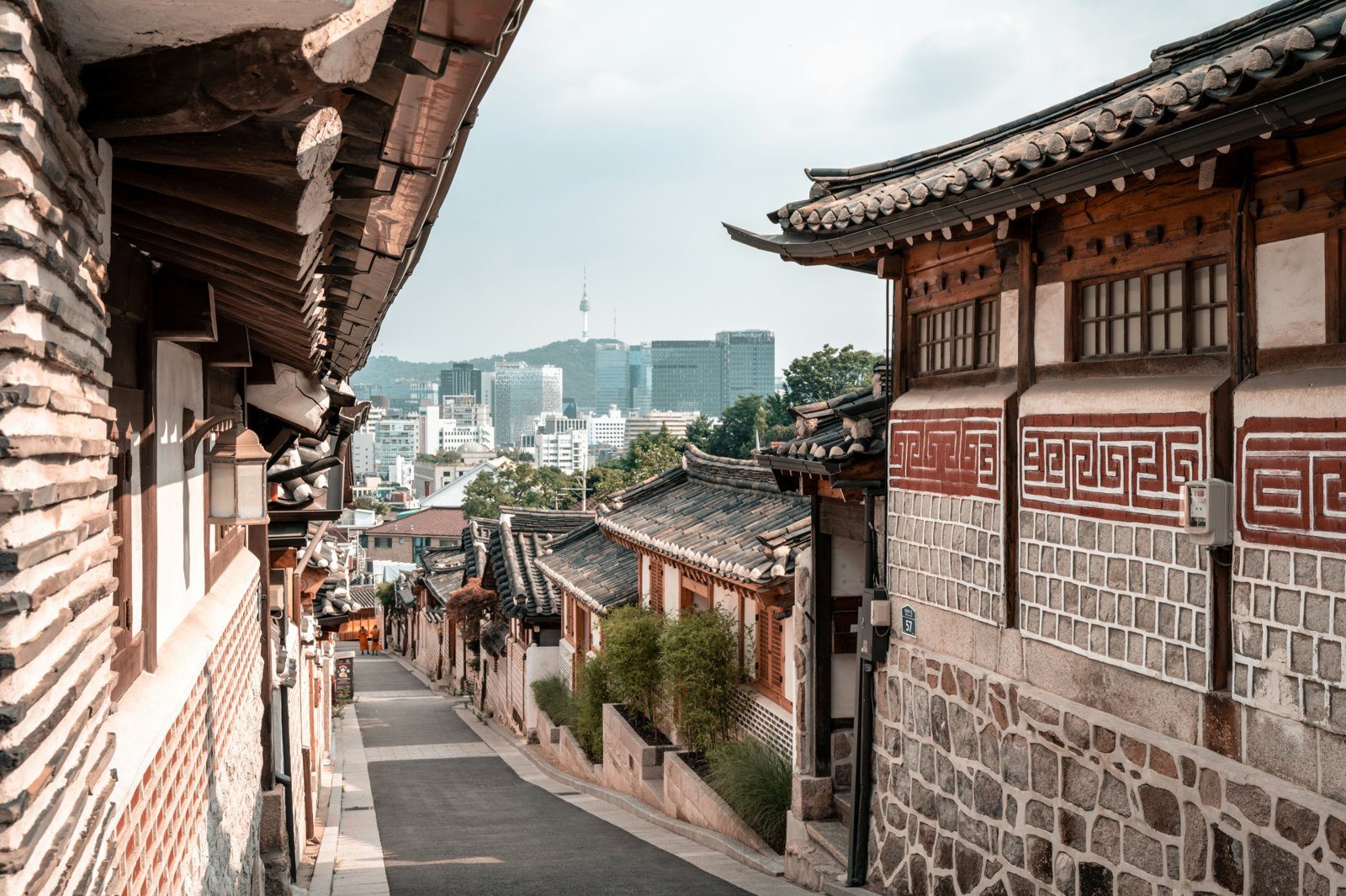
Tucked on the hillside between Gyeongbokgung and Changdeokgung is the loveliest stretch of old Seoul: Bukchon Hanok Village (북촌한옥마을), a maze of narrow lanes lined with hundreds of traditional Korean houses, or hanok. With curved tiled roofs descending toward the modern city skyline, it's one of Seoul's most photographed and most atmospheric places.
But here's the thing visitors often miss, and I want to say it before anything else: Bukchon isn't a museum or a theme park. It's a real neighbourhood where people actually live, behind those pretty wooden gates. Someone is doing their laundry in there. Someone's grandmother is having a nap. That's exactly what makes it special — and exactly why you should wander it with a little care. I'll come back to that, because it matters more here than at any other spot in this guide.
I've walked Bukchon more times than I can count — with visiting friends, on my own with a coffee, once at 7am in winter when the lanes were silent and dusted with snow and I had the whole hillside to myself. That early-morning version is the one I'd wish on you. The midday version, packed shoulder-to-shoulder with tour groups and rental hanbok, is a different and much louder place. So a lot of this guide is really about when and how, not just what. Get those right and Bukchon is magic.
Where: between Gyeongbokgung and Changdeokgung in central Seoul — easiest from Anguk Station (Line 3, Exit 2). Admission: free — it's a public neighbourhood you walk through. Best time: early morning on a weekday, for soft light and far fewer crowds. Wear comfortable shoes — the lanes are steep. Please keep your voice down: residents live here, and parts of the village have posted quiet hours (roughly 10am–5pm) because of over-tourism.
What Bukchon actually is
"Bukchon" means "north village" — it sits north of the stream that once divided old Seoul, on the slope between the two main palaces. In the Joseon dynasty this was the most prestigious address in the city: home to the yangban, the scholar-official aristocracy who wanted to live close to the royal court. If you wanted to be near power, you lived here. The hanok you see today mostly date from the early 20th century — when developers carved up the bigger aristocratic estates into the denser rows of smaller houses we walk through now — but the street plan and the aristocratic character go back centuries.
A traditional hanok is a low wooden house built around a courtyard, designed in deep conversation with the land around it. The classic ideal is baesan-imsu — a mountain at your back, water in front — and you can feel that logic in the way Bukchon's houses step up the slope. Inside, an ondol underfloor-heating system carries warmth from the kitchen fire through flues beneath the stone floor, while raised wooden-floored rooms (maru) stay cool and airy in summer. One house, two climates. It's a genuinely clever bit of architecture, and Bukchon is the densest surviving cluster of it in Seoul, which is why it feels like stepping into another era the moment you turn off the main road.
One thing worth setting straight, because it trips people up: Bukchon is not the same as a "hanok folk village" where everything is a preserved exhibit. The houses are private homes, small guesthouses, family-run cafés, working craft studios. You're not walking through a recreation of the past. You're walking through a corner of the present that happens to be very old.
What to see and do
Take it slowly; the whole joy of Bukchon is in the wandering, in turning down a lane just because the light looks nice. But there are a handful of spots and experiences worth steering toward, so here's how I'd shape a visit.
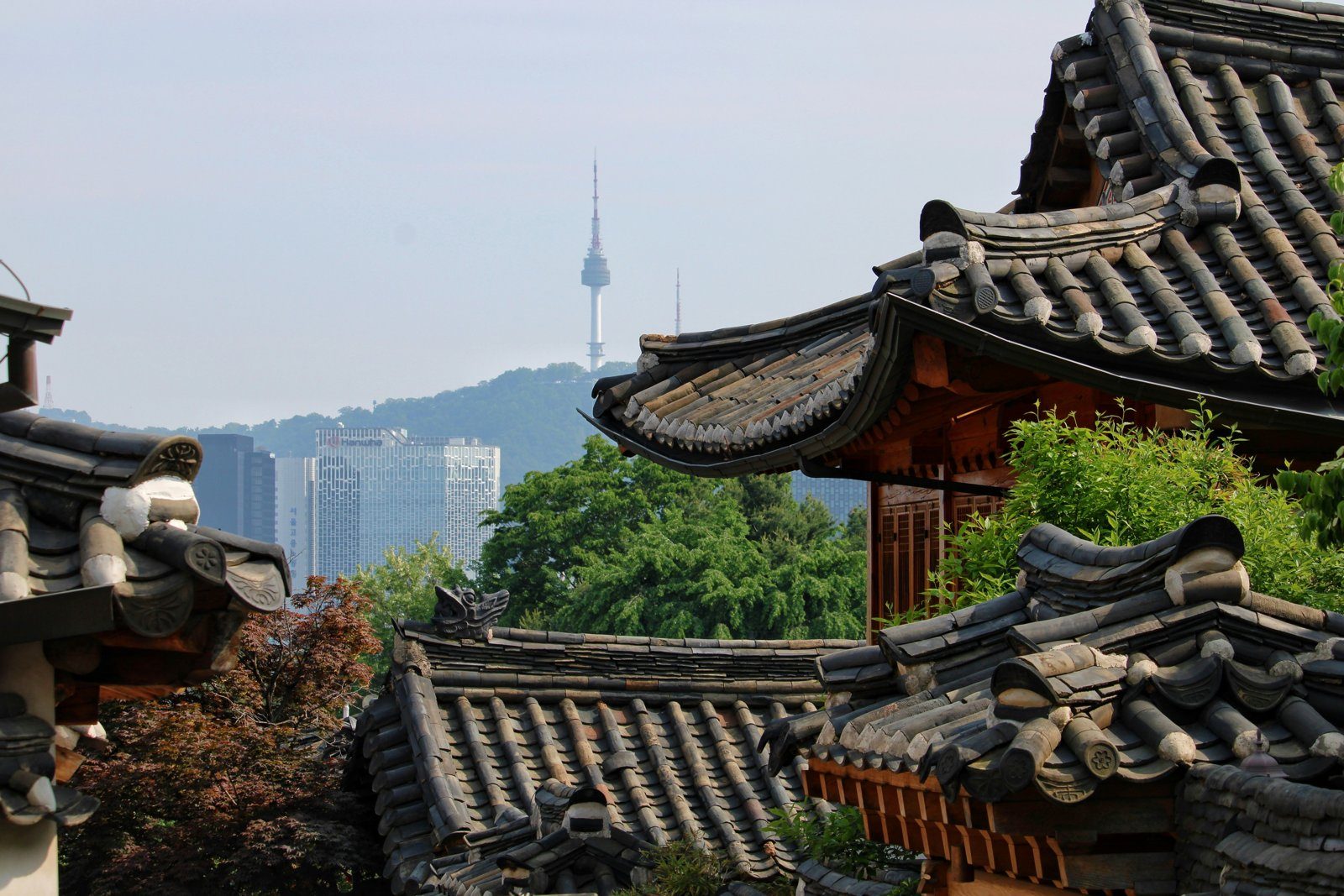
The single most photographed spot in Bukchon is a steep lane in Gahoe-dong where you look down a corridor of tiled hanok rooftops, with the towers of the modern city — and, on a clear day, N Seoul Tower on Namsan — rising beyond. It's the postcard, and honestly it earns it: the descending roofs and the skyline in one frame is a perfect little visual essay on what Seoul is. But it's also a narrow residential lane right outside people's front doors. Get your photo, take a breath to actually look at it with your own eyes, and then keep moving and keep quiet.
Come early. By mid-morning this lane fills with people queuing for the same shot, and there are usually volunteer wardens asking for hush. At 8am it can be almost empty, the light is soft and gold, and you'll have the view to yourself.
Long before it was an Instagram destination, Bukchon was a home for traditional crafts, and that thread is still alive. Tucked through the lanes you'll find small museums and working studios devoted to things like maedeup (decorative knot-tying), embroidery, and traditional crafts — and many run short hands-on sessions where you can actually make something. This is my favourite way to spend an hour here, because it turns a wander into a memory you took part in rather than just photographed.
These are little independent places, so opening days and session times vary and some are by reservation — worth checking ahead if there's a specific craft you want to try.
Plenty of the old houses have been gently converted into cafés, teahouses and galleries, and sitting inside one is the most relaxing way to experience a hanok. You end up on a cushion or a low chair around a courtyard, looking up at the underside of that beautiful timber roof, with a pot of traditional tea — maybe omija-cha (five-flavour berry) or a roasted-grain tea — cooling in front of you. It's a wonderful way to get off your feet on a hot or cold day and feel the building rather than just look at it.
The cafés thin out and get prettier as you drift toward the Samcheong-dong edge on the west side. A courtyard table on a quiet weekday afternoon is one of the nicest cheap luxuries in Seoul.
Like the palaces next door, Bukchon is a favourite place to rent hanbok and take photos in the lanes. Traditional dress against traditional houses makes the classic old-Seoul shot, and there's a real joy to it — Korean friends do this too, it isn't only a tourist thing. Rental shops cluster thickly around Anguk Station, often with packages that also cover the nearby palaces (where hanbok-wearers get in free, a lovely little perk).
Rent your hanbok near Anguk, do Gyeongbokgung or Changdeokgung first while you're fresh, then drift up into Bukchon's lanes for the quieter, more atmospheric photos.
Running down the western side of the hill is Samcheong-dong (삼청동), a long, gently sloping street of galleries, design shops, independent cafés and restaurants. It's where I send people who've had enough of the busiest photo lanes and want to just stroll, browse and eat without anyone shushing them. The mood shifts here from "delicate historic neighbourhood" to "relaxed creative street," and the two together make a far better afternoon than either alone.
Walk up through Bukchon's lanes in the cool of the morning, then come down the Samcheong-dong side for lunch and coffee. Downhill, fed, and happy — the right order.
Join Seoul Mate free and I'll send you "Where to Start" — the 10 K-dramas I recommend to every beginner — plus a weekly pick. No spam, leave anytime.
A note on visiting respectfully
Bukchon has become so popular that its residents have struggled with the crowds, noise and litter — to the point where the city has introduced visiting hours and quiet zones in the most affected lanes. None of this should put you off; it just means visiting kindly. Keep your voice low, don't peer into or enter private homes, take your rubbish with you, and avoid blocking doorways for photos. Go early and the village is calm, gorgeous, and almost yours.
If you love architecture, atmosphere and a good wander — yes, absolutely. Bukchon is one of the best places in Seoul to feel the old city. If you only want big sights and selfies, you might prefer the palaces; but for anyone who enjoys slow, photogenic neighbourhoods, it's a highlight. Pair it with a palace and you've got a perfect old-Seoul day.
When to visit
If you take one piece of timing advice from me, make it this: go early. I mean properly early — before 9am, ideally before 8am. The difference is night and day. At dawn the lanes are hushed, the light rakes low and warm across the tiled roofs, and you can hear your own footsteps. Two hours later the same lanes are a slow river of tour groups and selfie sticks, and the residents' patience is being tested. Early morning isn't just kinder to the people who live there; it's also simply the more beautiful experience.
By season, Bukchon has no bad one, but each has a flavour. Spring brings soft light and the odd blossom over a courtyard wall. Autumn — roughly mid-October into November — is my favourite, when the trees on the hill turn and the colours sit gorgeously against the grey tiles and white walls; it's also peak crowd season, so the early-morning rule matters double. Winter is cold and the slopes can ice up, but a light snow on the hanok roofs is one of the prettiest things in Seoul, and you'll have it almost to yourself. Summer is humid and hot on those exposed lanes, so that's when the hanok cafés earn their keep as cool-down stops.
For day of the week, a weekday beats a weekend by a wide margin. Weekends pull in domestic visitors on top of overseas tourists, and the village can feel overwhelmed.
How to get there
The simplest approach is by subway. Anguk Station on Line 3 (the orange line) sits right at the foot of the neighbourhood; take Exit 2 and you're a short, gently uphill walk from the lanes. There's a tourist information centre near the entrance where you can grab a free map, and honestly, a paper map helps — the hillside grid is easy to lose yourself in, which is half the charm but occasionally inconvenient. If you'd rather not navigate at all, the Naver Maps app gives accurate walking directions in Korea (Google Maps walking routes are unreliable here, which surprises a lot of first-timers — see our Naver Maps guide for why).
Because Bukchon sits between the two great palaces, you'll often arrive on foot anyway — wandering up from Gyeongbokgung or Insadong rather than making a special subway trip. That's the nicest way to do it. For the bigger picture of getting around the city, our Seoul subway guide covers the basics.
How long you need
Bukchon itself is small. If you just want to walk the main photo lanes and soak up the atmosphere, an hour to ninety minutes is plenty. Add a craft workshop or a sit-down in a hanok café and you're at two to three hours, which is the sweet spot — enough to feel unhurried without padding it out. I wouldn't build a whole day around Bukchon alone; it's at its best as one rich chapter of a larger old-Seoul day.
The natural move is to chain it together: a palace in the morning, Bukchon's lanes, lunch and coffee down in Samcheong-dong or over in Insadong, and you've filled a full, satisfying day without ever needing a taxi. Wear shoes you can climb in — the slopes are real, and cobbles plus a steep gradient is no place for slippery soles.
What to do — and what not to do
The "what to do" is the easy part: wander, photograph, drink tea, try a craft, look up at the rooflines, get pleasantly lost. The "what not to do" matters just as much here, so let me be plain about it.
- Don't raise your voice. Sound carries up these narrow lanes and straight into bedrooms. Keep conversations low.
- Don't enter, lean on, or peer through private gates and windows. A gate that's slightly open is still someone's front door, not a photo backdrop.
- Don't block doorways or driveways for a shot. People need to get in and out of their own homes.
- Take your rubbish with you. Bins are scarce and littering is a real sore point with residents.
- Watch the posted quiet hours. The worst-affected lanes have signs (and sometimes wardens) asking for silence during daytime hours — please respect them.
None of this is meant to scare you off. It's the opposite — these small courtesies are exactly what keeps Bukchon open and welcoming. Visit kindly and you're part of why it survives.
What's nearby
Bukchon sits in the richest cluster of old Seoul, all walkable:
- Gyeongbokgung & Changdeokgung — the two grand palaces on either side; the obvious pairing.
- Samcheong-dong — the gallery-and-café street running along the western edge of Bukchon, lovely for a wander and a coffee.
- Insadong & Ikseon-dong — the traditional-craft street and the trendy hanok alleys, just to the south.
- Jongmyo Shrine — the solemn royal ancestral shrine, a short walk southeast.
Round off the history with the National Museum of Korea.
Frequently asked questions
Is Bukchon Hanok Village free to enter? Yes. It's a public neighbourhood, not a ticketed attraction — you simply walk through the streets, and there's no entry fee or gate. Some individual museums, craft workshops or café experiences inside the village charge their own small fees, but wandering the lanes costs nothing.
How is Bukchon different from a "hanok folk village"? A folk village is a curated, preserved open-air museum where the buildings are exhibits. Bukchon is a living residential neighbourhood — the hanok are real homes, shops and studios that people use every day. That's why the etiquette around noise and privacy matters here in a way it wouldn't at a museum.
What's the best time of day to go? Early morning, without question. Before about 9am the lanes are calm, the light is beautiful, and you're not adding to the crowds that residents struggle with. Midday on a weekend is the busiest and least pleasant time. Whatever the hour, keep your voice down.
Affiliate link — if you book through it, KContentGuide may earn a small commission at no extra cost to you. We only point you to things we'd happily use ourselves.
👉 Doing the palaces too? See our complete guide to Seoul's 5 Grand Palaces, the perfect companion to a Bukchon day.
There's much more of Seoul still to come in our Seoul series. Subscribe below and you won't miss it.
Getting around? See our Seoul subway guide and Naver Maps guide, and read up on what Hallyu is before you go.