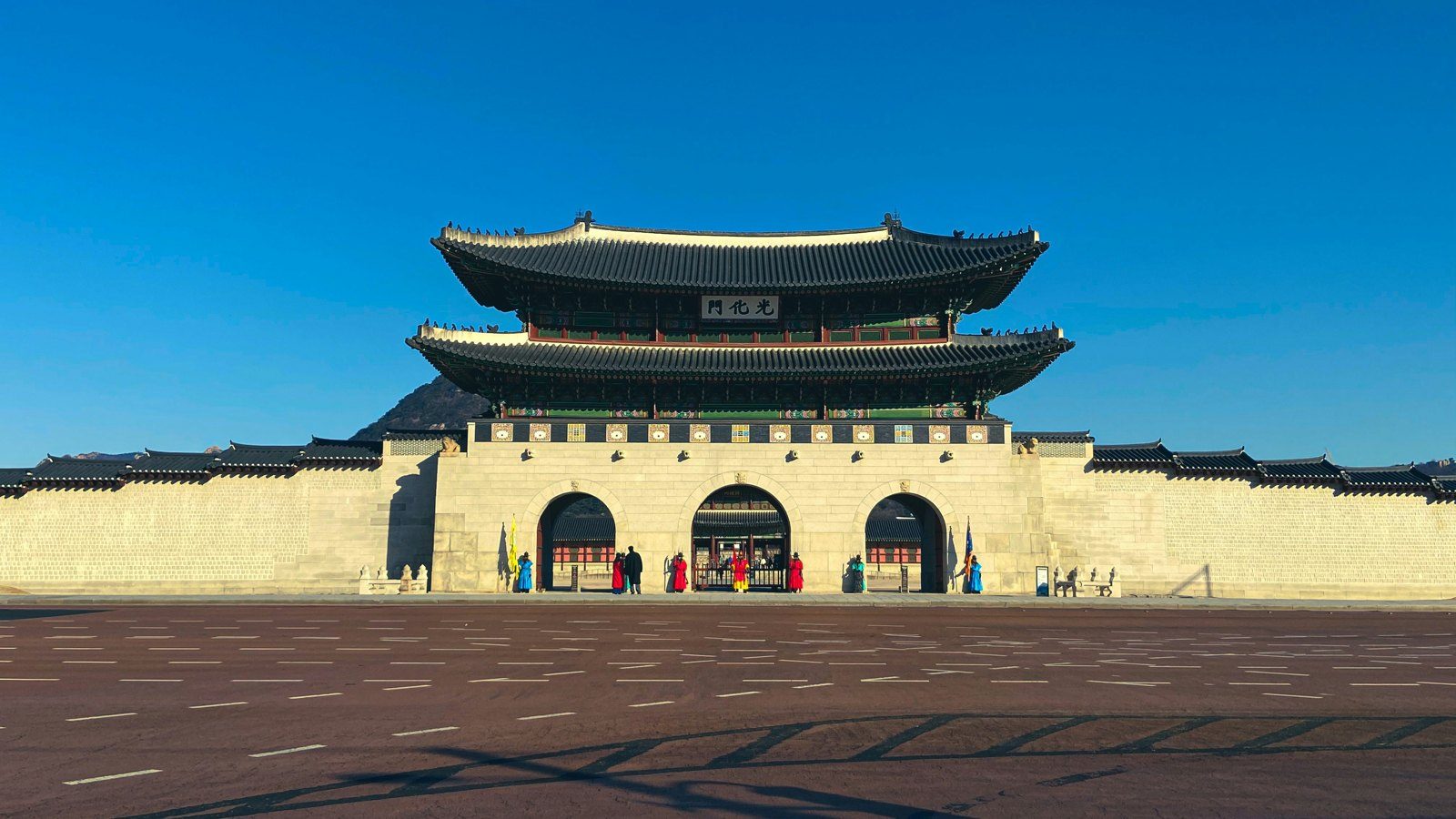
If you watch sageuk (historical dramas), you already know Gyeongbokgung (경복궁) even if you've never been — those sweeping courtyards, painted eaves and tiled roofs against a mountain are the real thing. Built in 1395, it was the main royal palace of the Joseon dynasty and the heart of old Seoul: the king's home, his government, and the stage for five centuries of court life.
It's the biggest and most important of Seoul's five grand palaces, and the easiest to fall in love with — wide, photogenic, and right in the centre of the city beneath Bugaksan mountain. I've lost count of how many times I've walked through Gwanghwamun gate, and it still gets me every time: you step off a busy modern boulevard, through a stone gateway, and suddenly the city noise drops away and there's a mountain framed perfectly behind a 600-year-old throne hall. That contrast — Seoul's glass towers on one side, a Joseon courtyard on the other — is the whole appeal in a single view.
I'll be honest about one thing up front: Gyeongbokgung is the most crowded of the palaces, especially around midday and on weekends. That doesn't put me off recommending it — it's first on my list for any visitor — but it does change how I tell people to visit it. Go early, go with a loose plan, and don't try to "do" every hall. Below is how I'd walk it, what's genuinely worth your time, and the practical stuff (the hanbok trick, the guard ceremony, when to come) that makes the difference between a rushed lap and a morning you actually remember.
Where: Gwanghwamun, central Seoul — Gyeongbokgung Station (Line 3, Exit 5) opens right at the palace, or Gwanghwamun Station (Line 5). Admission: a small fee (around ₩3,000 for adults) — and free if you're wearing hanbok. A combined ticket (about ₩10,000) covers the four palaces plus Jongmyo Shrine. Closed Tuesdays. Hours and prices shift with the season, so confirm on the official site before you go. (Send me the official or VisitKorea link and I'll add it here.)
A bit of history — why this palace matters
Gyeongbokgung was the first and grandest palace the Joseon dynasty built. When King Taejo founded the dynasty and moved the capital to Seoul (then called Hanyang) in the 1390s, this is where he planted the new kingdom's heart. The name means roughly "Palace of Shining Happiness," chosen as a blessing for the dynasty to come. For its first two centuries it was the centre of everything — the king lived here, governed here, held his great state ceremonies here.
Then came the part of the story I always think makes the place more moving, not less: it was burned to the ground during the Japanese invasions of the 1590s (the Imjin War), and it sat in ruins for nearly 270 years. For most of the Joseon dynasty's later life, Gyeongbokgung was an empty field. It wasn't rebuilt until the 1860s, under the powerful regent Heungseon Daewongun, in a massive and hugely expensive reconstruction. That grand rebuild barely got to breathe before the colonial era arrived in the early 20th century and much of the palace was torn down again, with a Japanese government building eventually planted right in front of the throne hall.
So almost everything you walk through today is the result of patient, ongoing restoration — a decades-long national project to undo that damage, remove the colonial-era additions, and rebuild the palace closer to its Joseon form. I find that worth knowing before you go, because it reframes what you're looking at. This isn't a frozen relic; it's a place Korea keeps choosing to bring back. When you stand in the main courtyard, you're standing somewhere that's been destroyed and rebuilt more than once, and is still being completed. For me that's the quiet emotional weight under all the postcard prettiness.
What to see — the highlights
The palace is big — too big to absorb in one go — so rather than march through every building, I steer people toward a handful that are genuinely worth slowing down for. Here are the ones I'd never skip, roughly in the order you'll meet them walking in from Gwanghwamun.
You start here whether you mean to or not — Gwanghwamun is the palace's grand three-arched front gate, looking out over Gwanghwamun Square with its statues of King Sejong (who gave Korea its alphabet) and Admiral Yi Sun-sin. It's been knocked down, moved and rebuilt more than once over the last century, so the gate you see is itself part of the restoration story. The guard-changing ceremony happens right out front (more on that below), so it's worth pausing here rather than rushing through.
Stand back across the square for the classic shot — gate, palace and Bugaksan mountain stacked up behind it. It's the single most "Seoul" photo you can take.
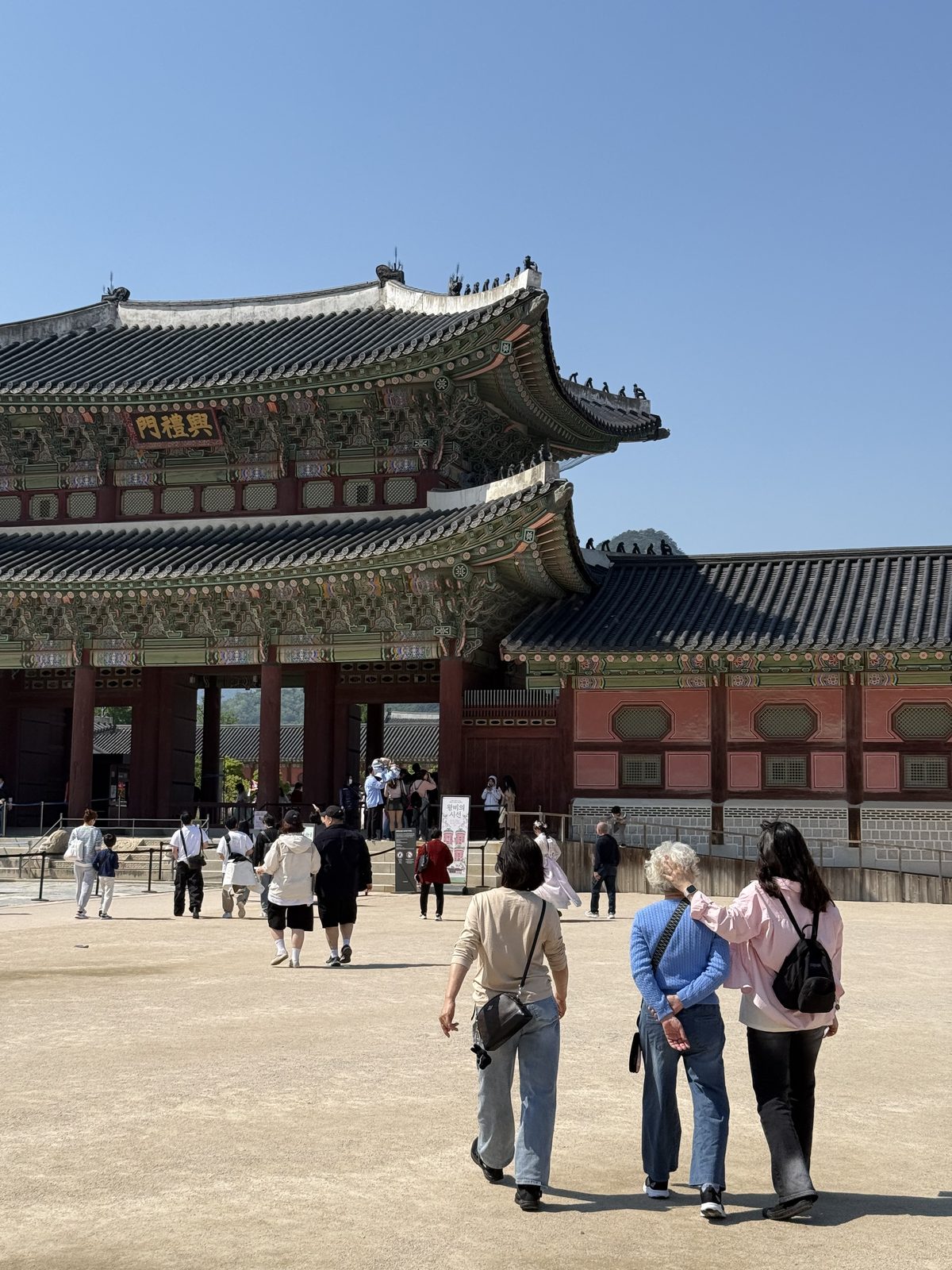
This is the heart of the palace and the image most people carry away from it: the grand main hall where kings were crowned and the most important state ceremonies were held. It sits on a two-tier stone terrace, ringed by a wide flagstone courtyard lined with rank stones (pumgyeseok) — little markers showing exactly where each grade of official had to stand. Peer inside and you'll see the royal throne backed by the Irworobongdo, the folding screen of the sun, moon and five peaks that symbolised the king's authority. If you've watched any sageuk, this courtyard will feel instantly familiar.
Look for the small carved animals lined along the roof ridges — guardian figures meant to ward off fire and evil. Once you spot them, you'll see them on every palace roof in Seoul.
My personal favourite. Gyeonghoeru is a breathtaking two-storey pavilion raised on 48 stone pillars in the middle of a large square pond, where kings held royal banquets and entertained foreign envoys. Reflected in the still water with Bugaksan behind, it's one of the most beautiful sights in the whole city — and it's a National Treasure. You usually admire it from the bank rather than walking up into it (interior access is limited and seasonal), but you don't need to go inside; the view across the water is the whole point.
Come on a still morning for a mirror reflection, or late afternoon when the low sun lights the painted underside of the roof. It's also one of the prettiest spots in autumn.
Toward the back of the grounds you'll find Hyangwonjeong, a small, perfect hexagonal pavilion sitting on its own tiny island in a round pond, reached by a slender wooden bridge. It's quieter and more intimate than the grand front courtyards — the kind of spot where the crowds thin out and you can actually hear the water. It's gorgeous in every season, but lotus-green summer and red-leaf autumn are especially lovely. This is where I tell people to slow down and just sit for a few minutes.
It's near the rear (north) end of the palace, so it pairs naturally with a walk out toward the back gate and the National Folk Museum.
Behind the ceremonial halls sit the more human, lived-in buildings — Gangnyeongjeon, the king's sleeping quarters, and Gyotaejeon, the queen's. These are lower and cosier than the throne hall, deliberately built without the grand roof ornaments to mark them as private space. Behind the queen's hall, don't miss Amisan, a charming little terraced garden with beautifully decorated hexagonal chimneys rising out of it — humble, domestic, and a nice antidote to all the grandeur out front. Most people breeze past this part; I think it's where the palace feels most like a home.
It's a reminder that real people lived their whole lives here. The ornamental chimneys especially — turning something as ordinary as a chimney into art is very Joseon.
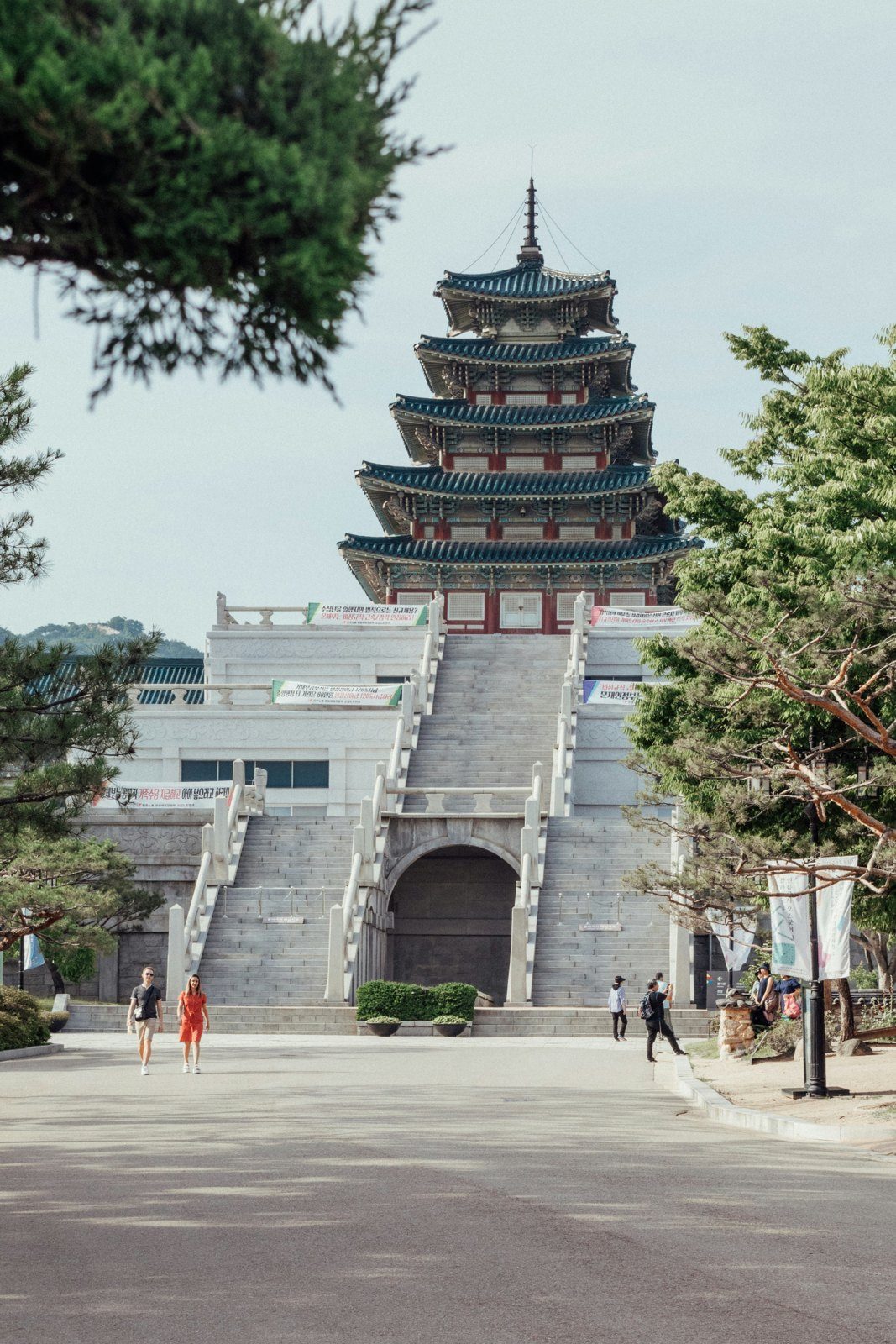
The grounds hold two excellent museums, both free. The National Palace Museum (near the front, by Gyeongbokgung Station) is full of royal treasures, court costumes, seals and the objects of palace life — it makes everything you've just seen make more sense. The National Folk Museum (toward the back, with its distinctive pagoda-style tower) walks you through everyday Korean life through the ages. Either is a perfect plan B if the weather turns, and both are genuinely good on their own merits.
Do the Palace Museum before you walk the grounds if you like context first, or save the Folk Museum for the end as you head out the back gate.
The royal guard-changing ceremony
Don't miss the Sumunjang (수문장, royal guard) changing ceremony at Gwanghwamun gate — guards in vivid traditional uniforms, drums, flags and ceremonial weapons recreate a Joseon-era ritual. It runs a few times a day (usually mid-morning and early afternoon), it's free to watch, and it's one of the best photo moments in Seoul. Check the day's schedule when you arrive, as it can pause for weather or events.
Join Seoul Mate free and I'll send you "Where to Start" — the 10 K-dramas I recommend to every beginner — plus a weekly pick. No spam, leave anytime.
Wear hanbok, get in free
Here's the move every visitor loves: rent a hanbok (한복, traditional dress) and your palace entry is free — and you'll get the dreamy photos to match. Hanbok rental shops cluster in the streets around the palace and in Bukchon; you pick an outfit for a few hours, wander the courtyards in costume, and return it after. It's touristy, yes, and completely worth it. A few honest pointers: most shops rent by the block of time (commonly something like four hours, with full-day options), so factor in time to get dressed and undressed. Hair styling and accessories are often a small add-on. And the free-entry rule does expect a recognisably traditional outfit — the shops know exactly what qualifies, so you don't have to worry, but a costume that's been heavily "modernised" can sometimes be a grey area.
One small thing I always say: you don't need to spend a fortune. The mid-range outfits photograph just as beautifully as the elaborate ones, and the magic is really the setting, not the silk.
When to visit
If you can manage it, come early in the morning right after opening. The light is soft, the big tour groups haven't arrived, and you can get those wide courtyard shots without a hundred other people in them. Late afternoon is the other good window — the low sun on the painted roofs is gorgeous, and crowds ease off before closing. Midday on a weekend is the busiest it gets, so I'd avoid that if photos matter to you.
Season-wise, every one has its case. Spring brings blossom and mild weather; autumn (roughly late October into November) is my favourite, with red and gold leaves around Hyangwonjeong and Gyeonghoeru. Summer is lush and green but genuinely hot and humid — bring water and a hat, because there's not much shade in the open courtyards. Winter is cold but clear and quiet, and a dusting of snow on the tiled roofs is magical (just dress warmly, as you'll be outside the whole time). Watch out, too, for occasional special night openings in spring and autumn — the palace lit up after dark is a different experience, but tickets for those sell out fast.
How to get there
This is the easy part — Gyeongbokgung is about as central and transit-friendly as a Seoul sight gets. The simplest option is Gyeongbokgung Station on subway Line 3 (the orange line); take Exit 5 and you surface essentially at the palace, right by the National Palace Museum. Gwanghwamun Station on Line 5 is also a short walk away and drops you at the square out front, which is a nice way to arrive because you approach the great gate head-on. If you're coming from elsewhere in the city, just search the palace in Naver Maps (Google Maps transit directions are unreliable in Korea) and let it route you — the subway is cheap, fast and tourist-proof. A taxi is fine too and not expensive, but at peak times the subway will usually beat it through downtown traffic.
How long you need
Be realistic with yourself here. You could spend a whole day if you went into every museum and every hall, but most visitors don't need to. For the highlights and the guard ceremony, I'd budget about 1.5 to 2 hours for the palace grounds. Add another 45 minutes to an hour if you want to do one of the on-site museums properly. If you're renting hanbok and taking your time with photos, give yourself a relaxed half-day and don't rush it — half the fun is dawdling. My honest advice: see the six highlights above well rather than trying to tick off every building tiredly. Palace fatigue is real, and a focused visit beats an exhausting one.
Practical tips
- It's closed on Tuesdays — plan around that (good to know if you're palace-hopping, since some other palaces close Mondays instead).
- Free English guided tours run at set times each day and are a great way to understand what you're looking at.
- Two free museums on site (Palace + Folk) if you want more, or shelter from rain.
- Go early or late — mornings are calmest; late afternoon light is beautiful on the roofs. Watch for occasional special evening openings in season.
- Wear comfy shoes — the grounds are large and mostly gravel and stone.
If you have any interest in Korean history, palaces or your favourite sageuk dramas, this is a must — and it's cheap (or free in hanbok), central and easy. Even a relaxed 1.5–2 hours hitting the highlights and the ceremony is plenty.
What's nearby
Gyeongbokgung sits in the most walkable, history-rich corner of Seoul, so build a half-day around it:
- Bukchon Hanok Village — lanes of traditional tiled houses just east of the palace, beautiful for a slow wander (be quiet; people live there).
- Samcheong-dong — a pretty street of cafés, galleries and boutiques running up the palace's east side.
- Insadong — traditional crafts, tea houses, antiques and souvenirs, a short walk south.
- Tongin Market — a fun local market by the palace's west gate, known for its "dosirak (lunchbox) café" where you pay with old-style brass coins.
- Gwanghwamun Square & Cheonggyecheon — the grand plaza out front, and a restored stream you can walk along, both just south.
- The other palaces — Changdeokgung and Changgyeonggung are a short way east, and Deoksugung is by City Hall, if you want to palace-hop.
Pair it with the National Museum of Korea for the full history fix.
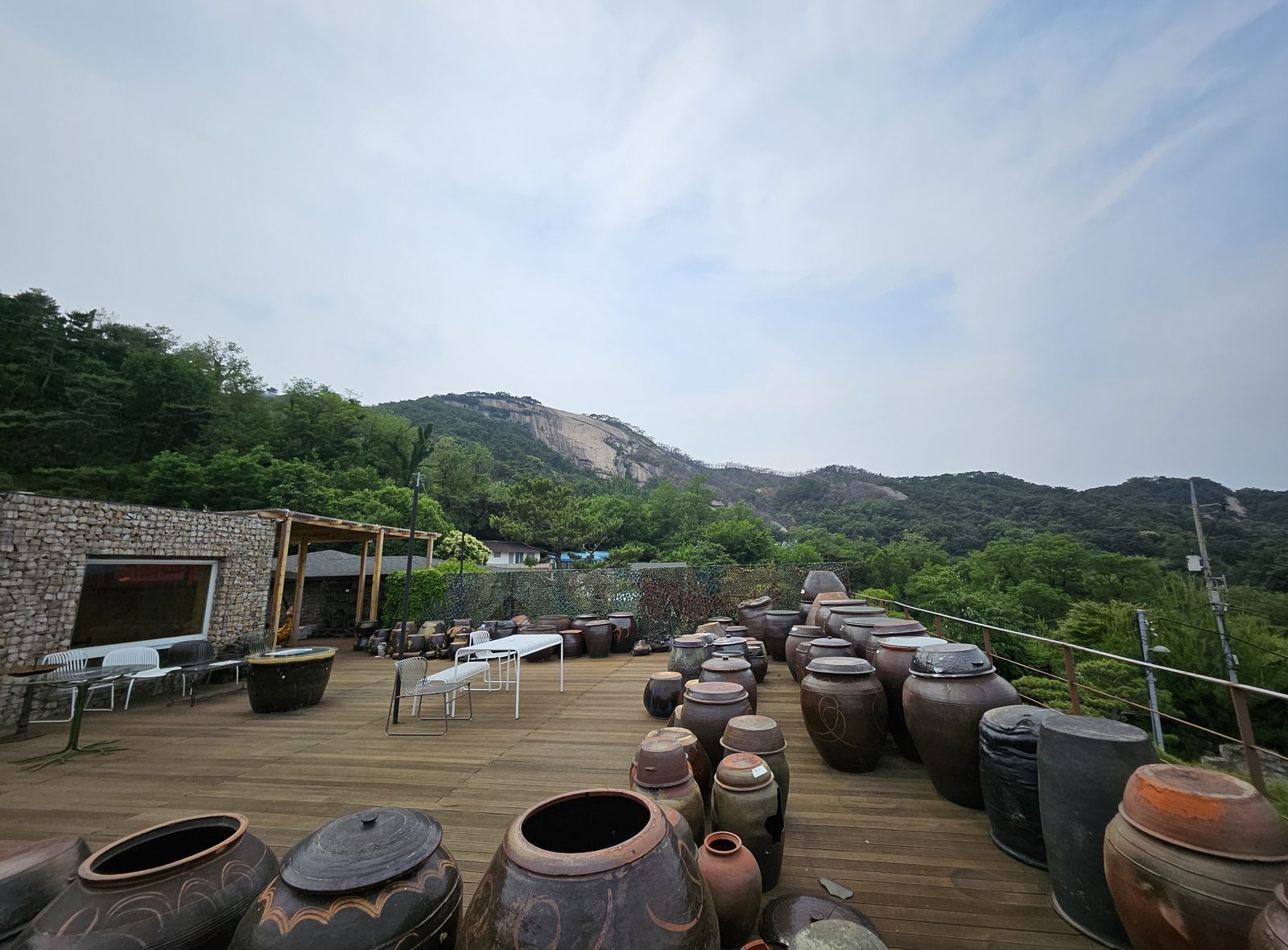
One exception that's worth a bus: Buam-dong, the quiet hillside village over the ridge behind the palace. It feels like a different city — low houses, small galleries, and the mountains right on top of you. The rooftop of the Mokin Museum is the spot: a deck covered in old onggi jars, stone figures along the railing, Inwangsan's granite face behind, and a view back across Pyeongchang-dong to Bukhansan.
The beauty of Gyeongbokgung's location is that you genuinely don't need to plan a separate outing for any of this — it's all on foot. A morning at the palace flowing into lunch and a wander in Bukchon, then tea in Insadong, is one of my favourite easy days in Seoul, and you'll barely touch the subway. If you've got the energy for a second palace, Changdeokgung is about a ten-minute walk east — just remember it's closed Mondays while Gyeongbokgung is closed Tuesdays, so the two together cover almost any day of the week.
Frequently asked questions
Is Gyeongbokgung worth visiting if I'm only in Seoul for a short time? Yes — if you see one palace, make it this one. It's the grandest, the most iconic, the easiest to reach, and it has the guard ceremony. A focused 1.5–2 hour visit fits comfortably into even a packed itinerary, and it's central enough that you can fold in Bukchon or Insadong around it.
Do I really get in free wearing hanbok, and where do I rent it? Yes, hanbok genuinely gets you free palace entry — it's a real, long-standing policy meant to encourage people to wear traditional dress. Rental shops cluster in the streets right around the palace and through Bukchon; you choose an outfit for a set block of time, wear it around the grounds, and return it after. It's one of the best-value tips in Seoul, since you save the entry fee and get lovely photos.
What day is Gyeongbokgung closed? Tuesdays. That's worth remembering, because most of Seoul's other palaces close on Mondays instead — so if you're palace-hopping, you can almost always find one open. Opening hours shift a little with the season, so check the current times before a tightly timed visit.
Affiliate link — if you book through it, KContentGuide may earn a small commission at no extra cost to you. We only point you to things we'd happily use ourselves.
👉 Seeing more than one? Our complete guide to Seoul's 5 Grand Palaces compares all five — which to pick, the money-saving integrated ticket, and a link to each.
This is part of our growing Seoul series — more of the city's best places to come, including the other palaces. Subscribe below and you won't miss them.
Getting around? See our Seoul subway guide and Naver Maps guide, and read up on what Hallyu is before you go.