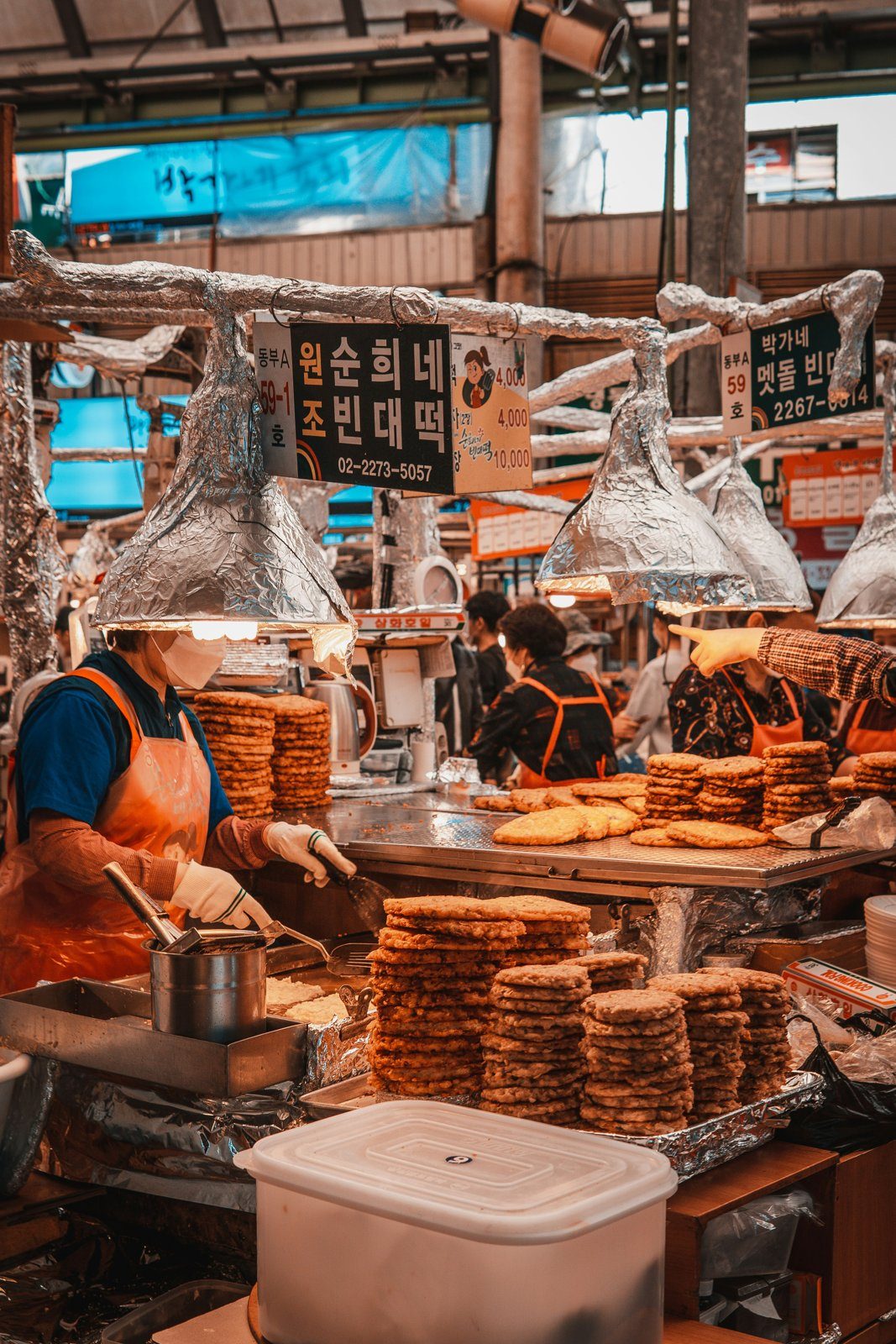
If you want to eat your way through old Seoul, there's one place to start: Gwangjang Market (광장시장). Opened in 1905, it's one of Korea's oldest permanent markets — and today it's the country's most famous street-food destination, a roaring, steaming maze of food stalls where grandmothers have been frying the same dishes for decades.
It's been featured on Netflix and drawn food lovers from all over the world, but at heart it's still a working Seoul market. Here's what to eat, and how to do it right.
I'll be straight with you: Gwangjang is not a hidden gem anymore, and I'm not going to pretend it is. It's busy, it's smoky, the famous stalls have queues, and — I'll get to this honestly below — its fame has come with some real downsides around pricing. But none of that changes the fact that it's still one of the most alive, most characterful places to eat in Seoul. The trick is going in knowing what you're doing instead of wandering in cold and getting overwhelmed. That's what this guide is for.
A quick history (and why it feels the way it does)
Gwangjang opened in 1905, and the story behind it actually matters to the mood of the place. It was founded by Korean merchants as a permanent, Korean-owned market during a period when much of the economy was falling under outside control — so from the very beginning it carried a stubborn, hold-your-ground sort of pride. That's part of why it still feels so unpolished and so resolutely local even now: it was never built to charm tourists, and a lot of the grandmothers frying pancakes have been at the same griddle for decades, sometimes inheriting the stall from the woman before them.
It helps to picture the layout. Gwangjang has two lives stacked on top of each other. Around the edges and upstairs it's a textile and clothing market — bolts of fabric, hanbok, and a famous corner of vintage and second-hand clothes that young Koreans now treasure-hunt through. Down the central spine runs the food alley, and that's the part the world knows: a covered cross of lanes lined with stalls, stools jammed around hot griddles, steam and chilli smoke hanging in the air. You don't need a plan to find it — just follow the smell of frying mung-bean batter and the noise.
Where: Jongno, central Seoul — Jongno 5-ga Station (Line 1) is right at the market. Admission: free to enter; you just pay for what you eat. Best time: late morning to early evening for the food stalls. Bring some cash — many stalls take cards now, but cash is still smoothest. It gets busy and crowded; lunch and dinner are liveliest.
What Gwangjang is
Gwangjang was Korea's first permanent daily market, and it still has two sides. Upstairs and around the edges it sells textiles, hanbok and vintage clothing — it's a well-known spot for second-hand and traditional dress. But what made it famous is the food alley down the middle: rows of stalls with stools crammed around hot griddles, where you sit elbow-to-elbow with locals and eat freshly made Korean classics.
What to eat — the must-tries
This is the reason to come. The signatures:
1. Bindaetteok (빈대떡) — mung-bean pancake
Gwangjang's most iconic dish: a thick, crispy pancake of ground mung beans, fried golden on huge griddles right in front of you. Hot, savoury and best torn apart and dipped in soy sauce with raw onion. This is the smell that defines the market.
2. Mayak gimbap (마약김밥) — the "addictive" mini rolls
Tiny seaweed-rice rolls, no bigger than a finger, served with a mustard-soy dipping sauce. They're nicknamed mayak ("drug") gimbap because people can't stop eating them. Cheap, moreish, and a Gwangjang signature.
3. Yukhoe (육회) — Korean beef tartare
Seasoned raw beef, sliced thin and often topped with a raw egg yolk and pear. Gwangjang has a little cluster of yukhoe restaurants and it's one of the best places in the city to try this Korean delicacy.
4. Janchi-guksu (잔치국수) & kalguksu (칼국수) — warm noodles
If bindaetteok and yukhoe are the showy stars, the noodle stalls are the comforting heart. Janchi-guksu — literally "banquet noodles" — is thin wheat noodles in a light anchovy-and-kelp broth, garnished with egg and seaweed. It's gentle, cheap, and exactly what you want as a palate-settler between richer bites. The kalguksu stalls hand-cut their noodles right there; a few are little institutions in their own right with their own loyal queues.
5. Sundae & jeon
You'll also find sundae (Korean blood sausage), platters of jeon (savoury fried fritters), spicy tteokbokki, and steaming kkori gomtang oxtail soup — proper, hearty Korean market food. The jeon stalls are a feast for the eyes alone: golden discs of battered vegetables, fish, and meat stacked high, sold by weight and brilliant with a bowl of makgeolli.
The honest verdict: what I'd actually queue for
If you only have room for a few things — and you will fill up faster than you think — here's where I'd spend my stomach space. Get the bindaetteok; it's the soul of the place and worth the smoke in your hair. Get a plate of mayak gimbap, because they're tiny, cheap, and genuinely moreish. If you eat raw beef, the yukhoe here is some of the best-value in the city. Beyond that, a warm bowl of noodles to round things off. Everything else is a bonus you can chase on a return visit.
Join Seoul Mate free and I'll send you "Where to Start" — the 10 K-dramas I recommend to every beginner — plus a weekly pick. No spam, leave anytime.
How to do the market right
- Go hungry and graze — the whole point is to bounce from stall to stall trying small things, not to sit down for one big meal.
- Sit at the counters — pull up a stool at a griddle stall; it's normal to share tables and eat shoulder-to-shoulder with strangers.
- Watch what's popular — the stalls with the longest local queues are usually the safest bet.
- Mind the prices — it's cheap, but confirm prices for things like yukhoe or seafood before ordering, especially at the busiest tourist stalls.
- Pair it with a drink — a bowl of makgeolli (rice wine) alongside bindaetteok is the classic Gwangjang combo.
- Jongmyo Shrine — the UNESCO royal ancestral shrine, a short walk west; perfect to pair with a market lunch.
- Insadong & Ikseon-dong — the traditional craft street and trendy hanok cafés, just nearby.
- Euljiro & Dongdaemun — the retro-cool backstreet bars of Euljiro and the giant Dongdaemun shopping district are within walking distance.
- Cheonggyecheon stream — the restored downtown stream runs right by the market for a post-meal stroll.
I'll be honest with you, friend, because that's what this site is for. Gwangjang's fame has a downside: some stalls — especially the busiest, most tourist-facing ones — have drawn real criticism, including from Korean media and city officials, for overcharging visitors and for prices that often aren't clearly displayed. After the controversy there were official warnings and the merchants' association promised to fix it, but it hasn't fully changed, and plenty of Koreans now go less often because of it. Most stalls are also cash-first. So protect yourself: carry cash, ask the price before you order, watch the portion go onto your plate, and favour the stalls where Korean regulars — not just tour groups — are actually eating. Go in aware and you'll still have a wonderful time.
A little secret from a Korean: the restaurants packed with foreigners aren't always the best ones. In very touristy areas — parts of Myeongdong and Insadong, for example — some places quietly tweak their food for visitor tastes (often noticeably sweeter or milder), and locals tend to skip them. The good news is the flip side: a place with few tourists but a steady local crowd is often where the real flavour is. My rule of thumb? Eat where Seoul's office workers eat. Around business districts like Gwanghwamun, Jongno, Euljiro and Gangnam, white-collar workers eat out almost every day, so the restaurants there live or die on taste and value — which makes them some of the most reliable meals in the city.
If you love food and atmosphere, Gwangjang is unmissable — loud, smoky, delicious and very alive. If you want a quiet sit-down meal, it might feel overwhelming; go at an off-peak hour, or treat it as a snack stop between sights. Either way, it's one of the most fun and authentic eating experiences in Seoul.
When to go, and how to navigate it
Timing genuinely changes the experience here, so it's worth thinking about. The food alley is liveliest from late morning through the evening, and the energy peaks around lunch and again at dinner. If you want the full sensory roar — every griddle going, every stool full, the place absolutely humming — come at peak. If crowds and queues stress you out, come mid-afternoon, somewhere between the lunch and dinner rushes; the famous stalls are calmer and you can actually get a stool without hovering. Very early morning is a different market entirely: quieter, more about the produce and textile traders than the street food, which has its own charm if you're an early riser.
Navigating it is simpler than it looks. The food stalls cluster along the main central lanes, so once you're in that spine you can't really get lost — just walk slowly and let the queues guide you. A few practical notes from experience: carry cash, because while more stalls take cards now, cash is still smoothest and fastest at the busy griddles. Travel light — it's crowded and you'll be sitting at tight counters, so a big backpack is a nuisance. And don't over-order at the first stall you see. The whole joy is grazing, so buy small, eat, move on, and keep some appetite for the next thing.
One more tip that serves you well anywhere in Korea: if you're navigating on your phone, Google Maps is famously unreliable here for walking directions. Locals use Naver Map or KakaoMap. If you've never set those up, our Naver Maps guide walks you through it, and the Seoul subway guide covers getting to Jongno 5-ga in the first place.
Frequently asked questions
Is Gwangjang Market good for vegetarians?
Partly. There's genuinely good vegetarian-leaning food — bindaetteok is made from mung beans, and the noodle and vegetable-jeon stalls have options. But be aware that "vegetable" broths often start with anchovy or beef stock, and dishes are rarely strictly meat-free in the Western sense. If you're a flexible vegetarian you'll eat happily; if you're strict, ask carefully and lean on the clearly plant-based fried items.
Can I go without speaking Korean?
Absolutely. Gwangjang is so used to visitors that pointing, smiling, and holding up fingers for quantity works fine. Many famous dishes have signs in English now. That said, a friendly "annyeonghaseyo" and "igeo juseyo" (this one, please) goes a long way and the ajummas warm to anyone who tries.
How much time should I budget?
An hour or two is plenty to graze the highlights without rushing. If you're pairing it with nearby sights — and you should — treat the market as a memorable lunch stop rather than a half-day destination. You'll have eaten your fill long before you've seen every stall.
What's nearby
Gwangjang sits right in the historic heart of Seoul:
Hungry for more? See our Korean street food guide and 10 Korean foods every fan must try.
Affiliate link — if you book through it, KContentGuide may earn a small commission at no extra cost to you. We only point you to things we'd happily use ourselves.
👉 Exploring old Seoul? Pair this with Jongmyo Shrine and the 5 Grand Palaces for a perfect downtown day.
There's much more of Seoul still to come in our Seoul series. Subscribe below and you won't miss it.
Getting around? See our Seoul subway guide and Naver Maps guide, and read up on what Hallyu is before you go.