Every allergy guide in our Eat series ends up saying the same sentence: "read the label." And every time I write it, I'm aware of what I'm actually asking you to do — stand in a brightly lit GS25 at nine at night, holding a package covered in a language you can't read, trying to decide whether a snack is safe. This guide exists to fix that. It's the one page where I teach the label itself: what Korean food packaging is legally required to tell you, exactly where on the package to look, which words to scan for every major allergen and diet, and — just as important — what a Korean label is not required to tell you.
Here's the encouraging part before we start: Korea's labelling system is genuinely good. Allergens aren't buried in the ingredient list the way they can be elsewhere — the law requires them called out in a separate, highlighted box near the ingredients, usually with a coloured or outlined background so it jumps out. Once you know that box exists and can recognise a dozen key words, the convenience store stops being intimidating and becomes what it really is: the most controlled, most readable food environment in the country. I've written the word lists below so you can scan them with your phone camera, screenshot them, or — if you're the paper type — print them. As always: manufacturers change recipes between batches, so read the actual package in your hand, every time.
Korean law requires a fixed list of allergens — including egg, milk, wheat, buckwheat, peanut, soybean, walnut, pine nut, mackerel, crab, shrimp, squid, shellfish, pork, beef, chicken, peach, tomato and sulphites — to be declared in a highlighted allergen box near the ingredient list, plus a "made in the same facility" advisory line where it applies. Find the box (look for ~함유, "contains"), scan it with a translation app, and match it against the word table below. The big catch: sesame is not on the mandatory list, and neither are halal or vegan concerns like alcohol or animal-derived additives — for those, you read the full ingredient list.
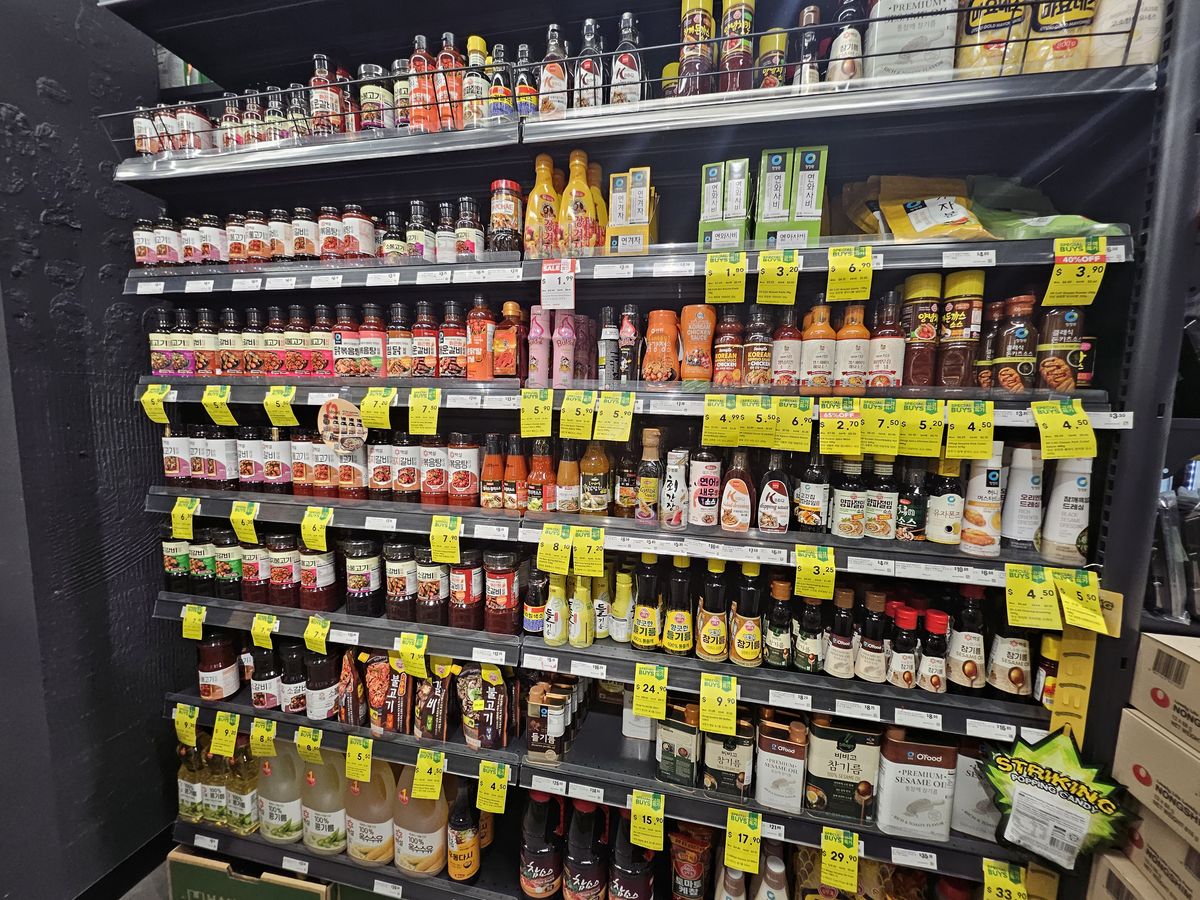
The anatomy of a Korean food label
Turn over any packaged product in Korea — a bag of chips, a triangle gimbap, a cup ramyeon — and you'll find the same standard block of information, laid out the same way almost every time. Learning this layout once means you can navigate every package in the country.
제품명 (product name) sits at the top of the information panel, often with the food type (식품유형) under it — useful when the front of the package is all branding and mascots. 원재료명 (ingredients) is the long comma-separated list, in descending order by weight, just like at home. Percentages appear for headline ingredients. Then comes the part you care about most:
The allergen box. Directly after (or inside) the ingredient list, Korean law requires allergens to be restated separately, on a contrasting or outlined background, in the form "…함유" — "contains…". A typical line reads 대두, 밀, 우유 함유 ("contains soybean, wheat, milk"). This is the single most useful design feature of Korean packaging: you don't have to parse the whole ingredient list to find the allergens; the law has already done it for you. The word 함유 (hamyu, contains) is your landmark — find it and you've found the box.
The facility advisory. Near the allergen box you'll often see a longer sentence in the pattern "이 제품은 ○○를 사용한 제품과 같은 제조시설에서 제조하고 있습니다" — "this product is made in the same facility as products using ○○." That's Korea's version of "may contain traces." How much weight to give it depends on your reaction threshold, which is a conversation for your allergist, not a food blog — but the sentence pattern is worth recognising so you know you're looking at an advisory, not a contents declaration.
The rest of the block — 내용량 (net weight), 유통기한/소비기한 (sell-by / use-by date, printed as 연.월.일: year.month.day, so 26.09.14 is 14 September 2026), 보관방법 (storage), and the nutrition panel (영양정보) with calories (열량), sodium (나트륨), sugars (당류) and so on. One habit worth building: the date format. More than one traveller has read 26.09.14 as the 26th of September.
What the law requires — and the two big gaps
Korea's mandatory allergen declaration list, administered by the Ministry of Food and Drug Safety, covers eggs (from poultry), milk, buckwheat, peanuts, soybeans, wheat, mackerel, crab, shrimp, squid, shellfish (oyster, abalone, mussel), pork, beef, chicken, peach, tomato, walnuts, pine nuts and sulphites. Anything on that list that's present in the product must appear in the highlighted box. A few things on it will surprise Western readers pleasantly: pine nuts and buckwheat are rarely declared allergens elsewhere, and both matter enormously in Korean food (pine nut garnishes on porridge; buckwheat in naengmyeon noodles).
Now the gaps, because they're where the risk lives. Gap one: sesame. As we covered at length in the sesame guide, sesame is not on Korea's mandatory list — remarkable, given how much of Korean food it touches, and given that the US, EU, UK and Australia all require it. Many manufacturers list 참깨 voluntarily in the ingredients, but its absence from the allergen box proves nothing. If sesame is your allergen, you read the full ingredient list, every time, and treat a silent label as unknown rather than clear.
Gap two: everything that isn't an allergen. The box is an allergy tool, not a diet tool. It won't tell a vegan about honey or animal-derived additives, won't tell a halal reader about alcohol in the seasoning or whether the 소고기 (beef) was slaughtered to standard, and won't distinguish fish sauce from fish for a pescatarian reading habits. For those questions the ingredient list is your text, and the word tables below are organised so you can scan for exactly what matters to you.
The master word table: allergens
These are the words to scan for, allergen by allergen. The bolded Korean is what actually appears on packages; the parenthetical forms are variants you'll also meet. Screenshot this section — it's designed to be read offline in a shop aisle.
| Your allergen | Scan for | Notes |
|---|---|---|
| Egg | 난류(가금류) · 계란 · 달걀 · 난백 (white) · 난황 (yolk) · 전란 (whole) · 마요네즈 | 난류 is the legal term in the allergen box; 계란/달걀 in ingredients |
| Milk / dairy | 우유 · 유제품 · 분유 (milk powder) · 전지분유/탈지분유 · 유청 (whey) · 카제인 · 버터 · 치즈 · 생크림 · 연유 (condensed) | 유당 = lactose (a sugar, but a sign milk is present); "유당 제로" is still milk protein |
| Wheat / gluten | 밀 · 밀가루 (wheat flour) · 소맥분 · 글루텐 | Buckwheat (메밀) is separate and also declared; soy sauce usually contains 밀 |
| Buckwheat | 메밀 | Naengmyeon and makguksu noodles, some teas — declared in Korea, unusual elsewhere |
| Peanut | 땅콩 · 낙화생 | Watch snack mixes and the anchovy-peanut banchan |
| Tree nuts | 호두 (walnut) · 잣 (pine nut) · 아몬드 · 캐슈넛 · 피스타치오 · 마카다미아 | Only walnut and pine nut are mandatory declarations — scan ingredients for the others |
| Soy | 대두 · 콩 · 간장 · 된장 · 고추장 · 두부 · 두유 · 대두단백 · 대두유/콩기름 · 레시틴 | The backbone of Korean seasoning — see the soy guide |
| Sesame ⚠️ | 참깨 · 참기름 · 깨 · 통깨 · 깨소금 · 검은깨/흑임자 · 참깨분말 | NOT mandatory — read the full ingredient list; 들깨/들기름 is perilla, a different plant |
| Fish | 고등어 (mackerel) · 멸치 (anchovy) · 액젓 (fish sauce) · 어분/어육 (fish meal/meat) · 가쓰오부시 | Only mackerel is a mandatory declaration — other fish appear in ingredients only |
| Crustacean | 새우 (shrimp) · 게 (crab) · 새우젓 (salted shrimp) · 크릴 | 새우젓 hides in kimchi — see the shellfish guide |
| Mollusc | 오징어 (squid) · 조개류 (shellfish) · 굴 (oyster) · 전복 (abalone) · 홍합 (mussel) | All mandatory; 굴소스 = oyster sauce |
| Meat allergies | 돼지고기 (pork) · 쇠고기/소고기 (beef) · 닭고기 (chicken) | All three are mandatory declarations — rare internationally, useful in Korea |
| Fruit & other | 복숭아 (peach) · 토마토 · 아황산류 (sulphites) | Peach turns up in juices, dressings and marinades |
The word table: diets, not allergies
If you're reading labels for halal, vegan or vegetarian reasons, the allergen box helps you less and the ingredient list matters more. The words that decide things:
| You avoid | Scan for | Notes |
|---|---|---|
| Pork (halal) | 돼지고기 · 돈지 (pork fat) · 젤라틴 (gelatine) · 돈골 (pork bone) | Pork is a mandatory declaration, which makes this easier than in many countries; gelatine's source often isn't stated — treat unstated 젤라틴 as a question |
| Alcohol (halal) | 주정 (ethanol/spirits) · 알코올 · 맛술/미림 (cooking wine) | 주정 appears in many sauces and some kimchi as a preservative — a personal-standard question for observant readers |
| All meat (vegetarian) | 쇠고기/소고기 · 닭고기 · 돼지고기 · 사골 (beef bone) · 다시다 (meat bouillon) · 육수 (meat stock) · 치킨분말 | 다시다 and 사골 farro powders hide in "vegetable" ramyeon — see the meat-free guide |
| All seafood (vegan/veg) | 멸치 · 액젓 · 새우젓 · 굴소스 · 가다랑어 · 다시마는 OK (kelp — plant) | Anchovy powder is the default umami in countless soup bases |
| All animal (vegan) | 위 전부 + 꿀 (honey) · 우유/유청/버터 · 난류/계란 · 젤라틴 | The vegan guide covers restaurant versions of the same traps |
The 30-second method, in the shop aisle
Here's the actual sequence I'd teach a friend, phone in hand. One: flip the package and find 함유 — the allergen box. Two: point your translation app's camera at the box (Papago and Google Translate both handle Korean packaging text well; Papago is generally stronger on food vocabulary). Three: match what you see against your words from the tables above. Four — only if your concern isn't a mandatory allergen (sesame, alcohol, honey, non-mackerel fish, almonds): scan the full ingredient list the same way. Five: if the label is damaged, the print is too small, or the product is unpackaged with no label at all — that's not a "probably fine," that's a "choose something else." The whole point of packaged food is that it tells you; food that can't tell you doesn't get the benefit of the doubt.
Two practical notes on the camera method. Steam-fogged refrigerator cases and curved cup-ramyeon labels defeat the camera more than anything else — take the product out and flatten the label with your thumb. And translation apps occasionally render 대두 as "big bean" or 난류 as "turbulence" (it's a homonym of the weather word — genuinely). If a translation looks absurd, match the Korean characters against this page directly instead of trusting the English.
Join Seoul Mate free and I'll send you "Where to Start" — the 10 K-dramas I recommend to every beginner — plus a weekly pick. No spam, leave anytime.
Reading real products: four worked examples
A cup ramyeon. The allergen line on a typical spicy cup ramyeon reads something like 대두, 밀, 우유, 난류, 쇠고기, 돼지고기, 닭고기, 새우, 오징어, 조개류 함유 — soy, wheat, milk, egg, beef, pork, chicken, shrimp, squid, shellfish. That looks alarming until you realise it describes the seasoning sachet's whole supply chain. The practical readings: gluten-free is out (밀), vegan is out (everything), soy-allergic is out (대두), halal readers note 돼지고기, and a shellfish-allergic reader just learned this "beef" ramyeon carries 새우. This one line is why the box exists.
A triangle gimbap (삼각김밥). Tuna-mayo (참치마요) declares 난류 (the mayo), 대두, 밀 and fish. The plain grilled-salmon or beef versions still usually carry 대두 and 밀 through the sauce. Egg-allergic readers: 마요 in the product name means 난류 in the box, every time.
A "vegetable" snack. The shrimp crackers, the onion rings, the corn snacks — scan for 새우 (the famous shrimp cracker is exactly what it says), 우유 and 밀 in the seasoning powder, and remember honey-butter anything means 우유 and often 꿀.
A carton in the milk fridge. 우유 is milk; 두유 is soy milk; 귀리음료/오트음료 is oat drink; "유당 제로" or 락토프리 is lactose-free cow's milk — fine for lactose intolerance, not for milk-protein allergy, as we covered in the egg & dairy guide. The cartons look nearly identical; the one word tells you which you're holding.
Where labels can't follow you
This whole guide covers packaged food, and it's worth being honest about the boundary. Restaurant food, market stalls, street carts, bakery trays and the free banchan on a restaurant table carry no labels at all — there, you're back to the asking-and-choosing skills in our restaurant phrase guide and the dish-by-dish matrices in each allergy guide. The same applies to food bought loose at traditional markets, and to anything repackaged in-store. A reasonable strategy for a higher-risk allergy is to let packaged food carry more of your meals than it would at home — Korea's convenience stores are genuinely good enough to make that pleasant rather than sad — and to treat restaurant meals as the planned, researched events of the day rather than improvisations.
Frequently asked questions
Is the allergen box legally reliable? It's a legal requirement with real enforcement, and for the mandatory list it's the most reliable single feature of Korean food shopping. It is still produced by humans at manufacturers whose recipes change — which is why you read the package in your hand rather than remembering last month's, and why a severe allergy still warrants the facility-advisory conversation with your allergist.
What if there's no allergen box at all? Small-batch, imported or locally repackaged products sometimes have minimal Korean labelling. No box doesn't mean no allergens — it usually means the product falls outside the standard labelling flow. Read the full ingredient list if there is one; if there isn't, that's a "choose something else."
Do imported products follow Korean rules? Officially imported food gets a Korean-language sticker with ingredients and allergens in the Korean format — often covering the original label. It follows the same 함유 pattern, so the method here still works.
Which translation app is better for labels? Both Papago and Google Translate handle packaging text well. Papago tends to do better with Korean food vocabulary; Google is more forgiving of curved and low-light labels. Having both installed costs nothing. For single words, matching the Korean characters against this page beats either.
Is "무" the same as "free"? 무 (mu) as a prefix means "without" — 무가당 (no added sugar), 무알코올 (alcohol-free), 무글루텐 (gluten-free, rare but growing). Useful, but a marketing claim is not an allergen declaration: a 무글루텐 cookie made in a wheat facility still carries the facility advisory. Read the box anyway.
Where does this leave sesame and almond readers? Doing one extra step, permanently: the full ingredient list, not just the box, because neither is a mandatory declaration. The sesame guide and nut guide carry the full word lists and restaurant strategies for both.
Affiliate link — if you book through it, KContentGuide may earn a small commission at no extra cost to you. We only point you to things we'd happily use ourselves.
Food allergies can cause severe reactions, including anaphylaxis, which is life-threatening. This is a practical reading guide based on experience — not medical advice — and nothing here should override the plan you've made with your allergist, including how to treat facility advisories, trace exposure and non-mandatory allergens like sesame, which are individual medical questions. Labelling rules and recipes change; the package in your hand is the only authority, and this page is a reading aid, not a guarantee. For halal readers, ingredient reading is not certification — check certifying bodies where that standard matters to you. Carry any prescribed emergency medication exactly as your doctor directs, keep your allergy written in Korean, and when a label can't give you a clear answer — choose something else. No snack is worth the risk.
Bottom line
The Korean food label is on your side more than almost any label in Asia: a legally required, visually highlighted allergen box; an unusually long mandatory list that includes pine nuts, buckwheat, pork, beef and chicken; and a consistent layout you can learn in one evening. Learn the landmark word 함유, keep your personal scan-list from the tables above, use the camera, and remember the two gaps — sesame isn't required, and diet concerns (halal, vegan) live in the full ingredient list, not the box. This page is the companion key to every guide in our Eat series — from gluten-free to halal — so keep it bookmarked for the shop aisle, and eat well over there.