Somewhere in this series I called Korean convenience stores "the most controlled, most readable food environment in the country," and several readers wrote asking for the full version of that thought. Here it is. If you're travelling Korea with a food allergy, a religious dietary standard or a plant-based diet, the humble 편의점 (pyeonuijeom) — the GS25, CU, 7-Eleven or Emart24 glowing on every block — is quietly the safest place you can eat. Everything is sealed. Everything is labelled, in a format the law standardises. Nothing is garnished by hand at the last second, nothing arrives unannounced the way banchan does, and nobody needs to remember whether sesame oil went into the pan, because the label already answered.
That doesn't make it foolproof — a Korean convenience store is also a dense little maze of mayo, wheat, fish cake and milk, and half the products wear cute packaging that tells you nothing at a glance. So this guide is the store itself, aisle by aisle: what each product category actually is, which diets and allergies each one tends to work for, the playbook matrix, and how to turn a GS25 into a genuinely good meal rather than a sad one. It pairs with our label-reading guide — that page teaches you to read; this one tells you what you're reading. As always: recipes and suppliers change between batches, so the package in your hand outranks anything written here.
Korean convenience stores are the lowest-risk food environment in Korea for restricted eaters: sealed products, legally standardised allergen boxes, 24-hour availability. The reliable corners: plain rice products (햇반 microwave rice), fruit and salads, roasted gim, boiled eggs (if egg is fine for you), bananas and 두유 (soy milk) or 귀리 (oat) drinks, and a growing vegan-labelled shelf. The traps: triangle gimbap is mayo-and-fish territory, dosirak lunch boxes are a mixed plate you can't deconstruct, cup ramyeon seasoning carries almost every allergen at once, and the hot-food counter (어묵, 호빵) is the one unlabelled zone in the shop. Read the 함유 box, every time.
Why the convenience store is your ally (a food-business view)
Restaurants are wonderful and this series spends most of its time teaching you to navigate them — but from the operations side, the difference is simple: a restaurant is a kitchen full of humans improvising under time pressure, and a convenience store is a supply chain. The gimbap wasn't rolled by someone who might forget your request; it was manufactured, sealed and labelled to a legal standard hours ago. Korea's labelling law requires the major allergens declared in a highlighted box on every one of those packages (the details, and the law's two gaps, are in the labels guide), and Korean convenience chains turn their stock over fast, so date codes are current and fresh food is genuinely fresh.
Add the practical layer — they're open 24 hours, they're everywhere (Korea has more convenience stores per person than almost anywhere on earth), most have a seating counter, a microwave (전자레인지) and a hot-water dispenser you're free to use — and you have something close to a self-service restaurant where every dish comes with its ingredients printed on it. For a parent travelling with an allergic child, that's not a downgrade from restaurant dining. Some days it's the upgrade.
The aisles, one by one
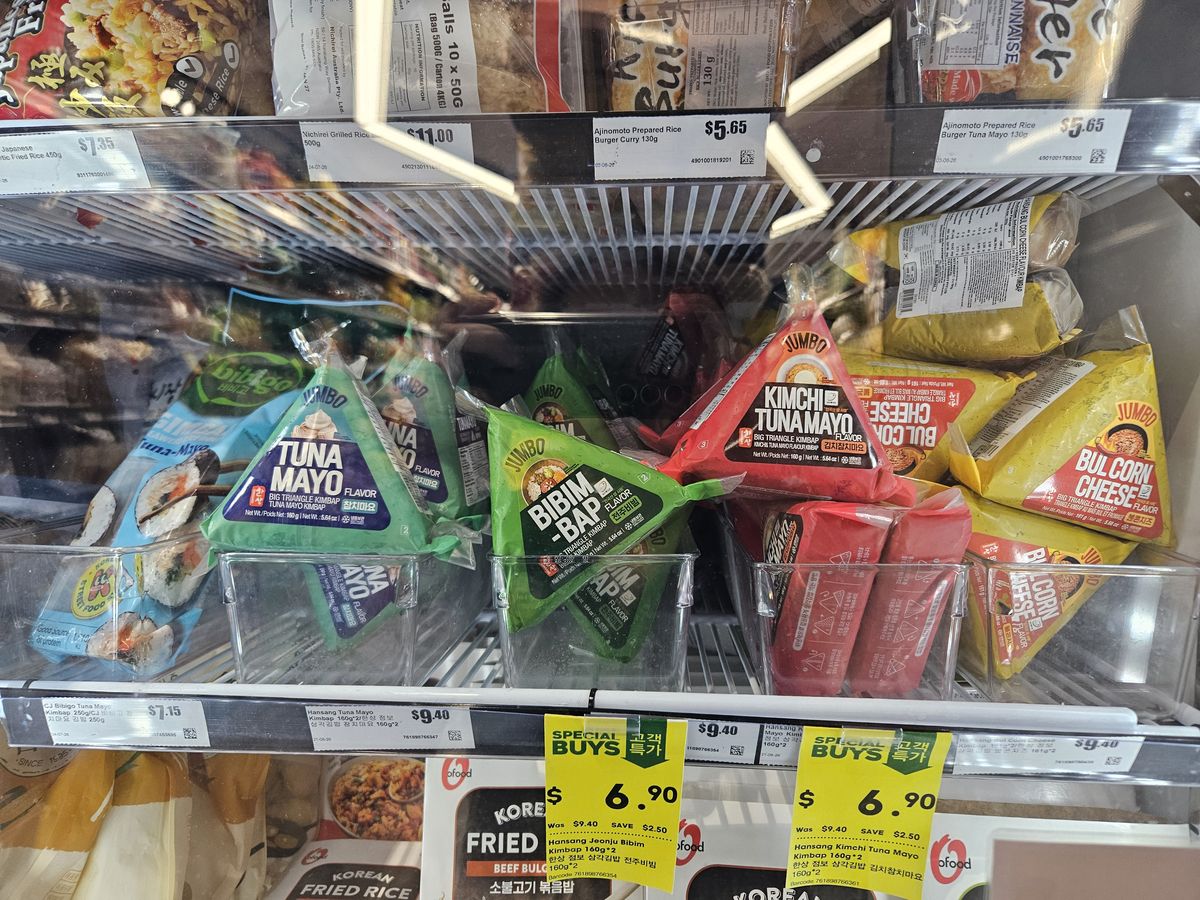
The 1,500-won triangle is the symbol of Korean convenience eating, and the flavour names tell you most of what you need: 참치마요 (tuna mayo — egg, fish, soy), 전주비빔 (bibimbap-style — usually beef), 불고기 (beef, soy marinade), 스팸 (pork), 멸치 (anchovy). Almost every variety carries 대두 (soy) and 밀 (wheat) through the seasoning, the mayo ones carry 난류 (egg), and the rolled gimbap adds the standard egg strip and ham. Halal readers: assume pork or non-certified meat unless the label proves otherwise. The move here isn't to give up — it's to flip the triangle over and read the box, because a few varieties (plain grilled salmon, some vegetable ones) run cleaner than the rest of the shelf.
The 4,000~6,000-won lunch boxes are Korea's best food bargain — rice, a main, and six little compartments of sides. That's exactly the problem for restricted eaters: it's a communal table in a plastic tray. The fried things share a fryer at the factory, the sides are seasoned with soy-sesame dressings, there's usually ham or fish cake tucked somewhere, and one allergen line covers the whole box, so you can't tell which compartment carries the 새우. If your restriction is mild ("I just avoid pork"), the label plus a look through the lid works. For a serious allergy, I'd pass on the mixed boxes and build your own meal from single-ingredient items instead — which the rest of this list is for.
We read a real cup-ramyeon allergen line in the labels guide: soy, wheat, milk, egg, beef, pork, chicken, shrimp, squid, shellfish — ten declarations in one seasoning sachet. That's typical, not exceptional: the powder is a whole supply chain dried into dust. Gluten-free is out (the noodle is wheat), vegans need the specifically vegan-labelled lines (they exist — 채식/비건 라면 is a real and growing shelf), halal readers should look for the handful of halal-certified imported ramyeon some branches stock, and the seafood-allergic should treat every "beef" cup as seafood until the box says otherwise. When a cup does pass your label check, the hot-water dispenser by the counter is free to use.
The chilled sandwich triangle is egg-mayo-ham territory almost by definition, the burgers are burgers, and the packaged bakery shelf (모닝빵, cream breads, 깨찰빵) runs on wheat, milk, egg and — remember — sesame that the law doesn't force onto the allergen line. What this shelf does offer over a real bakery: everything is sealed and printed, so there are no open trays and shared tongs. If wheat, egg and dairy are fine for you and your concern is, say, shellfish or nuts, the sandwich shelf is actually one of the calmest lunches in the country.
By the register: steamed buns (호빵) in winter, fish-cake bars, sometimes fried chicken bits under a heat lamp. This corner is the exception to everything good I've said — it's loose food, warmed in-store, with the labelling on a box you may never see. 어묵 (fish cake) is fish and wheat by nature; 호빵 fillings range from red bean (usually the safest) to meat and cheese; fried items share whatever oil the store uses. Treat this corner like street food, not like the rest of the shop: fine for the unrestricted, a skip for serious allergies.
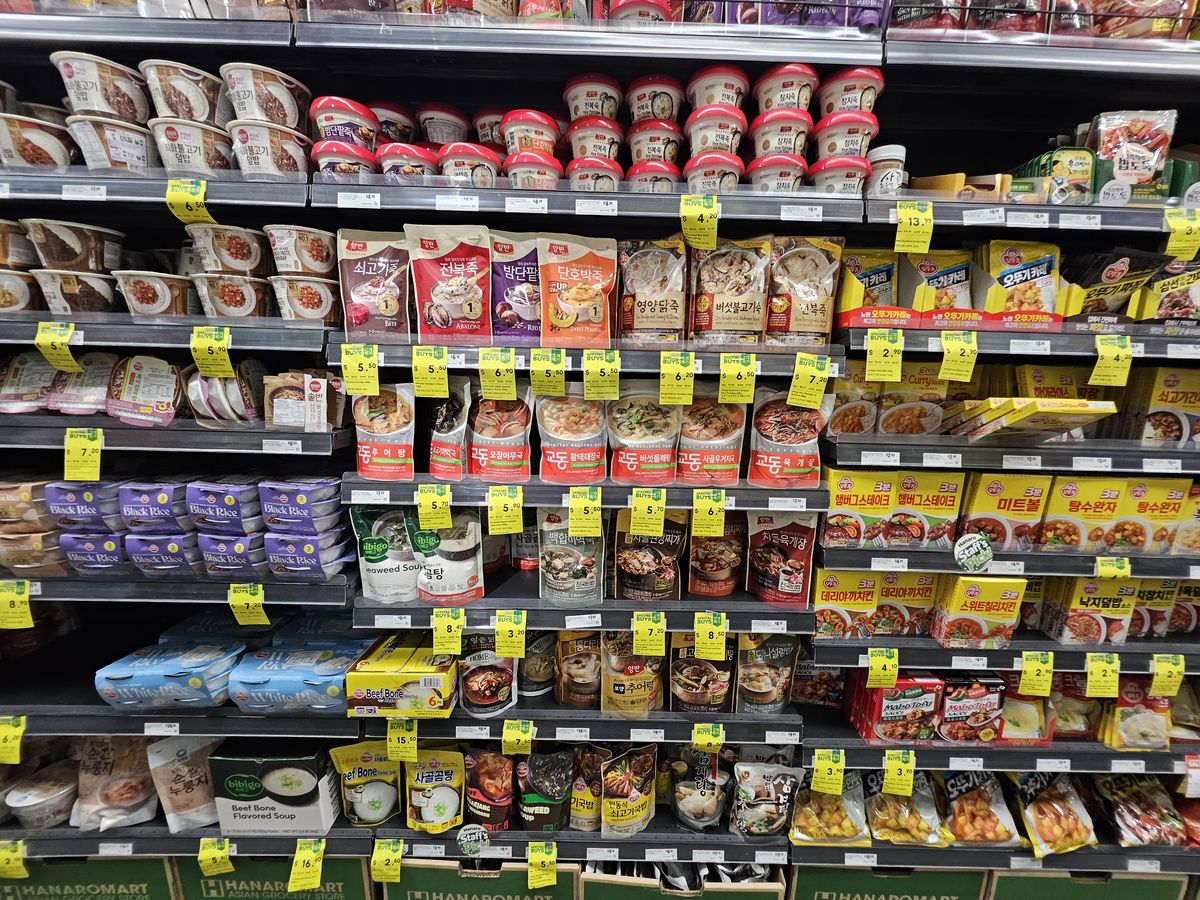
This is where restricted eaters actually eat, and it's a better spread than people expect. 햇반 and its cousins — microwavable plain rice, ingredient list: rice. Boiled eggs (구운계란, 반숙란), sold in pairs. Fresh fruit — bananas, cut-fruit cups, cherry tomatoes. Roasted gim — seaweed, oil, salt (check which oil: some brands roast in sesame oil, some in other oils — the label says). Salads with the dressing in a separate sachet you can simply not open. Plain yoghurt and cheese if dairy's fine; 두유 (soy milk), 귀리/오트 drinks and lactose-free milk if it isn't. Nuts and dried fruit in sealed packs. A microwaved 햇반 + boiled eggs + gim + fruit is a real Korean meal — it's basically what half the country eats for breakfast — and every component has a one-line ingredient list.
Join Seoul Mate free and I'll send you "Where to Start" — the 10 K-dramas I recommend to every beginner — plus a weekly pick. No spam, leave anytime.
The playbook matrix: what usually works, by restriction
The usual caveat, doubled: this table describes how these product categories typically run, and convenience-store product lines change constantly — new flavours monthly, reformulations without announcement. It's a shopping strategy, not a promise. The label on the specific item decides.
| Product | 🌱 Vegan/Veg | 🕌 Halal | 🌾 Gluten-free | What to check |
|---|---|---|---|---|
| 햇반 (plain microwave rice) | 🟢 | 🟢 | 🟢 | Ingredient list is essentially rice — the anchor of every restricted meal here |
| Fresh fruit / banana / fruit cups | 🟢 | 🟢 | 🟢 | — |
| Roasted gim (seaweed) | 🟢 | 🟡 | 🟢 | Which oil it was roasted in (sesame-allergic: check for 참기름) |
| Boiled / roasted eggs | 🟡 veg | 🟢 | 🟢 | Egg-allergic obviously skip; vegetarian-fine, vegan-no |
| 두유 · oat drinks · lactose-free milk | 🟢/🟡 | 🟢 | 🟡 | 두유=soy; lactose-free is still milk protein; some oat drinks carry 밀 traces |
| Salads (sachet dressing) | 🟡 | 🟡 | 🟡 | Skip the sachet and check toppings (ham, egg, cheese variants exist) |
| Triangle gimbap | 🔴 | 🔴 | 🔴 | Mayo/fish/meat + soy-wheat seasoning; rare cleaner varieties — read each one |
| Dosirak lunch box | 🔴 | 🔴 | 🔴 | Mixed compartments, one shared allergen line — can't deconstruct |
| Cup ramyeon (standard) | 🔴 | 🔴 | 🔴 | Sachet carries many allergens at once; noodle is wheat |
| Vegan-labelled ramyeon / 비건 line | 🟢 | 🟡 | 🔴 | A real, growing shelf — vegan ≠ halal-certified, and the noodle is still wheat |
| Sandwiches / burgers | 🔴 | 🔴 | 🔴 | Egg-mayo-ham-wheat territory; calm option only for those clear of those four |
| Hot counter (어묵·호빵·fried) | 🔴 | 🔴 | 🔴 | The unlabelled zone — treat as street food |
| Snacks & chips | 🟡 | 🟡 | 🟡 | Seasoning powders (milk, shrimp, beef); the 함유 box answers fast |
| Nuts & dried fruit | 🟢 | 🟢 | 🟢 | Nut-allergic: this shelf and its facility lines are your hazard zone instead |
🟢 usually workable — confirm on the label every time · 🟡 depends on the specific product — read before buying · 🔴 usually conflicts — exceptions exist but are rare. Vegan column: 🟡 veg = vegetarian-workable, not vegan. Halal column reflects ingredient reading only, not certification — certified products are the standard where certification matters to you.
Allergy-by-allergy quick notes
For readers coming from our allergy guides, the store in one paragraph each. Shellfish/fish (guide): the danger is concentrated in ramyeon sachets, 어묵 and seafood gimbap — the single-ingredient shelf is your calm corner, and 새우 is a mandatory declaration so the box catches it. Nuts (guide): main dishes are largely clear; the snack aisle and its shared-facility lines are where you slow down, and 땅콩·호두·잣 are all mandatory declarations. Soy (guide): honestly the hardest aisle in Korea — 대두 runs through nearly every seasoned product, so you'll live on 햇반, eggs, fruit, plain dairy and careful label work. Sesame (guide): the one allergen the box may not name — full ingredient list, every time, and watch the gim's roasting oil. Egg & dairy (guide): mayo means egg across the gimbap and sandwich shelves; dairy hides in bakery, snacks and "butter" flavours, but 난류 and 우유 are both mandatory declarations, so the box is reliable. Gluten (guide): wheat is everywhere seasoned, but 햇반 + eggs + gim + fruit + plain dairy is a complete GF meal available on any street corner at 3am.
Using the store like a local
A few mechanics that make this smooth. The microwave is self-service — 햇반 goes in for the time printed on its lid (usually 90 seconds), and it's normal to eat at the window counter. The hot-water dispenser by the register is for cup noodles; free, help yourself. Prices are fixed and cards work everywhere — tap your travel card or any Visa/Mastercard; no cash needed, no tipping, ever. The 1+1 and 2+1 tags on shelves mean buy-one-get-one — the deal applies to that exact product, and the free one rings up automatically. Most stores stock a small fresh-fruit and salad delivery daily, so morning visits get the best of that shelf. And if a label defeats you and staff are free, showing your allergy card in Korean works here too — but the honest advantage of the convenience store is that you rarely need to ask anyone anything.
A realistic convenience-store day
Proof of concept, for a traveller keeping to, say, a gluten-free or multi-allergen line. Breakfast: banana, drinkable plain yoghurt (or 두유), a boiled-egg two-pack — all single labels, read in thirty seconds. Lunch: microwaved 햇반, a pack of roasted gim, cherry tomatoes, and a salad with the sachet left sealed; eat at the counter watching the street. Afternoon: cut-fruit cup and a bag of plain nuts (or a checked snack). Dinner: if a restaurant's on the plan, this is where the restaurant guides take over — but a second 햇반 with a vegan-labelled cup ramyeon (label permitting) and gim is a legitimate, warm, salty, satisfying end to a travel day. Nobody's dream honeymoon dinner — but as the meal that's always there, always labelled, always open, it's the safety net that makes the adventurous meals possible.
Frequently asked questions
Which chain is best for restricted eaters? They're more alike than different — GS25, CU, 7-Eleven and Emart24 all follow the same labelling law and stock similar categories. Larger branches (especially near universities and office districts) carry more of the vegan line and fresh food; Emart24 and bigger GS25s tend to have the widest 비건 shelves. Pick by size, not brand.
Is there actually a vegan section? Increasingly, yes — vegan ramyeon, vegan dosirak at some branches, plant-based drinks, and products marked 비건 or with vegan certification logos. It's a shelf, not an aisle, and it varies by branch — but it exists now in a way it simply didn't a few years ago. Our vegan guide covers the restaurant side of the same story.
Can I trust the allergen box on convenience food? As much as anywhere in Korea — these are major manufacturers under a legal declaration regime, and the box is the same standardised format the labels guide teaches. The standing caveats: sesame isn't mandatory, facility advisories are your allergist's call, and reformulations happen — read the package in your hand, not last week's.
Are the fresh items (gimbap, sandwiches, salads) safe date-wise? Korean convenience chains are strict about date codes on fresh food, and turnover is fast. Check the 소비기한 (use-by) as you would at home — the format is year.month.day — and refrigerated items past their time are pulled aggressively. This is one of the better-run cold chains you'll meet.
What about halal certification? Ingredient-reading gets you to "no pork, no alcohol in the listed ingredients" — it cannot get you to certified. A small number of imported halal-certified products (some ramyeon, snacks) appear in bigger branches and in areas like Itaewon. For observant readers, the certified products, fruit, rice, eggs, dairy and seafood shelf are the workable set; our halal guide covers the wider strategy.
Is convenience-store eating looked down on? Not remotely — it's a national institution. Students, office workers, taxi drivers and grandmothers all eat at that window counter. Nobody will look twice at a traveller doing the same, and honestly, the people-watching is free.
Affiliate link — if you book through it, KContentGuide may earn a small commission at no extra cost to you. We only point you to things we'd happily use ourselves.
Food allergies can cause severe reactions, including anaphylaxis, which is life-threatening. This is a practical shopping guide based on experience — not medical advice — and the product categories described here change formulation constantly, so nothing in this guide substitutes for reading the label on the specific package in your hand, every single time. Sesame is not a mandatory declaration on Korean labels; facility advisories and trace exposure are questions for your allergist; and for halal readers, ingredient reading is not certification. The hot-food counter is unlabelled — treat it accordingly. Carry any prescribed emergency medication exactly as your doctor directs, keep your allergy written in Korean, and when a label can't give you a clear answer — choose something else. No snack is worth the risk.
Bottom line
The Korean convenience store is the restricted eater's base camp: sealed, labelled, open all night, and stocked — if you know which shelves to trust — with genuinely complete meals. Anchor on the single-ingredient corner (햇반, eggs, gim, fruit, drinks you've checked), treat the triangle gimbap and dosirak as label-reading exercises rather than defaults, skip the unlabelled hot counter when your stakes are high, and let the 함유 box do the work it was designed to do. Learn to read it properly in the labels guide, take the restaurant toolkit from what to ask in a Korean restaurant, and browse the rest of the Eat series for your specific allergen's full map. The adventurous meals are the point of the trip — the convenience store is what makes them possible. And for how this all plays out on arrival day itself, our first 24 hours guide walks the timeline hour by hour.