If there is one meal on every Korea bucket list, it's this one: meat on a grill in the middle of the table, scissors and tongs, lettuce in one hand, a mess of small dishes everywhere, someone shouting for more pork belly. Korean barbecue isn't just dinner — it's the dinner people fly here for. And if you've been reading this series with an allergy, a religious standard or a plant-based diet, you'll have noticed something: almost every guide I've written ends up pointing at the barbecue table. For soy allergy, the unmarinated cuts are the escape hatch. For gluten-free, same. For egg and dairy, the meat itself is clear. The barbecue table is the most adaptable meal in Korean food — if you know which parts of the table are yours and which aren't.
So this is the barbecue chapter: the whole table taken apart piece by piece — the meat, the marinades, the two dips, the wraps, the free side dishes, the grill itself — with an honest answer for each restriction. My colleague-in-spirit already wrote the etiquette-and-technique version (how to eat Korean BBQ like a local — read it, it's the fun one); this is the safety-and-strategy version from someone who has spent years fielding "can I eat this?" across a counter. As always: every kitchen differs, so confirm every single time — but barbecue is the meal where asking works best, because you can see everything being cooked.
The meat itself is the safest part of the table: unmarinated cuts (samgyeopsal, moksal, saeng-galbi, chadol) are just meat — no soy, no wheat, no egg, no dairy. The risk lives in the accessories: marinades (soy sauce + wheat + sugar), ssamjang (soy twice over, sometimes sesame), gireum-jang (sesame oil), gyeran-jjim (egg), corn cheese (egg + dairy), and the shared grill and tongs. Halal: the mainstream table is pork-centric — beef-only and certified restaurants are the route. Vegan: honestly, a barbecue restaurant is the wrong venue — I'll show you the closest real alternatives instead of pretending. Learn the table's parts, order deliberately, and this meal belongs to almost everyone.
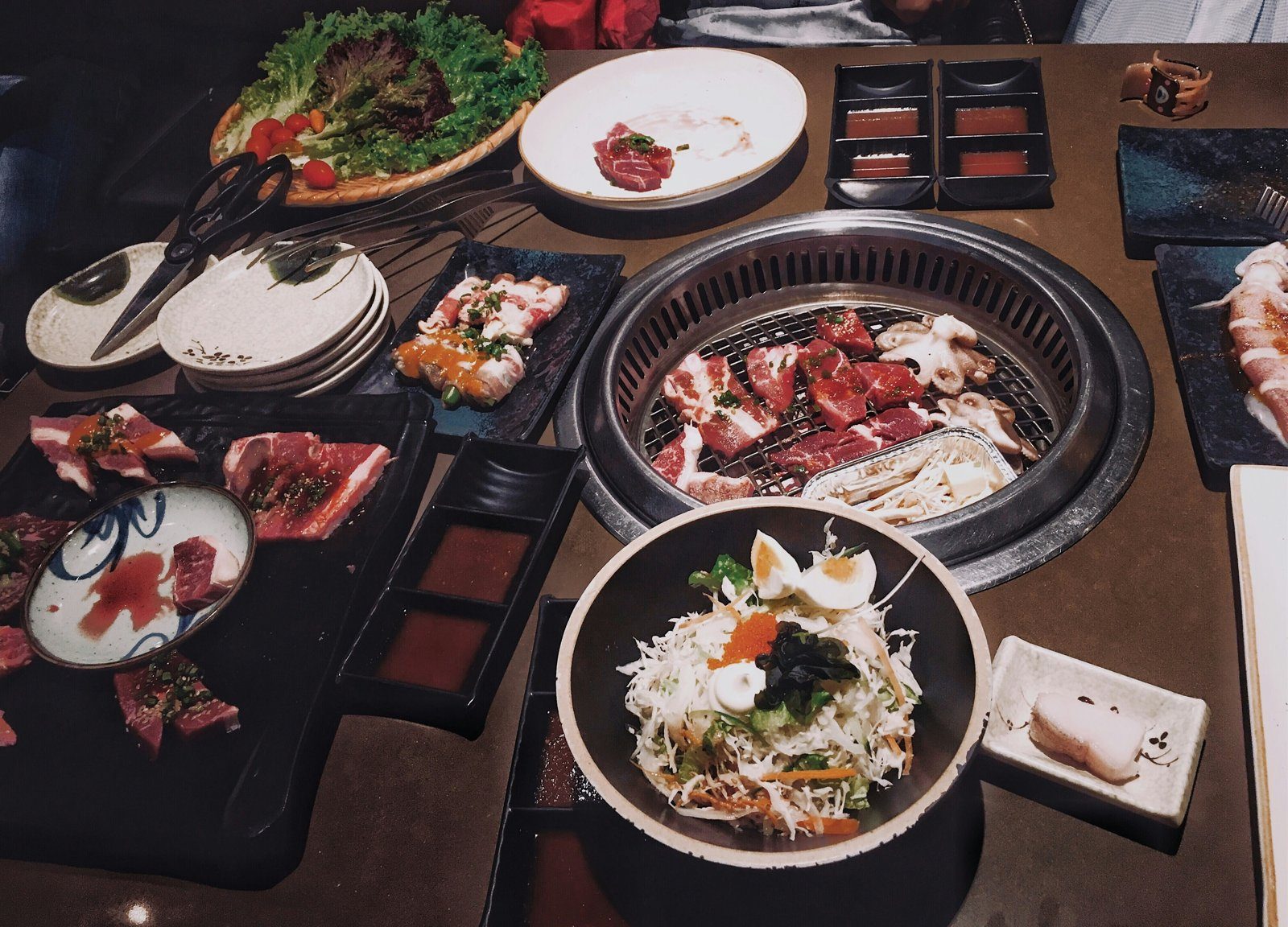
The table, taken apart
This is the single most important distinction on the menu. Unmarinated (생~, saeng-) cuts — samgyeopsal (pork belly), moksal (pork neck), saeng-galbi (fresh short rib), chadol-bagi (thin brisket), deungsim (sirloin) — are meat, full stop. Salt and pepper happen at the table, by you. Marinated (양념~, yangnyeom-) cuts — bulgogi, yangnyeom-galbi, dak-galbi — are soaked in a soy-sauce base that almost always carries wheat and sugar, sometimes pear, sometimes sesame oil. If your restriction touches soy, gluten or sesame, the whole marinated column is out and the whole unmarinated column is in. That one menu word does more work than any phrase card.
Every table gets ssamjang — doenjang and gochujang blended, which means soybean twice over, often with sesame oil or crushed sesame folded in. The quiet alternative most restaurants happily bring is gireum-jang: sesame oil with salt and pepper. Here's the fork in the road we've seen across this series — for soy allergy, gireum-jang is the hero that unlocks the whole meal; for sesame allergy, it's the enemy, and your dip is plain salt ("소금만 주세요"). Neither dip is compulsory: meat, salt, garlic and lettuce is a complete, traditional way to eat this meal.
The wrap station is the safest corner of the table: lettuce (상추), perilla leaves (깻잎 — perilla, not sesame, despite the English "sesame leaf" mistranslation we untangled in the sesame guide), raw garlic, green chilli, sliced raw onion. All vegetables, all visible. Two footnotes: the onions sometimes swim in a soy-vinegar dressing (ask, or take dry slices), and pickled radish paper (쌈무) is just radish, sugar and vinegar — usually fine for everyone. If you're building the lowest-risk plate at the table, it's grilled unmarinated meat + plain lettuce + garlic + rice, and it's genuinely one of the best bites in Korea.
Barbecue restaurants love giving you things: a bubbling gyeran-jjim (steamed egg — the egg-allergic child's biggest table hazard, as we covered in the egg & dairy guide), corn cheese (mayo + mozzarella = egg + dairy in one pan), a finishing doenjang jjigae (soybean paste, usually on an anchovy broth), and rotating banchan that can include the peanut-anchovy stir-fry from the nut guide. None of this is ordered; all of it is refusable. The move is one sentence when you sit down: tell them what not to bring. A table that never receives the gyeran-jjim can't cross-contaminate anyone with it.
The honest cross-contact paragraph. The grill plate is shared by everything your table cooks — if someone's yangnyeom-galbi (soy-wheat marinade) caramelises on the same plate as your plain samgyeopsal, that surface now carries the marinade. Fixes, in order of politeness: order all-unmarinated for the table (the food's better that way anyway, fight me); ask for a plate change ("불판 갈아주세요") — completely normal, staff do it constantly when plates char; and cook the restricted person's meat first, on the fresh plate, with the clean tongs. Same logic as the shared fryer in every other guide — the ingredient list isn't the only exposure path, the equipment is one too.
Join Seoul Mate free and I'll send you "Where to Start" — the 10 K-dramas I recommend to every beginner — plus a weekly pick. No spam, leave anytime.
The safe-for matrix: the barbecue table, piece by piece
Columns for the three big dietary frameworks, notes for the allergens — because at this table the allergen answers depend on which component you're holding, and the per-allergen guides carry the full maps.
| On the table | 🕌 Halal | 🌱 Veg/Vegan | 🌾 GF | Allergen notes |
|---|---|---|---|---|
| Samgyeopsal / moksal (pork, plain) | 🔴 | 🔴 | 🟢 | Just meat — clear of soy, egg, dairy, nuts, sesame |
| Saeng-galbi / chadol / deungsim (beef, plain) | 🟡 | 🔴 | 🟢 | Beef itself fine; halal = sourcing question, see below |
| Bulgogi / yangnyeom-galbi (marinated) | 🔴 | 🔴 | 🔴 | Soy-sauce marinade = soy + usually wheat; sometimes sesame, pear |
| Ssamjang | 🟡 | 🟡 | 🟡 | Soy twice; often sesame; wheat via the soy sauce in some blends |
| Gireum-jang (sesame oil + salt) | 🟢 | 🟢 | 🟢 | The soy-free hero — but pure sesame, so sesame-allergic take salt only |
| Lettuce / perilla / garlic wraps | 🟢 | 🟢 | 🟢 | Perilla (깻잎) is not sesame; check onion dressing |
| Gyeran-jjim (free steamed egg) | 🟢 | 🟡 veg | 🟢 | Egg by definition — decline it for egg allergy; broth may be anchovy |
| Corn cheese | 🟡 | 🟡 veg | 🟢 | Mayo (egg) + mozzarella (dairy) |
| Doenjang jjigae (finisher) | 🟡 | 🟡 | 🟡 | Soybean paste; broth usually anchovy; wheat possible via paste |
| Naengmyeon (the cold finisher) | 🟡 | 🟡 | 🔴 | Buckwheat + wheat noodles; broth varies; boiled-egg half on top |
| Plain rice + doenjang-free banchan | 🟢 | 🟡 | 🟢 | Inspect the small plates — dressings are where soy/sesame ride |
| The shared grill itself | 🟡 | 🔴 | 🟡 | Cross-contact surface — plate change ("불판 갈아주세요") resets it |
🟢 usually workable — confirm at your table · 🟡 depends on recipe, sourcing or your standard — ask · 🔴 usually conflicts. 🟡 veg = vegetarian-workable, not vegan. Halal column reads ingredients only, not certification — see the next section.
The halal question, honestly
Korean barbecue culture is pork-forward — samgyeopsal is the default order of the whole country — so the halal route needs deliberateness. Three tiers, honestly ranked. Best: certified restaurants. Seoul's Itaewon area and a growing handful of places elsewhere serve halal-certified Korean barbecue, and that's the only tier where the answer is clean all the way down. Middle: beef-only tables at regular restaurants — order saeng-galbi or chadol, skip every marinade, note that the beef is almost certainly not halal-slaughtered and the grills have cooked pork before you; where that lands depends entirely on your own standard, which is yours to set, not mine. And know what's underneath: ssamjang and doenjang jjigae occasionally carry alcohol (주정) as a preservative, per the label rules in our labels guide. The full strategy — certification bodies, what to ask, seafood-barbecue alternatives — lives in the halal guide; the short version is that halal Korean barbecue absolutely exists, but you choose the restaurant before you choose the cut.
The vegan answer, without pretending
I promised this series would never claim a dish is fine when it isn't, so: a Korean barbecue restaurant is not a good place to eat vegan. The vegetables share the meat grill, the "vegetable" sides lean on fish sauce and anchovy broth, and paying barbecue prices to eat lettuce is nobody's bucket-list night. What actually delivers the same pleasures — fire, communal table, wrap-it-yourself — is the adjacent family of dishes: beoseot-gui (mushroom grill) where some barbecue houses will grill king oyster mushrooms on a fresh plate if you ask, dubu-kimchi in its vegan form at dedicated restaurants, and the wrap-table logic of ssambap restaurants, where the point is the vegetables and the meat is optional. Seoul's vegan Korean restaurants increasingly do a "barbecue night" experience outright. The vegan guide maps that world — go there rather than negotiating with a pork-belly house.
Ordering it: the script
"Unmarinated, please." — "Yangnyeom an doen geollo juseyo" (양념 안 된 걸로 주세요) · "Sesame-oil dip instead of ssamjang." — "Ssamjang daesin gireum-jang juseyo" (쌈장 대신 기름장 주세요) · "Just salt, please." — "Sogeum-man juseyo" (소금만 주세요) · "Please don't bring the steamed egg / corn cheese." — "Gyeran-jjim-eun / kon-chijeu-neun an jusyeodo dwaeyo" (계란찜은/콘치즈는 안 주셔도 돼요) · "Could you change the grill plate?" — "Bulpan garajuseyo" (불판 갈아주세요) · "Does the marinade have ___ in it?" — "Yangnyeom-e ___ deureoga-yo?" (양념에 ___ 들어가요?). Show your allergy card when you sit down, not when the food arrives — at barbecue, everything is decided at ordering time. The fuller toolkit is in what to ask in a Korean restaurant.
And one piece of timing advice that applies doubly here: go at opening time or mid-afternoon. Barbecue restaurants at 7pm on a Friday are glorious chaos, and glorious chaos is the enemy of a careful order. At 5:30, the same staff will happily change your grill plate, hold the gyeran-jjim, and double-check the marinade — because they have the thirty seconds it takes.
A build-your-table cheat sheet
Putting it all together, the order that works for each reader of this series. Soy or gluten: unmarinated cuts, gireum-jang, lettuce, garlic, rice — skip ssamjang, marinades and the jjigae. Sesame: same meat, salt-and-pepper dip, no gireum-jang, watch for seed sprinkles on banchan. Egg and/or dairy: everything on the grill is yours — just wave off the gyeran-jjim and corn cheese at the start. Nut allergy: the barbecue table is one of Korea's safest dinners for you; give the banchan its ten-second scan for the peanut-anchovy dish. Shellfish: the meat is clear — check whether the doenjang jjigae and any dipping sauces ride on shrimp or anchovy, per the shellfish guide. Halal: certified house first, beef-only second, your standard decides the rest. Vegan: a different restaurant, honestly — and a better night for it.
Frequently asked questions
Is samgyeopsal really free of soy and gluten? The meat as it arrives — raw pork belly slices — is just pork. What you add determines the rest: ssamjang brings soy (and its soy sauce often brings wheat), marinated cuts bring both. Order unmarinated, dip in salt or gireum-jang, and the classic wrap is soy-free and gluten-free. As always, confirm nothing was pre-seasoned — a small number of houses brine or oil their cuts.
What about the scissors and tongs? Shared within your table, not between tables — they're brought fresh with your order. The cross-contact question is your own table's marinated meat, not the neighbours'. If your group orders both marinated and plain, ask for a second set of tongs ("집게 하나 더 주세요") and cook the plain meat first.
Is the fire itself a problem — charcoal vs. gas? Not for allergens. Charcoal (숯불) versus gas grills is a flavour argument, not a safety one. The surface the meat touches is what matters, and the plate-change request resets it either way.
Can kids with allergies do Korean barbecue? It's actually one of the better restaurant formats for allergic kids, because everything is visible and cooked in front of you — no hidden kitchen steps. The two moves: refuse the free egg and cheese dishes at sit-down, and give the child their own plate and utensils before the banchan flurry starts. The arrival-day version of this logic is in our first 24 hours guide.
What's the one dish to check hardest? The finishing doenjang jjigae. It looks like a freebie soup; it's actually the most allergen-dense thing on the table — soybean paste, usually anchovy broth, sometimes shellfish, sometimes wheat through the paste. If your restriction touches any of those, let the table have it and keep your spoon out.
Affiliate link — if you book through it, KContentGuide may earn a small commission at no extra cost to you. We only point you to things we'd happily use ourselves.
Food allergies can cause severe reactions, including anaphylaxis, which is life-threatening. This is a food guide based on experience — not medical advice — and nothing here overrides the plan you've made with your allergist, including how to treat shared grills, utensils and trace exposure, which are individual medical questions. Marinades, pastes, dips and banchan vary between restaurants, regions and batches; the descriptions here are typical recipes, not guarantees about any table. For halal readers, ingredient reading is not certification — where certification matters to you, choose certified restaurants. Carry any prescribed emergency medication exactly as your doctor directs, keep your allergy written in Korean, confirm at the table every time, and when you can't get a clear answer — choose something else. No meal is worth the risk.
Bottom line
Korean barbecue looks like the most chaotic meal in Korea and is secretly the most controllable: everything is visible, everything is cooked in front of you, and the risky parts are all optional extras around a core — plain meat, fire, lettuce, garlic, rice — that almost every restriction can eat. Learn the saeng/yangnyeom distinction, choose your dip deliberately, wave off the free egg and cheese, and don't be shy about the plate change; the staff genuinely don't mind. Pair this with the etiquette guide at how to eat Korean BBQ like a local, keep your allergen's own map from the Eat series in your pocket, and go have the bucket-list dinner. You've earned it — and now you know exactly which parts of the table are yours. Next stop on the bucket list: the same choosing logic, out on the street — our street food & markets guide.