Here's my honest confession about Hospital Playlist (슬기로운 의사생활): I don't watch it for the surgery. I watch it for the meals. Twenty-four episodes of five exhausted doctors in their forties sitting down to eat together — in the cafeteria, in a car park, at a barbecue place at midnight, out of a shared instant noodle pot in a break room — and somehow that's the whole emotional engine of the show. Take the food out and you don't have a drama. You have a documentary about long shifts.
So this guide is two guides. The first half is the filming locations proper: the real hospital that plays Yulje Medical Center, the neighbourhood walk, the camping trip. The second half is the part nobody writes about, which is what these people are actually eating and how you'd order the same thing yourself. I spent decades in kitchens before I started writing about Korea, so that second half is the part I can tell you things about that a location list can't.
One caution before we start, and it matters more here than in any other filming guide I've written: the main location is a working hospital with sick people in it. Not a studio, not a retired building — a live tertiary hospital where someone is having the worst day of their life in the next corridor. I'll tell you how to see it respectfully, and I'll also tell you honestly that for most fans the right answer is to admire it from the outside and go eat instead. The show would approve.
Hospital Playlist (2020–2021, tvN / Netflix) follows five friends who met in medical school and now work at the same Seoul hospital: Lee Ik-jun (general surgery), Ahn Jeong-won (paediatric surgery), Kim Jun-wan (cardiothoracic), Yang Seok-hyeong (OB-GYN) and Chae Song-hwa (neurosurgery). They operate, they argue, they play in a terrible band, and they eat. 24 episodes across two seasons, directed by Shin Won-ho and written by Lee Woo-jung — the same pair behind the Reply series, which explains a lot about the warmth. Season 1 peaked at 14.1% nationwide; Season 2's premiere was the highest in tvN's history at the time.
Why this is a strange filming trip — in a good way
Most filming-location guides send you to a photogenic place that a drama borrowed for an afternoon. Hospital Playlist barely has those. The show is set almost entirely inside a hospital, a band room and a series of restaurants, which means the "locations" are either a functioning medical facility you shouldn't wander around, a set that no longer exists, or a small eating place that may well have changed hands since 2021.
That sounds like bad news for a travel guide. I'd argue the opposite, because it forces the trip to become what the show is actually about. You can stand outside the hospital for ten minutes and get your photo. Then the real pilgrimage is the food: sitting down to grilled pork belly with people you like, eating cold noodles on a hot day, buying a triangle kimbap at midnight because your shift ran long. That's a trip anyone can do, in any Korean city, on any budget. It's also, conveniently, the best part of visiting Korea.
There's one more thing worth knowing before you plan around this show. Because of COVID, a good deal of the later Yulje material was shot on a purpose-built set rather than in the real hospital. So if you go looking for a specific corridor from a late Season 2 episode and can't find it, you're not going mad — it genuinely isn't there. The production built its own version, and that version has been struck.
The hospitals
The gleaming hospital that plays Yulje is Ewha Womans University Seoul Hospital, a then-new university hospital in the Magok district. According to the hospital's own account in Korean medical trade press, filming covered the lobby and its café, patient wards, the fourth-floor Healing Garden, the underground car park, and an operating room for one surgery scene.
What I find genuinely lovely about this is how much the hospital gave the production beyond a building. It supplied a medical advisor — the head of its Organ Transplantation Center — who worked on the script for Ik-jun's liver-transplant storyline and was present for the operating-room shoot. That's why the surgical material feels unusually unembarrassing for a K-drama. It wasn't guessed at. If you've ever wondered which bits of Korean medical dramas are true, we went through that question properly in Korean hospitals in real life vs K-dramas.
And now the honest part. This is a large, busy hospital. The exterior and the grounds are public space and nobody will mind you taking a photo from outside; the lobby is also, technically, a public area. But the wards are not, the Healing Garden exists for patients and their families, and a group of fans photographing a corridor is a genuine intrusion on people having a hard day. My advice: photograph the building from the street, don't go inside unless you have an actual reason to, and spend your real time somewhere else in the city. The show is about kindness. Behave accordingly.
260 Gonghang-daero, Gangseo-gu, Seoul. Magok Station (Lines 5 & 9) or Balsan Station (Line 5), roughly a 10–15 minute walk from either. Background on the filming is in this Korea Biomedical Review report on the hospital and the drama.
The fictional Gangwoon University Hospital — the provincial hospital that matters so much to one character's storyline — was filmed at Hallym University Dongtan Sacred Heart Hospital, south of Seoul in Hwaseong.
I'm listing this for completeness rather than recommending it. It's an hour out of central Seoul, it's another functioning hospital with exactly the same etiquette problem as the first one, and there is nothing to do nearby that you'd have travelled for. Unless you are a serious completist, know that it exists and leave it at that.
Hwaseong-si, Gyeonggi-do, reachable from Seoul in about an hour by subway and bus. Again: a live hospital, not an attraction. Cast and production details are on the drama's Wikipedia page.
Fan location trackers place some of the show's quieter romantic scenes — a kiss, a night walk — in Yeonnam-dong, the café neighbourhood strung along the Gyeongui Line Forest Park. The park is a 6.3 km green strip built on a buried railway line, and the Yeonnam stretch is its most popular section; Seoulites call it "Yeontral Park".
This is the location I'd actually send you to, drama or no drama. On a warm evening the lawn fills with people sitting on mats with convenience-store beer and fried chicken, there are small cafés and restaurants on both sides of the strip, and it has precisely the unhurried, slightly scruffy, everyone-is-welcome quality that Hospital Playlist is built on. Walk the park, eat something, sit down for a while. You'll have done the show properly.
Note that I can only source this one to fan documentation rather than an official production list, so treat the exact spots as approximate. The neighbourhood is right; a specific bench is not something I'd stake a trip on.
Hongik University Station (Line 2 / Gyeongui-Jungang / Airport Railroad), Exit 3 — the park starts a few minutes' walk away. Details on the official Visit Seoul page for Gyeongui Line Forest Park.
Join Seoul Mate free and I'll send you "Where to Start" — the 10 K-dramas I recommend to every beginner — plus a weekly pick. No spam, leave anytime.
The Season 2 camping episode was filmed at Sanneomi Farm in the Pyeongchang mountains — a campsite attached to a working goat farm, high enough up that the view does most of the work.
If you want one location from this show that is genuinely a destination, this is it. Korean mountain camping is its own pleasure, and the appeal of the scene — a group of overworked adults finally sitting still outdoors — translates completely to real life. It's also in the same part of Gangwon-do as a lot of other good things, so it slots into a wider trip rather than demanding its own.
Practical honesty: it's a private campsite roughly three hours from Seoul, you'll want a car, and you need to book. I wasn't able to verify its current rates or opening season from an official source I'd quote, so check before you commit a day to it. Mountain weather in Gangwon also changes fast — pack a layer more than you think you need, even in summer.
210 Sanneomi-gil, Mitan-myeon, Pyeongchang-gun, Gangwon-do. Search 산너미목장 on NAVER Map for current booking and access details. Car strongly recommended.
Now the real reason you're here: the food
Hospital Playlist does something unusual with eating. In most dramas food is a set-dressing for a conversation. Here the food is the conversation — who orders, who pays, who's too tired to chew, who turns up late and gets the cold leftovers. If you want to understand the show's five friendships, watch who shares a spoon with whom.
The restaurants themselves are a mixture of sponsor chains and small neighbourhood places. The best-documented is Hanam Pig House (하남돼지집), a grilled-pork chain that sponsored the show from Season 1; the COEX branch in Gangnam reportedly has photos of the cast on the wall. The hospital café that appears in the lobby is a chain coffee outlet inside the real Ewha hospital. I'm naming those two because they're the ones I can source from more than one place — and I'd still check they're open before making a special trip, because four years is a long time in the Korean restaurant business.
But honestly? Chasing specific branches is the least interesting version of this. What's worth your time is eating the show's food, which you can do anywhere in Korea. Here's what's actually on their table and what you need to know to order it.
What the five of them actually eat
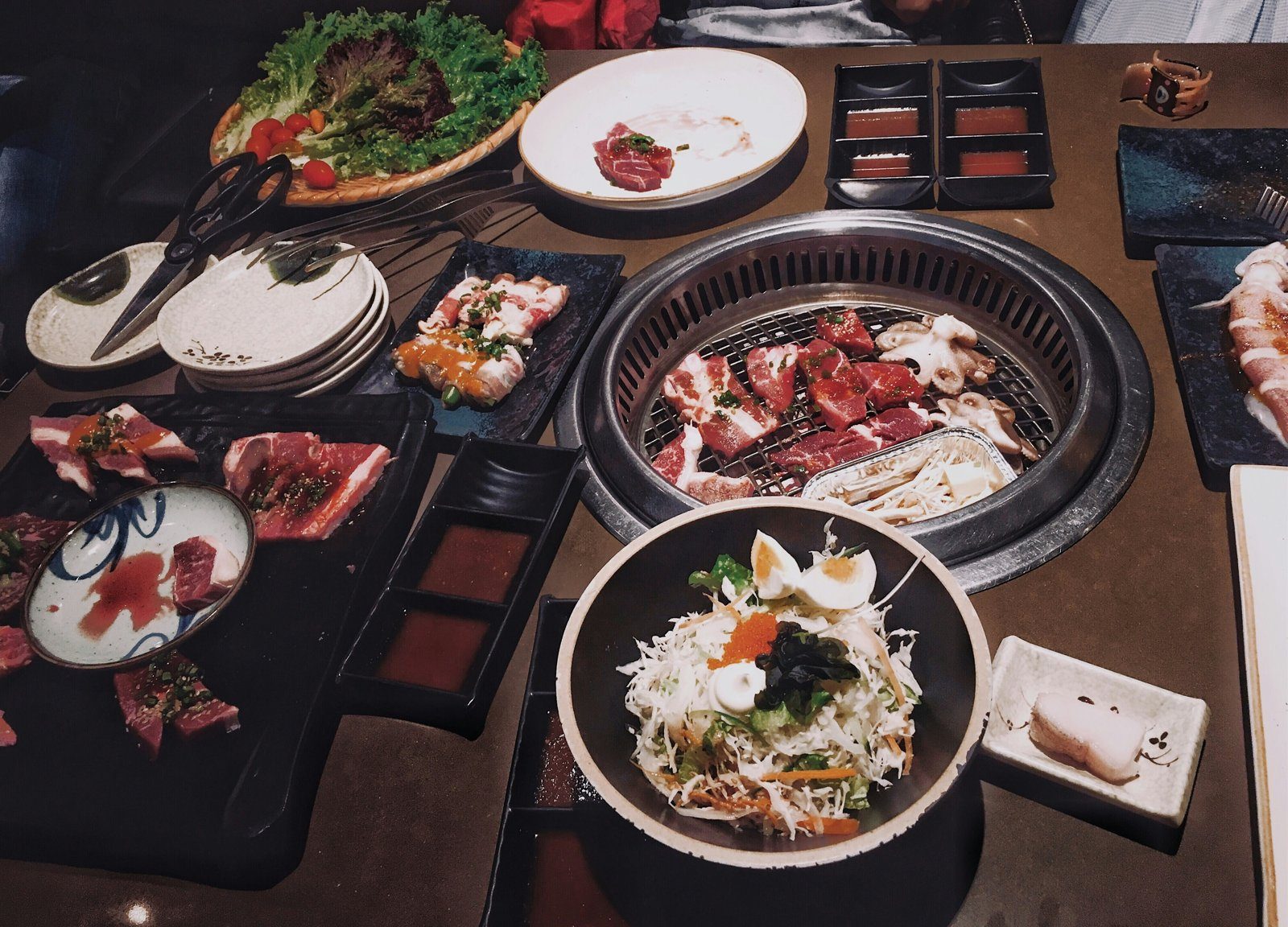
Samgyeopsal and grilled pork, late at night. The default group meal of the series, and of Korean working life generally. Thick pork belly on a tabletop grill, lettuce to wrap it in, ssamjang to smear on, soju to wash it down. There's a whole etiquette to it that nobody explains to visitors — who grills, when to cut, what the scissors are for — so we wrote it out properly in how to eat Korean BBQ. One practical note from my own years behind a counter: at most places the staff will grill for you if you look lost, and asking is not rude.
Instant noodles in the break room. The most honest food in the show. Ramyeon eaten standing up at 2am out of the pot, because there's no time and nobody's judging. You can replicate this one in any Korean convenience store, which have hot-water dispensers and a counter to stand at — and which are a genuine travel resource rather than a last resort. Our Korean convenience store guide covers what's actually good in there.
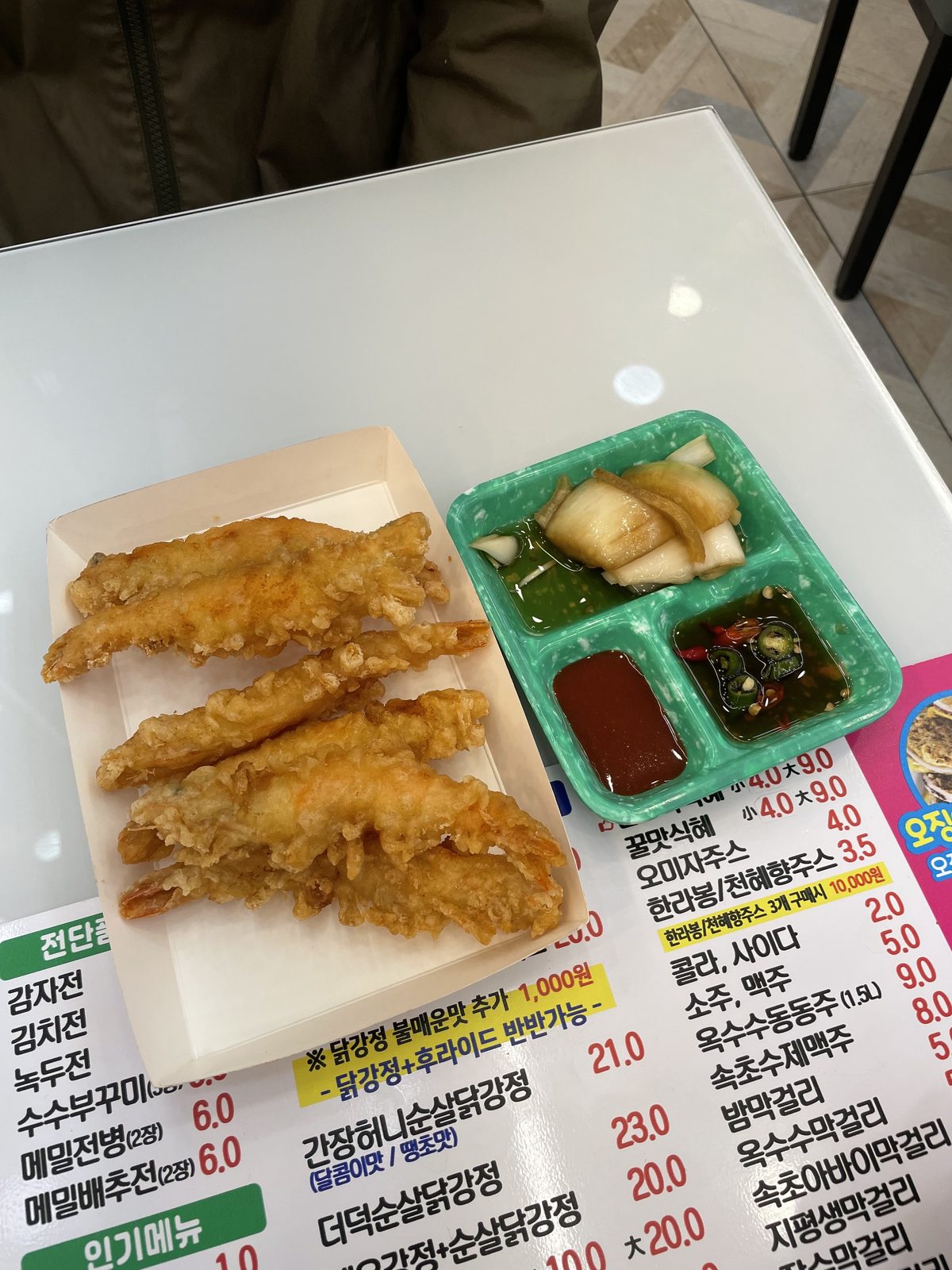
Tteokbokki and bunsik. Chewy rice cakes in sweet-hot sauce, usually with fish cake and a boiled egg, eaten in a small shop with plastic stools. This is Korean comfort food at its most specific — sweet, spicy, slightly too much — and it shows up in the series the way it shows up in real life, which is whenever somebody needs cheering up. More on the whole bunsik category in Korean street food & bunsik.
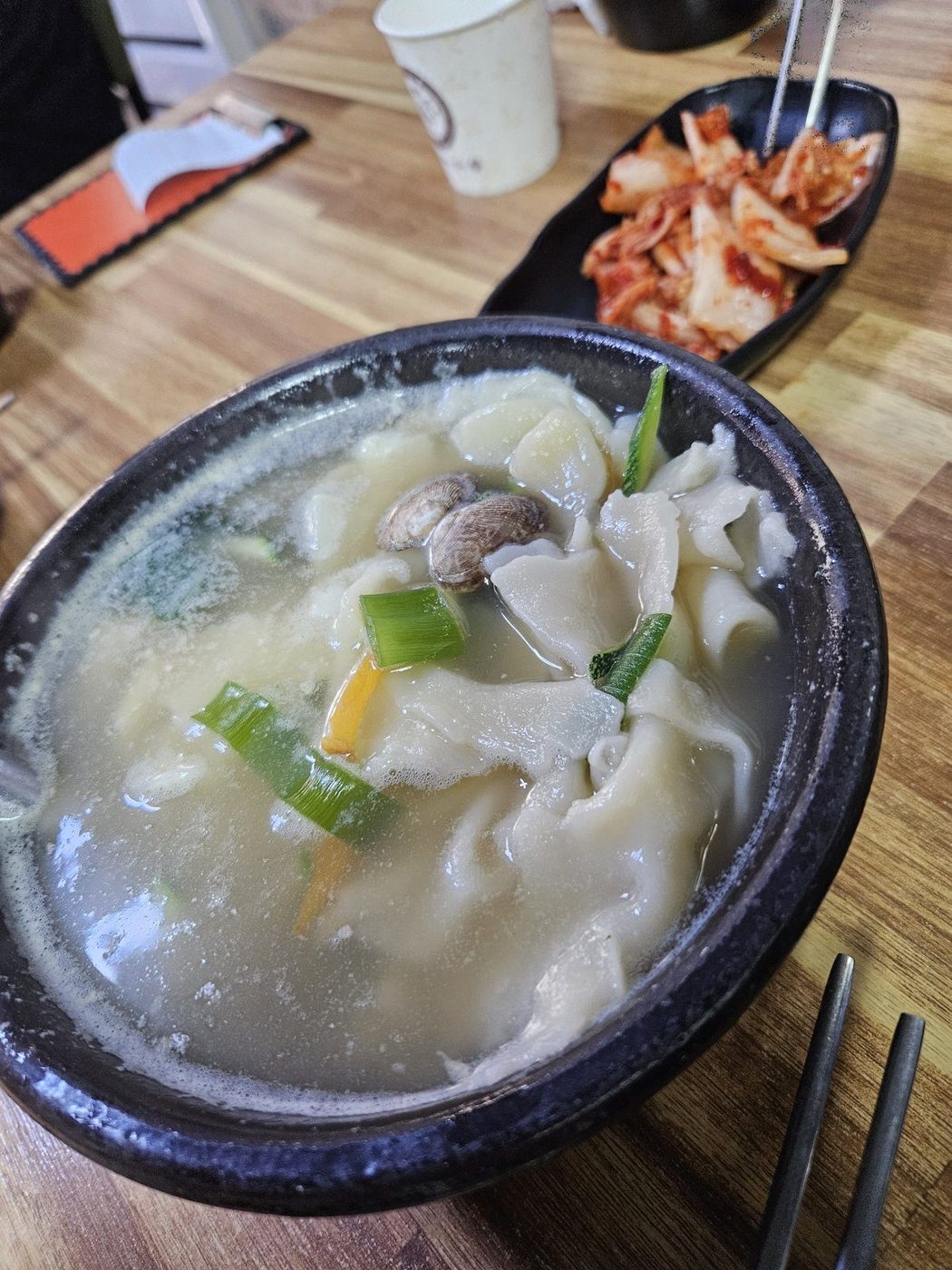
Noodles on a rainy day. There's a very Korean instinct the show gets exactly right: when it rains, you want noodles and something fried. Kalguksu, janchi-guksu, sujebi — soft wheat noodles or hand-torn dough in a clear broth, with kimchi on the side. If you only eat one thing on a grey afternoon in Seoul, make it this.
Coffee, constantly. The cafeteria coffee, the lobby café run, the cup someone brings someone else as an apology. Korea runs on iced americanos regardless of the weather, and the hospital coffee run is one of the show's most reliable little rituals.
Jjajangmyeon. Black bean noodles, ordered in, eaten fast. The food of a delivery order at the end of a long day — and worth knowing that in Korea this is Chinese-Korean food, a category of its own, not an import you'd recognise from China.
Every dish above has a version of the same problem for anyone with a restriction — the pork, the fish cake in the tteokbokki, the wheat in the noodles, the soy and sesame in nearly all of it. I've written these up dish by dish rather than in general: Korean BBQ, street food and cafés and desserts, each with a safe-for grid by restriction. Recipes vary between shops, so treat all of it as "ask every time" rather than settled — and what to ask a Korean restaurant gives you the sentences to ask with.
Plenty of fans have filmed walkthroughs of the Magok hospital exterior and the Yeonnam-dong strip. Have a look at YouTube results for "Hospital Playlist filming locations" before you go — it'll save you wandering.
Doing it as one Seoul day
Here's the itinerary I'd actually follow, and it's a good day out even for someone who's never seen the show. Start in the morning at Magok — take Line 5 or 9, photograph the hospital from the street, and then, since you're already there, walk ten minutes to the Seoul Botanic Park, which is genuinely one of the city's better green spaces and almost nobody puts it on an itinerary.
In the afternoon, come back east on Line 5 and change for Hongik University Station. Walk the Gyeongui Line Forest Park through Yeonnam-dong, stop at a café, and stay until dusk when the lawn fills up. Then eat: find a grilled-pork place nearby, order samgyeopsal and something to drink, and sit there for two hours. That's not a filler item on the list — that's the actual point of a Hospital Playlist pilgrimage.
Total cost is a few subway fares plus dinner. If you want to stretch it to two days, add the Pyeongchang campsite as a Gangwon overnight; if you'd rather stay in the city, swap in a market — Gwangjang Market gives you the standing-and-eating version of the same pleasure.
Practical notes
- The hospitals are hospitals. Exterior photos, street level, brief. Don't photograph patients or staff, don't go into wards, and don't make a group of it. This is the one rule on this page I'd ask you to take seriously.
- Use NAVER Map, not Google Maps — search the Hangul names I've given. Our NAVER Map guide walks you through setting it to English.
- Get a T-money card — the Seoul half of this is all subway. See the T-money card guide.
- Restaurant details go stale. The eating places tied to this show were identified by fans in 2020–2021. Check anything specific is still open and still the same business before you travel for it.
- Book the campsite. Sanneomi Farm is private, seasonal and three hours out. Don't drive up on spec.
Frequently asked questions
Is Yulje Medical Center a real hospital? No — Yulje is invented. The building you see is Ewha Womans University Seoul Hospital in Magok, Gangseo-gu, and a separate replica set was built for a lot of the interior work, especially after COVID restrictions kicked in. So "Yulje" is part real building, part set, and no single place you can walk into.
Can I visit the hospital as a fan? You can stand outside it, and the exterior is genuinely striking. The lobby is a public area, but the wards and the fourth-floor garden are for patients. I'd keep it to the outside. If that feels like a thin reward, remember the show's own values — turning up somewhere and making a nurse's day harder is about as un-Hospital-Playlist as it gets.
Where was the band room? Almost certainly a built set rather than a real room, and not something you can visit. I couldn't find any credible identification of a real location for it, and I'd rather tell you that than invent one.
Are the restaurants from the show still open? Some are, some have changed. The grilled-pork chain that sponsored the series still operates and the COEX branch is the one fans mention, but the smaller independent places identified back in 2020–21 are exactly the sort of business that turns over. My honest advice is to treat the restaurant list as inspiration for what to eat, not a route to follow.
What should I watch next? If it's the hospital setting you liked, start with our best Korean medical dramas round-up. If it was the gentleness, Doctor Slump is the closest match in tone — and its locations are a much more walkable Seoul trip, which I've mapped out in the Doctor Slump filming locations guide.
Explore our guides to Doctor Slump, It's Okay to Not Be Okay and Goblin — and plan a full week with our 7-day Korea itinerary for K-drama fans.
🇰🇷 Korea Travel Essentials
Everything you need before you go
-
🚇 Getting Around Seoul
Magok and Yeonnam-dong are both on the subway — one card covers the whole day.
Read our T-money guide → -
🍽️ Eating With Restrictions
Allergies, halal or plant-based? Fifty dishes graded, plus phone-ready Korean cards.
See Eat Korea Safely → -
🗺️ Navigation
Google Maps barely works in Korea. Download NAVER Map — switch to English in Settings → Language.
-
✈️ Airport → City
Magok is actually close to Gimpo — here's the Incheon arrival guide.
Read our airport guide →